Dong Thap boosts conservation, ecotourism development at Tram Chim National Park

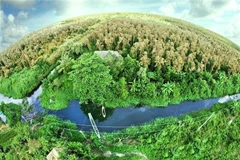
The Tram Chim National Park in the Mekong Delta province of Dong Thap, one of the few remaining inland wetlands of the former Dong Thap Muoi region, plays a vital role in conserving biodiversity and developing sustainable ecotourism.

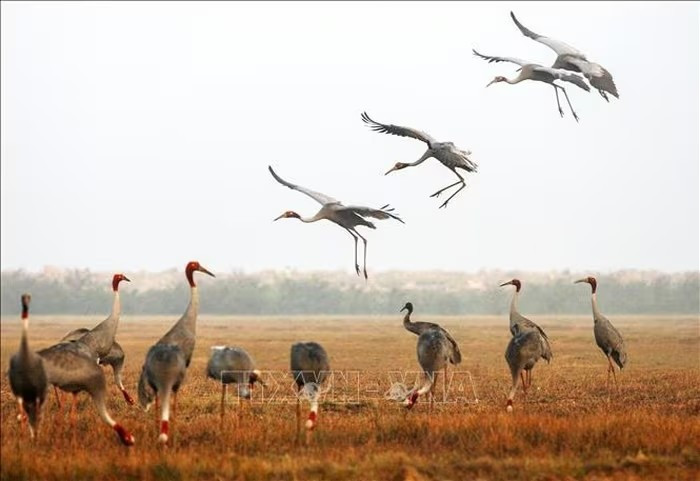
The Tram Chim National Park was previously home to a large population of red-crowned cranes, with a recorded number of more than 1,000 birds arriving during their annual migration. (Photo: VNA)

Dong Thap (VNA) – The Tram Chim National Park in the Mekong Delta province of Dong Thap, one of the few remaining inland wetlands of the former Dong Thap Muoi region, plays a vital role in conserving biodiversity and developing sustainable ecotourism.

Recognised by the Ramsar Convention in 2012 as the 2,000th Ramsar site in the world and Vietnam’s fourth, the national park remains a haven for migratory birds and features rich terrestrial and aquatic ecosystems. Therefore, conserving the national park alongside the development of ecotourism has become the locality’s strategy for promoting economic growth and environmental protection.

Covering an area of over 7,300ha, Tram Chim is a wetland with characteristics typical of the inland wetland ecosystem of Dong Thap Muoi (the Plain of Reeds), adjacent to four communes: Tram Chim, Phu Tho, Tam Nong, and An Hoa.

According to Dr Duong Van Ni, former Director of the Mekong Wetland University Network in the Mekong Delta region, the Tram Chim National Park boasts high biodiversity. Studies have identified 349 species of phytoplankton, 161 species of attached algae, 139 species of higher plants, 102 species and groups of zooplankton, 44 terrestrial animal species, 67 fish species, 40 amphibian and reptile species, 104 bird species, and 12 mammal species.

Beyond its core area, the national park has a buffer zone covering more than 16,800 hectares. Often described as the “green lung” of the region, the park is increasingly developed as one of Dong Thap’s key ecotourism destinations.

According to Doan Van Nhanh, Deputy Director of the Tram Chim National Park’s Centre for Conservation and International Cooperation, to preserve the park’s ecosystem, the provincial People’s Committee has consulted experts and scientists to develop an ecosystem restoration plan as part of the project to conserve red-crowned cranes.

The park was previously home to a large population of red-crowned cranes, with a recorded number of more than 1,000 birds arriving during their annual migration. However, the number of cranes returning to Tram Chim dropped sharply over time. In recent years, the number of cranes returning is almost zero, according to park data.

In an effort to turn things around, the Dong Thap provincial People's Committee approved a project titled "Red-Crowned Cranes Conservation and Development in the Tram Chim National Park in 2022-2032". To realise the dream of bringing the cranes back, the park authority is focusing on improving and restoring the ecosystem and habitat for the birds.

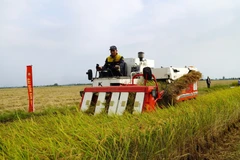
In addition, local authorities have planned a 1,623-hectare buffer zone for organic rice cultivation, a total of 200 hectares. Most farmers in the park’s buffer zone support the model.

According to Nguyen Van Lam, Director of the Tram Chim National Park, over the past two years, as ecosystem restoration efforts have shown positive results, the park has begun collaborating with businesses, producers of OCOP products, and local communities to develop tours and tourism services that enhance experiences for travellers in connection with promoting conservation.

Pham Duc Hoa, Director of the Tram Chim Tourism Area, affirmed that ecosystem restoration is not only scientifically significant but also holds cultural and spiritual value.

The project on conserving red-crowned cranes demonstrates Dong Thap’s strong and resolute commitment to promoting nature conservation, ecotourism development, and environmental education./.

VNA

See more

Official heritage plaque i sinstalled on the 12 recognised Shan Tuyet tea trees in Dong Phuc commune. (Photo: VNA)

Thai Nguyen: 12 ancient Shan Tuyet tea trees win national heritage status

The recognition honours the biological, cultural and historical values of these centuries-old Shan Tuyet tea trees – natural treasures deeply woven into the livelihoods, traditions and identity of local ethnic communities. The title affirms the community’s commitment to preserving and promoting the value of this iconic local tea variety.

Sarus cranes at Tram Chim National Park (Photo: VNA)

Return of sarus cranes: Hope takes wing in Dong Thap wetland

Beneath the wide Mekong Delta sky, Tram Chim National Park is racing against time, pouring heart and science into a decade-long (2022–2032) plan to rescue the Eastern sarus crane – an elegant, scarlet-headed bird listed as endangered on the International Union for the Conservation of Nature (IUCN) Red List and a living emblem of both the park and all of Dong Thap province

French Ambassador Olivier Brochet speaks at the press conference in Hanoi on December 11 to mark the 10th anniversary of the Paris Agreement on climate change and highlighting the COP30 outcomes. (Photo: VNA)

International community ready to support Vietnam in energy transition, climate response

In a video message to the press conference, UN Resident Coordinator in Vietnam Pauline Tamesis said the UN is ready to support Vietnam in building a pipeline of projects capable of absorbing financing mobilised under the Political Declaration on establishing the Just Energy Transition Partnership (JETP), as well as from global climate finance sources, including the Green Climate Fund and the Loss and Damage Fund.

Forest rangers in Son La province apply technological devices and software to forest management, monitoring, and protection. (Photo: nhandan.vn)

Digital technology application enhances forest management, protection

With a total forest area of over 14 million hectares, including more than 10 million hectares of natural forests, forests exist in all 34 provinces and cities across the country. Given the large area and limited workforce, applying digital solutions in forest management and protection has become a top priority for the forestry sector.

Sunda pangolins (Manis javanica), also known as the Javan pangolin, are listed in Group IB – critically endangered and strictly protected from all commercial exploitation (Photo: VNA)

Quang Ngai releases rare pangolin back into nature

Initial verification showed that the animal weighed 3.7kg and measured over 60cm. It was identified as a Sunda pangolin (Manis javanica), also known as the Javan pangolin, listed in Group IB – critically endangered and strictly protected from all commercial exploitation.

Residents of Tuyen Quang province take part in the One Billion Trees Programme. (Photo: VNA)

Tree-planting programme exceeds one-billion-tree goal

The total comprises 573.9 million scattered trees and 865.2 million trees grown in concentrated plantations, equivalent to 429,125 hectares of forest. Provinces posting the strongest results include Phu Tho with 177.9 million trees, Lao Cai with 108.8 million, and An Giang with 98.5 million.

Construction activity is one of the causes of air pollution in Hanoi. (Photo: VNA)

Hanoi takes urgent measures to curb air pollution

The city requires the enhanced application of advanced technologies and remote monitoring systems, including satellite remote sensing, drones, and AI-integrated traffic cameras, to monitor, detect, and strictly address the illegal burning of garbage, straw, and agricultural by-products.