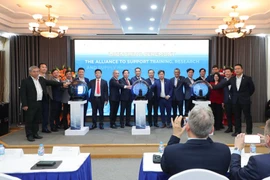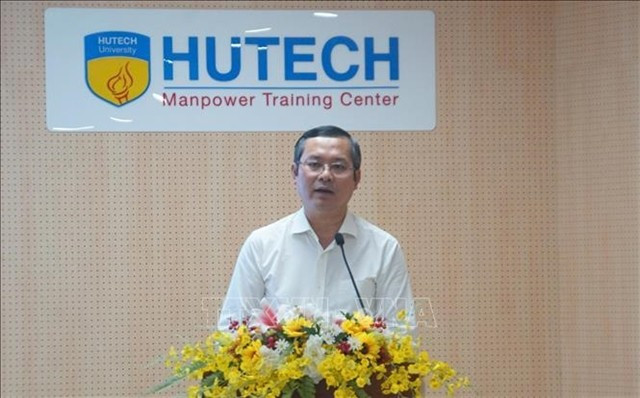
HCM City (VNS/VNA) - Developing high-quality human resources is the decisive factor for Vietnam to successfully build its semiconductor industry, Deputy Minister of Education and Training Nguyen Van Phuc said at a conference reviewing the implementation of national strategies on semiconductor workforce development held in Ho Chi Minh City on December 26.
The conference, organised by the Ministry of Education and Training (MoET), assessed initial results of Strategy 1018 on Vietnam’s semiconductor industry development to 2030 with a vision to 2050, and Programme 1017 on developing human resources for the sector.
Issued in 2024, the two Prime Ministerial decisions demonstrate the Government’s strategic vision in positioning semiconductors as a core high-tech industry, with human resource development identified as the key pillar, Phuc said.
“Progress has been recorded in recent years, particularly in growing awareness and proactive engagement among higher education institutions, many of which have opened or piloted training programmes related to semiconductor technology.”
Businesses have also actively partnered with universities, gradually forming the “triple helix” linkage between the State, training institutions and enterprises.
In addition, training institutions have adopted policies to attract talent, leading to marked improvements in teaching and research capacity in semiconductor-related fields.
The MoET is currently submitting proposals to the Government on scholarship and tuition support policies to further assist learners.
Despite these gains, persistent challenges, including limited training scale, shortages of qualified lecturers and experts, underdeveloped laboratory facilities and occasional coordination gaps arose during implementation.
Given the scale and strategic importance of the two programmes, the deputy minister called for stronger engagement from universities and enterprises, urging discussions to focus on curriculum innovation aligned with industry needs, faculty development, investment in laboratories and digital transformation.
Reporting on the implementation of Strategy 1018 and Programme 1017, Nguyen Anh Dung, deputy director of the ministry’ Higher Education Department, said the ministry had issued Plan No. 1758 in November 2024 to operationalise the two Prime Ministerial decisions, ensuring synchronised, timely and effective implementation.
The MoET also advised the Prime Minister to issue Directive No. 43 in December 2024, which emphasises high-quality human resources, particularly those with digital skills, as essential for Vietnam’s deeper participation in the semiconductor value chain and other core high-tech industries.
Efforts to rapidly develop the national semiconductor ecosystem have since been intensified. Notably, Decision No. 1131, issued in June 2025, approved a list of 11 strategic technologies and 35 strategic technology products, providing a clear orientation for training, research and investment priorities.
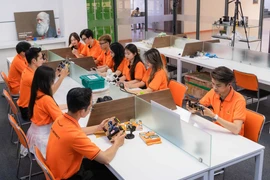
Parallel measures include promoting STEM education and career guidance at the general education level, reviewing and adjusting university and vocational training programmes in electronics, microchips, information technology and automation, and strengthening links with enterprises, industrial parks and high-tech zones.
According to MoET statistics, more than 237,000 students were admitted to STEM programmes in the first phase of the 2025 university admissions cycle, including over 137,000 students enrolled in semiconductor-related fields based on national training standards.
Dung stressed the need to further refine the legal framework and policy packages, including scholarships, tuition exemptions and preferential credit schemes to attract high-quality learners, alongside breakthrough investment in faculty development, laboratory equipment and specialised software for practice and simulation.
He also highlighted the importance of expanding cooperation among the State, universities, research institutes and domestic and international enterprises, particularly partners with investment potential in Vietnam, while promoting resource and knowledge sharing, internships and advanced training programmes.
At the conference, representatives from major enterprises and corporations shared assessments of semiconductor workforce demand and discussed opportunities to strengthen the “triple helix” linkage to better align training with industry needs./.
VNA