Ho Chi Minh City (VNA) – Ho Chi Minh City is witnessing a structural shift in foreign direct investment (FDI), marked by the emergence of billion-dollar projects in data centres, digital infrastructure and financial technology. The move toward higher-quality capital is expected to create new growth drivers and enhance the city’s long-term competitiveness.
Billion-dollar digital infrastructure projects
A consortium led by the UAE’s G42 Group has signed a long-term framework agreement with Vietnamese partners to develop hyperscale data centres in Vietnam, with total expected investment of up to 2 billion USD. The facilities, to be located in Ho Chi Minh City, will meet international standards and provide digital services for public agencies, businesses and global partners.
At the city’s February socio-economic meeting, Chairman of the municipal People’s Committee Nguyen Van Duoc said a US investor is also implementing a data centre project worth around 2 billion USD. About 60% of the capital, or 1.2 billion USD, is expected to be disbursed in the second quarter of 2026.
Duoc described the projects as a positive signal for FDI inflows and a key foundation for the city’s goal of achieving double-digit economic growth.
Beyond providing secure storage, processing and transmission capacity, large-scale data centres are seen as critical infrastructure for attracting international financial institutions, fintech firms and global technology corporations.
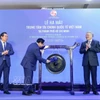
Their importance has become more evident following the launch of the Vietnam International Financial Centre in Ho Chi Minh City (VIFC-HCMC) on February 11, where data is considered the backbone of modern finance.
Pham Tuan Anh, Head of the Technology Division at the centre’s Executive Board, said VIFC-HCMC will prioritise advanced technology infrastructure to position itself as a regional financial hub, facilitating capital flows into Vietnam and serving as a gateway for FDI and foreign indirect investment.
On its opening day, the centre attracted strong investor interest. Singapore- and Australia-based Vantage Point Asset Management committed to mobilise up to 10 billion USD over five years for investment in data infrastructure, fintech platforms and smart urban systems.
Plans are also underway to establish a 1-billion-USD Ho Chi Minh City Digital Asset Investment Fund to support digital finance and fintech ecosystems.
Shift toward high-value FDI
The rise of digital and financial projects reflects a broader transformation in the city’s FDI structure. While previous decades saw an influx of labour-intensive manufacturing, current capital flows are targeting sectors that require advanced infrastructure, stable energy supply and a transparent regulatory framework.
According to Lam Dinh Thang, Director of the municipal Department of Science and Technology, digital infrastructure is becoming foundational to the city’s next development phase.
By the end of January, Ho Chi Minh City had more than 20,470 valid FDI projects with total registered capital exceeding 142.2 billion USD. In 2025 alone, it attracted over 8.37 billion USD, maintaining its leading position nationwide.
More importantly, investment is increasingly concentrated in high-tech sectors generating greater added value and spillover effects. The shift aligns with the city’s strategy to restore double-digit GRDP growth from 2026 and become an international mega city by 2045.
To sustain momentum, the city is accelerating institutional reforms, infrastructure upgrades and human resource development to compete more effectively for high-quality capital in the region./.