Mild earthquakes recorded in three regions of Vietnam

Since 2021, scientists have recorded hundreds of small quakes across the region historically part of Kon Tum, especially around Kon Plong district, which is now part of Quang Ngai province.

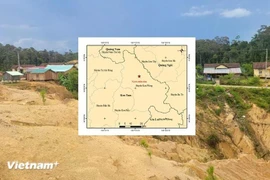
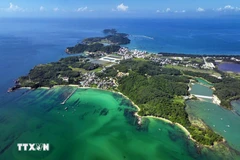
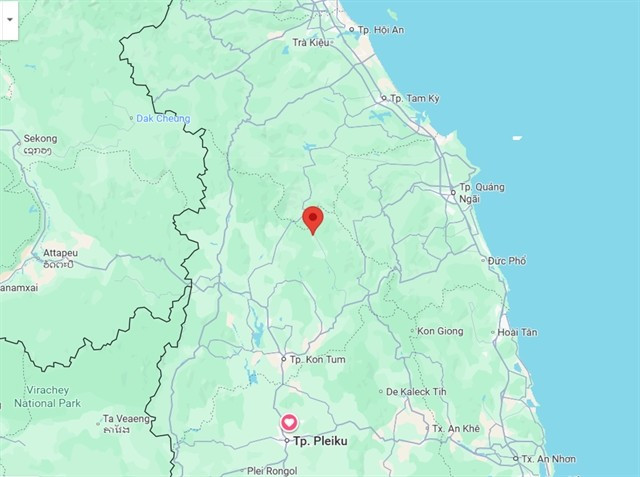
The site of November 8 morning’s earthquake in Quang Ngai, shown on Google Maps. (Photo: VNA)

Hanoi (VNA) - A series of mild earthquakes were recorded in the northern, central and central highland regions of Vietnam over the past two days, rattling residents in Son La, Hue and Quang Ngai but causing no damage.

The latest tremor hit Mang Ri commune in Quang Ngai at on November 8 morning, registering a magnitude of 4.0 on the Richter scale at a depth of about 8km.

It followed two smaller quakes on November 7 – one of magnitude 3.6 in northern Son La province and another of 4.0 in Hue city later that evening.

Nguyen Xuan Anh, Director of the Earthquake Information and Tsunami Warning Centre, described the Quang Ngai event as a 'triggered earthquake,' likely linked to local stress changes in the Earth’s crust rather than major tectonic movement.

Since 2021, scientists have recorded hundreds of small quakes across the region historically part of Kon Tum, especially around Kon Plong district, which is now part of Quang Ngai province.

The strongest in recent years – magnitude 5.0 – struck in July 2024, following a 4.7 quake in August 2022.

Anh said the pattern was expected to continue but that future quakes were unlikely to exceed magnitude 5.5. He added that more detailed studies were needed to better understand the region’s seismic activity.

Earthquakes in Vietnam are mostly minor, usually below magnitude 5.0, and rarely cause damage or casualties. Even so, scientists monitor them closely as part of long-term efforts to assess seismic risk and improve early-warning systems./.
VNA

See more

Construction workers reinforce steel and pour concrete to cover the underground drainage channel, helping collect rainwater and tackle flooding in Da Nang. (Photo: VNA)

A new “shield” against climate change

Smart urban areas are no longer simply about technology; they are becoming a tool that enables authorities to forecast risks, adapt quickly and protect their residents.

Vietnam is exerting efforts to cope with climate change. (Illustrative photo: VNA)

Vietnam approves carbon credit pact with Singapore under Paris Agreement

Signed on September 16, 2025, the Implementation Agreement on carbon credits collaboration under Article 6 of the Paris Agreement on climate change affirms Vietnam and Singapore’s pioneering role and commitment to close cooperation in the international carbon market, making a substantive contribution to global climate response.

A view of Vo Cuong ward, Bac Ninh province (Photo: VNA)

Bac Ninh earmarks over 1.7 billion USD for environmental protection

By 2030, Bac Ninh aims to ensure that all operating industrial clusters and industrial parks have centralised wastewater treatment systems meeting standards, while at least 95% of wastewater in Grade-I urban areas and 70% in Grade-II urban areas is collected and treated to required standards.

Many inland canals in Can Tho city dries up following a prolonged period of extreme heat. (Photo: VNA)

Government adopts action programme on environmental protection, climate resilience

The programme aims to translate the Party's orientations into concrete actions while strengthening environmental governance, enhancing climate resilience, and promoting a green, circular and low-carbon economy. It will serve as the basis for ministries, sectors and localities to formulate implementation plans for the 2026–2030 period, with a vision to 2045.

Dray Sap Waterfall lies within the UNESCO Dak Nong Global Geopark in Nam Da commune, Lam Dong province. (Photo: VNA)

Lam Dong steps up efforts to retain UNESCO global geopark status

Covering nearly 4,760 square kilometres across 22 communes and wards in western Lam Dong (equivalent to 73.1% of the former Dak Nong province's natural area), the geopark was shaped by millions of years of geological activity and successive volcanic eruptions.

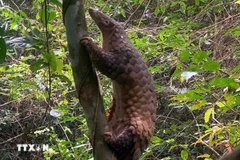
A stump-tailed macaque (Macaca arctoides) is handed over to the Cam Lo–Dong Ha forest ranger station in Quang Tri province on January 27, 2026 (Photo: VNA)

Rare primate handed over to Phong Nha - Ke Bang National Park

A stump-tailed macaque (Macaca arctoides) was handed over to the Centre for Rescue, Conservation, and Development of Creatures under the Management Board of Phong Nha - Ke Bang National Park in Quang Tri province on July 21, for rehabilitation and eventual release into the wild.

Two Red Lories (Eos rubra) found among the 104 wild animals being kept without documentation proving their lawful origin in Phuoc Thanh commune, Tay Ninh province. (Photo published by VNA)

Criminal proceedings launched against case of illegal keeping, trading of 104 wild animals

They recorded a total of 104 wild animals, comprising 92 African spurred tortoises (Geochelone sulcata) of various sizes, six Red Lories (Eos rubra) and six Green-cheeked Parakeets (Pyrrhura molinae). Authorities said the animals are subject to management under Vietnam's forestry legal regulations and are listed in Appendix II of the Convention on International Trade in Endangered Species of Wild Fauna and Flora (CITES).

BUYO Bioplastics' biodegradable plastic products are made from brewer's grains and sugarcane bagasse. (Photo: nhandan.vn)

Vietnam urged to shift from plastic waste treatment to full life-cycle management

For years, efforts to tackle plastic pollution in Vietnam have focused mainly on waste collection, recycling and disposal. However, as sustainable development and green trade standards become increasingly important, specialists argued that a broader approach is needed, covering everything from product design and material selection to production, consumption and recycling.