Ninh Binh set to establish conservation area for endangered Delacour’s langurs

The northern province of Ninh Binh is planning to establish a species and habitat conservation area dedicated to the critically endangered Delacour’s langur.

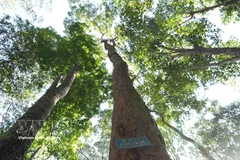
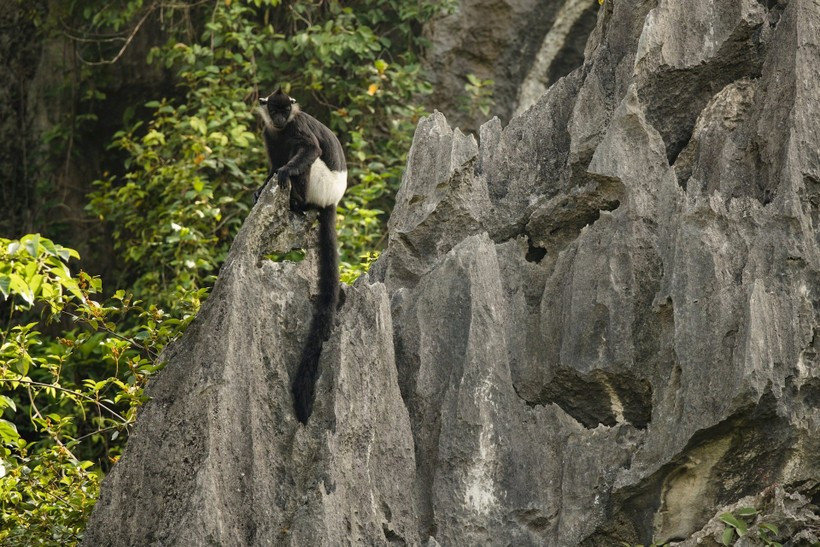
The Delacour’s langur, also known as the white-shanked langur, is considered a “global treasure” and among the 25 most endangered species in the world. (Photo: FFI)

Hanoi (VNA) – The northern province of Ninh Binh is planning to establish a species and habitat conservation area dedicated to the critically endangered Delacour’s langur, following feedback from the Ministry of Agriculture and Environment, the Ministry of National Defence, and local authorities.

The provincial Department of Agriculture and Environment will soon complete verifying the project dossier and submit it to the provincial People’s Committee for approval in line with the Government’s Decree 156/2018/ND-CP, according to the department’s report submitted to the Ministry of Agriculture and Environment.

Once the conservation area is approved, the Department of Home Affairs will work with the Department of Agriculture and Environment and relevant agencies to propose the provincial People’s Committee set up a management body for the reserve, the report reads.

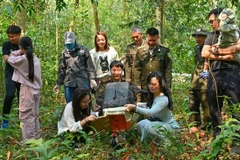
In 2016, when Vietnamese scientists and the international conservation organisation Fauna & Flora International (FFI) surveyed Kim Bang Forest, recording seven groups of Delacour’s langurs with a total of 40 individuals. Since then, the population has steadily increased to 128.

The plan was advanced after directives from the Prime Minister in 2020 and subsequent instructions from the former Ministry of Agriculture and Rural Development (now the Ministry of Agriculture and Environment).

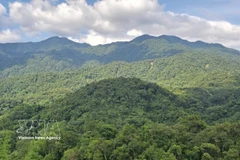
The proposed conservation zone covers more than 3,180 hectares across several communes, including Ba Sao, Thanh Son, Lien Son, Kha Phong, Tan Son, and Thi Son.

Boundaries were reviewed to avoid overlap with existing investment projects, and the proposal was integrated into the provincial master plan for 2021–2030 with a vision to 2050.
khai-thac-khoang-san-a3.jpg
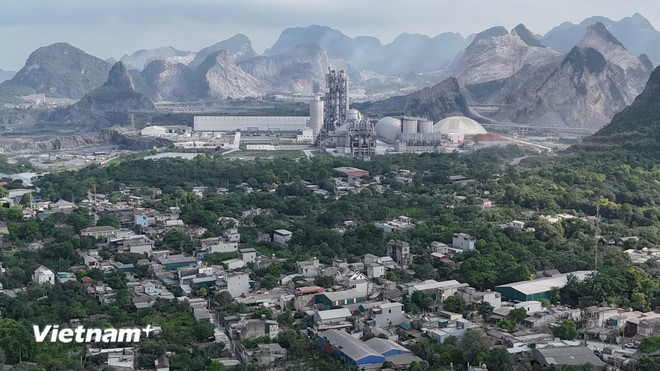
Mineral extraction causes environmental pollution. (Photo: VietnamPlus)

The Department of Agriculture and Environment confirmed that mining sites within the planned reserve have been excluded. Current mineral exploitation projects in Tan Son ward, Tuong Linh ward, Ba Sao ward and Lien Son communes in former Kim Bang township (now Tam Chuc and Ly Thuong Kiet wards) will terminate their operations by December 31, 2025.

Those projects will also carry out soil rehabilitation and environmental restoration, and hand over land to local authorities for green and sustainable development projects in line with the master plan of former Ha Nam province (now part of Ninh Binh province) for the 2021–2030 period, with a vision to 2050, which was approved by the Prime Minister under Decision No. 1686/QD-TTg, dated December 26, 2023.

The move follows a series of articles published by VietnamPlus in July highlighting the severe impact of quarrying, cement production and material transportation in former Kim Bang and Thanh Liem districts of Ha Nam, which caused widespread pollution and threatened the local community as well as the surrounding biodiversity, particularly the Delacour’s langur.

In response, the Ministry of Agriculture and Environment instructed Ninh Binh authorities to verify the reported issues, strengthen the monitoring of mining and cement facilities, and take immediate remedial action.

Recently, the ministry also urged the People’s Committee of Ninh Binh province, as well as those of other provinces and cities, to protect landscapes and restore the environment at mines that have already closed or are due to close./.

VNA

See more

Forest rangers in Son La province apply technological devices and software to forest management, monitoring, and protection. (Photo: nhandan.vn)

Digital technology application enhances forest management, protection

With a total forest area of over 14 million hectares, including more than 10 million hectares of natural forests, forests exist in all 34 provinces and cities across the country. Given the large area and limited workforce, applying digital solutions in forest management and protection has become a top priority for the forestry sector.

Sunda pangolins (Manis javanica), also known as the Javan pangolin, are listed in Group IB – critically endangered and strictly protected from all commercial exploitation (Photo: VNA)

Quang Ngai releases rare pangolin back into nature

Initial verification showed that the animal weighed 3.7kg and measured over 60cm. It was identified as a Sunda pangolin (Manis javanica), also known as the Javan pangolin, listed in Group IB – critically endangered and strictly protected from all commercial exploitation.

Residents of Tuyen Quang province take part in the One Billion Trees Programme. (Photo: VNA)

Tree-planting programme exceeds one-billion-tree goal

The total comprises 573.9 million scattered trees and 865.2 million trees grown in concentrated plantations, equivalent to 429,125 hectares of forest. Provinces posting the strongest results include Phu Tho with 177.9 million trees, Lao Cai with 108.8 million, and An Giang with 98.5 million.

Construction activity is one of the causes of air pollution in Hanoi. (Photo: VNA)

Hanoi takes urgent measures to curb air pollution

The city requires the enhanced application of advanced technologies and remote monitoring systems, including satellite remote sensing, drones, and AI-integrated traffic cameras, to monitor, detect, and strictly address the illegal burning of garbage, straw, and agricultural by-products.

The World Bank delegation holds working session with Can Tho city People's Committee and relevant units (Photo: VNA)

World Bank delegation surveys Can Tho urban resilience project

The project is jointly financed by the WB with up to 250 million USD and a 10-million-USD non-refundable grant from the Swiss State Secretariat for Economic Affairs (SECO), along with counterpart funding from the Vietnamese Government. Its goal is to build a climate-resilient and sustainable city that can drive socio-economic growth across the Mekong Delta, mitigate flood vulnerability in central Can Tho, and improve inter- and intra-regional transport connectivity.

The direction of Storm Koto as of 04:00 on November 27. (Photo: VNA)

Lam Dong province’s coastal localities brace for Storm Koto

Local authorities have activated round-the-clock duty operations, continuously updated storm warnings and flood information and intensified inspections of riverside and seaside areas, low-lying zones, and locations at high risk of landslides and deep flooding.

Border guard officers at Ky Ha Port Border Gate are assisting residents in securing their boats. (Photo: VNA)

VPA General Staff directs urgent response to Storm Koto

Military Regions 4, 5 and 7 were tasked with directing provincial military commands to advise local authorities, review response plans, and coordinate with relevant departments and sectors to identify disaster-prone areas, including locations at risk of flash floods, landslides, major dykes, embankments and reservoirs, and flood-prone zones, particularly those heavily affected by recent rains.