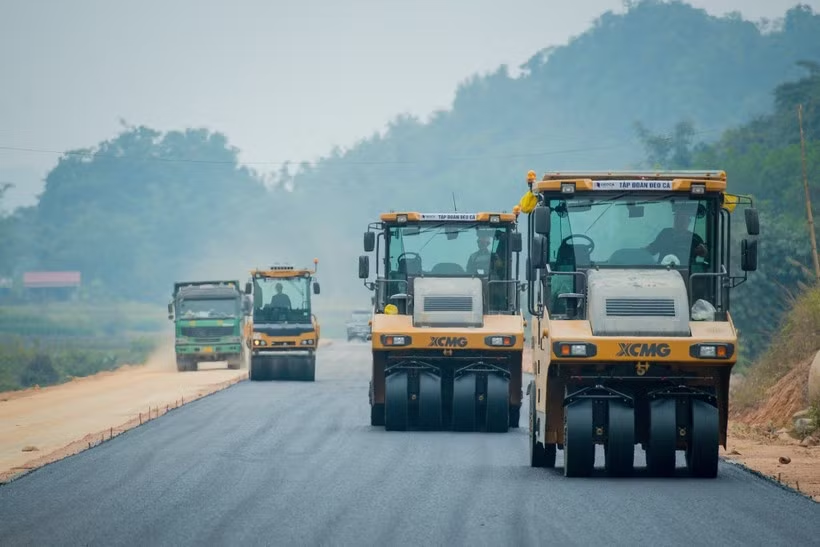
Hanoi (VNA) – Vietnam disbursed 55.74 trillion VND (2.18 billion USD) in public investment capital during the first two months of 2026, equivalent to 5.6% of the plan assigned by the Prime Minister, the Ministry of Finance (MoF) reported on March 4.
The result reflects strong efforts by ministries, sectors, and localities at the start of the year, as 2026 marks the beginning of the 2026–2030 medium-term public investment plan with a record volume of capital and projects.
Although the disbursement rate was unchanged from the same period in 2025, the actual value rose by more than 10.9 trillion VND, indicating an increase in resources injected into the economy.
The Prime Minister assigned the 2026 State budget investment plan to ministries, central agencies, and localities in late 2025, aligned with the Law on Public Investment and resolutions of the National Assembly and Government.
Total assigned capital reached 995.3 trillion VND, equal to about 92% of the public investment plan approved by the National Assembly and up around 93 trillion VND from 2025. Of the sum, more than 345 trillion VND came from the central budget and over 650 trillion VND from local budgets.
A notable feature of this year’s allocation plan is that localities distributed only 95% of the local budget capital assigned by the Prime Minister, or about 617.7 trillion VND. The remaining 5%, worth more than 32.5 trillion VND, was reserved for the Lao Cai–Hanoi–Hai Phong railway project in line with a National Assembly resolution.
The total available financial resources exceeded 1 quadrillion VND when additional local allocations and extended funds are included.
By the end of February, more than 975 trillion VND had been allocated to specific programmes and projects.
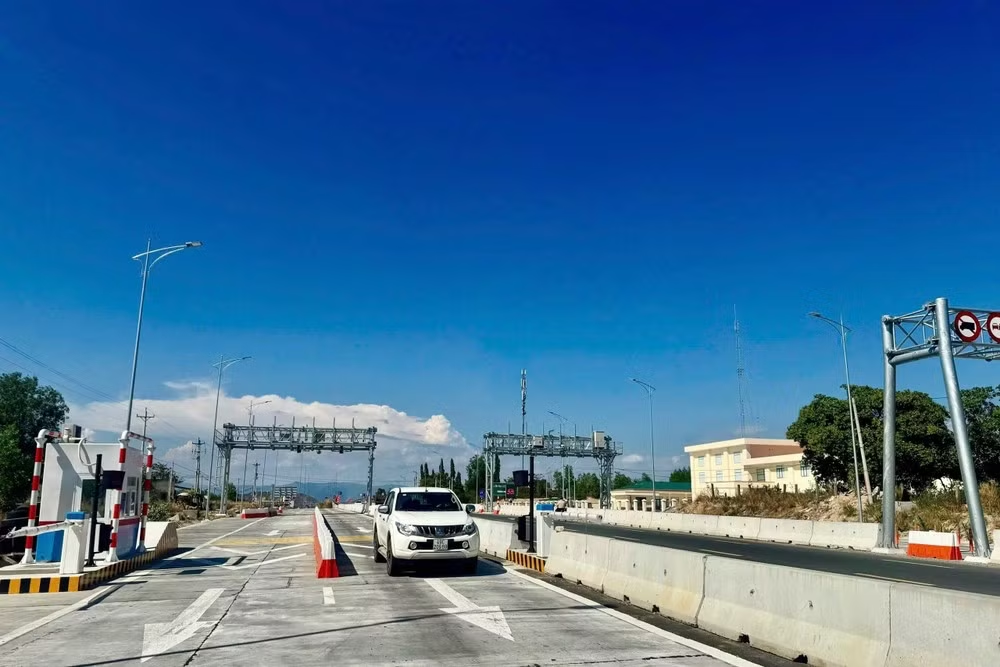
Aside from locally balanced budgets and extra funding provided by local governments, the detailed allocation reached 962.54 trillion VND, equivalent to 96.7% of the plan assigned by the Prime Minister. Unallocated capital amounted to 32.81 trillion VND, accounting for 3.3% of the assigned plan across 15 ministries and central agencies and 15 localities. Most of this capital is still undergoing procedures for project allocation.
A MoF report showed wide disparities among ministries and localities. Six ministries and agencies and 14 localities posted disbursement rates above the national average, including the Vietnam Bank for Social Policies, the Vietnam Expressway Development Investment Corporation, the Ministry of Public Security, and the cities of Hai Phong, Ho Chi Minh City, Hanoi, Can Tho, and Da Nang.
Meanwhile, 29 ministries and central agencies and 20 localities recorded rates below the national average, with 25 units posting almost no disbursement during the period.
Removing bottlenecks
According to the MoF, delays in capital allocation are among the factors directly affecting disbursement progress in the early months of the year.
Disbursement progress is also typically slow at the beginning of the year as investors focus on completing procedures, implementing capital plans, and continuing construction on ongoing projects. This year, the Lunar New Year holiday occurred later than usual, interrupting construction activities and reducing the volume of completed and payable work.

Beyond seasonal factors, several structural bottlenecks remain unresolved, including difficulties in compensation and site clearance, risks of shortages and price fluctuations of construction materials, as many major projects are implemented simultaneously.
Several internal limitations have also been identified, including capacity and accountability among project investors, management boards, and contractors, along with shortages of personnel in public investment following administrative restructuring. Also, ODA-funded projects have not yet finalised legal procedures and therefore cannot be allocated capital.
To address these issues, the MoF has conducted inspections and requested ministries, sectors, and localities to adjust projects with improper capital allocation.
In the coming months, the ministry said priority will be given to allocating the remaining 32.8 trillion VND and accelerating construction progress to create payable workloads and boost disbursement in subsequent quarters of 2026./.