Rice exports reach 1.57 billion USD in first four months, but challenges remain

Vietnam exported 3.3 million tonnes of rice worth 1.57 billion USD in the first four months of 2026, down 2.3% in volume and 11.1% in value year-on-year

nong-nghiep.jpg
Vietnam exported 3.3 million tonnes of rice worth 1.57 billion USD in the first four months of 2026. (Photo: VNA)

Hanoi (VNA) - Vietnam exported 3.3 million tonnes of rice worth 1.57 billion USD in the first four months of 2026, down 2.3% in volume and 11.1% in value year-on-year, according to the Ministry of Agriculture and Environment.

Domestic paddy prices have also fluctuated sharply, plunging during the harvest before rebounding within days, creating difficulties for both farmers and exporters.

By the end of April, the country's winter-spring rice cultivation area had reached 2.93 million hectares, with 1.67 million hectares harvested and output estimated at 11.5 million tonnes. The summer-autumn rice crop covered an estimated 355,500 hectares.

Rice exports in April alone were estimated at 1.1 million tonnes worth 492.7 million USD, bringing total exports since the beginning of the year to 3.3 million tonnes valued at 1.57 billion USD.

The average export price stood at 468.4 USD per tonne, down 9% from the same period last year.

According to the Vietnam Food Association (VFA), India's 5% broken rice was quoted at around 353 USD per tonne in late April, while Thailand's equivalent was priced at about 386 USD per tonne.

The Philippines remained Vietnam's largest rice importer, accounting for 48.5% of total exports, followed by China with 15.6% and Ghana with 7%.

Compared with the same period last year, rice export value to the Philippines rose 6.7%, while shipments to China jumped 44.4%.

In contrast, exports to Ghana fell 28.7%, while those to Côte d'Ivoire plunged 59.6%, the steepest decline among Vietnam's 15 biggest export markets.

Do Ha Nam, Chairman of the Vietnam Food Association, said domestic paddy prices had fallen to around 5,000 VND per kilogram during the recent harvest, discouraging many farmers from selling. However, prices rebounded rapidly just a few days later, leaving exporters scrambling to secure supplies.

He attributed the volatility largely to developments in the Philippine market, which accounts for more than 40% of Vietnam's rice exports.
557a2f0d-cc95-416e-ad59-c73a613bcb91.jpg
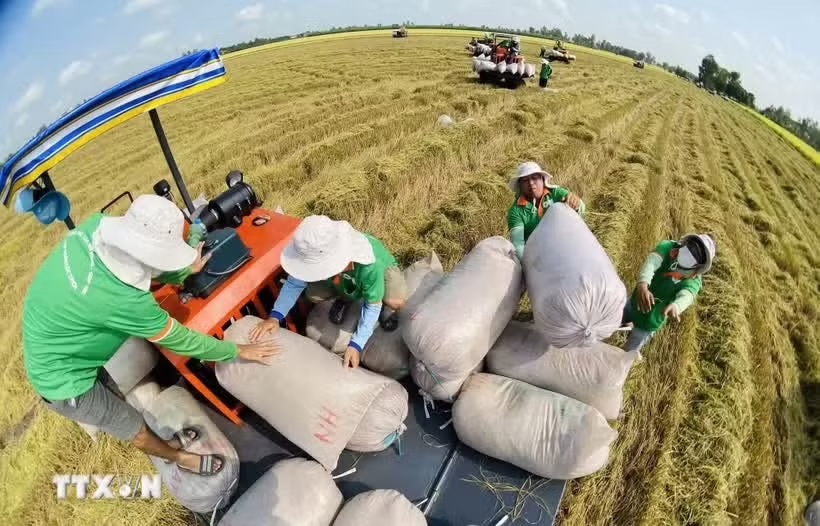
Rice is harvested Vietnam. (Photo: VNA)

Nam noted that in 2025, the Philippines announced a temporary suspension of rice imports during the final four months of the year, raising concerns over excess inventories in Vietnam. However, the country later resumed purchases, quickly reversing market sentiment.

The sharp market reversal left many exporters in a difficult position. Fearing a shortage of export contracts and facing intense competition during the harvest, they stepped up paddy purchases. But when prices surged, the inventories they had built up became harder to sell, driving up costs and eroding profit margins.

The volatility has also affected farmers, many of whom lack adequate drying and storage facilities and are therefore forced to sell their harvest immediately when prices are low.

To address the problem, Nam proposed expanding access to drying and storage facilities, allowing farmers to use paddy as collateral for bank loans, or enabling them to store their harvest at exporters' warehouses.

Deputy Minister of Agriculture and Environment Vo Van Hung said recent discussions with Philippine officials confirmed that demand for Vietnamese rice remains strong. The two countries are also working toward long-term cooperation, with the Philippines expected to send a delegation to Vietnam to discuss strategic collaboration in the rice sector.

Hung stressed that Vietnam should pursue long-term agreements with key importers to reduce the impact of sudden policy shifts and ensure greater stability for rice exports. He added that the ministry is reviewing policies on rice exports, production linkages and storage capacity to better support both farmers and businesses./.

See more

Delegates at the Vietnam-China investment cooperation promotion seminar jointly organised in Beijing on August 24 pose for a photo. (Photo: VNA)

Chinese firms praise Vietnam’s investment environment

Vietnam’s political stability, fast-growing economy, and increasing focus on science and technology, with many policies that promote the sector’s growth, create ideal conditions for Chinese tech firms looking to invest and expand in the country.

Illustrative photo (Photo: VNA)

FDI businesses look for deeper administrative reforms

While appreciating the progress, FDI firms said the next stage of reforms should go beyond putting procedures online. They want administrative processes to be simplified on digital platforms, data systems to be better connected, information to be provided only once and regulations to be applied consistently.

A view of the Vietnam–Singapore Industrial Park in Ho Chi Minh City (Photo: VNA)

Vietnam witnesses surge in Singapore investment inflows

The strong investment flow reflects not only the potential of the Vietnamese market but also the close bilateral relationship, particularly since the two countries upgraded ties to a Comprehensive Strategic Partnership in March 2025.

Mariculture – new growth driver for Vietnam’s ocean economy (Photo: VNA)

Mariculture – new growth driver for Vietnam’s ocean economy

Resolution No 20-NQ/TW on building and developing Vietnam into a strong maritime nation identifies marine farming as a new pillar of the marine economy. It targets mariculture production value growing by an average of around 8% annually and accounting for 15% of the total fisheries sector value.

Representatives of the Vietnamese Embassy in China and Bac Ninh province at the seminar in Beijing on August 21. (Photo: VNA)

Bac Ninh seeks to attract Chinese investors to high-tech industries

With strengths in technology, manufacturing and new energy, Chinese companies have considerable room to expand investment in Vietnam. Meanwhile, Bac Ninh's strategic location, well-developed infrastructure and dynamic policies make it an attractive destination for Chinese investors.

A view of the deep-water port Gemalink. (Photo: gemadept.com.vn)

Seaport profits surge as trade growth supports positive second-half outlook

Profit contributions from joint ventures and associates rose 58%, with Gemalink alone increasing 43%. The improvement provided a clearer indication of core operating performance, while Gemadept also recorded an extraordinary gain of more than 600 billion VND from a divestment move in the second quarter.

Online shopping is becoming increasingly common, but unlike traditional transactions, consumers often cannot directly see products, meet sellers or immediately verify information. - Illustrative image (Photo: VNA)

Consumer trust key to sustainable e-commerce growth

Management agencies should strengthen coordination and data sharing with digital platforms, preserve electronic evidence and prevent sellers whose accounts have been blocked from quickly resuming business under new identities.

An organic vegetable model in Hanoi. (Illustrative photo: VNA)

Vietnam fine-tuning Extended Producer Responsibility policy to promote circular economy

Vietnam’s revised EPR framework is therefore expected to build a more comprehensive ecosystem covering collection, transportation, sorting, recycling, data management and supervision, making producers’ responsibilities closely linked to actual recycling outcomes. This will help EPR become a genuine driver of the recycling market and Vietnam’s transition toward the circular economy.

Visitors look for traditional Vietnamese handicrafts at Paris Fair (Photo: VNA)

Vietnamese firms urged to join global value chains

Vietnam should develop a strong domestic business force capable of absorbing technology, standards, management practices and market access from major corporations. At the same time, it is necessary to issue policies that encourage FIEs to actively seek, develop and use Vietnamese suppliers.

Processing prawns for export (Photo: VNA).

Vietnam's economy expected to grow 11% in 2027

AFP reported that Vietnam’s economy grew 8.4% year-on-year in the second quarter of 2026, exceeding the previous forecast of 7%. In the first half of the year, GDP expanded 8.2%, with industry and construction remaining key drivers of growth, alongside a recovery in manufacturing activity and domestic demand.