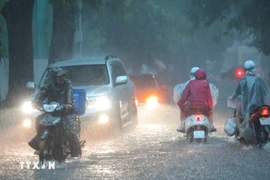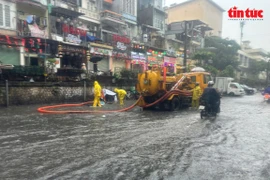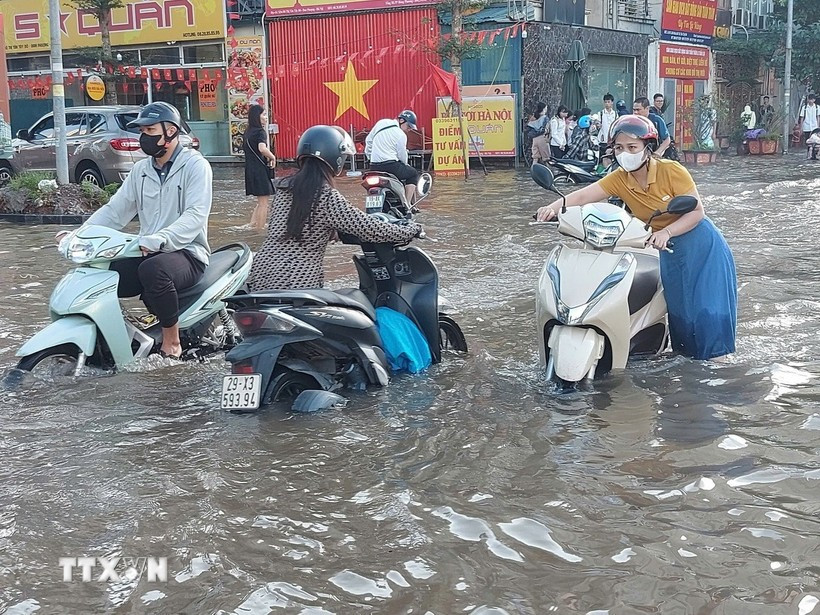
Hanoi (VNA) – Experts have called for a comprehensive approach, grounded in science and technology and involving intersectoral, intergovernmental, and interregional collaboration, to tackle urban flooding, a growing concern in major Vietnamese cities.
Urban flooding not only causes economic losses and disrupts residents’ lives but also exposes gaps in urban planning, infrastructure, and governance capacity, experts said.
In Ho Chi Minh City, flooding occurs not only during the rainy season but also due to high tides. Areas such as Binh Thanh and Thu Duc frequently experience floods of 20–50 cm, severely affecting traffic and daily life. Anti-flood projects, including underground drainage systems and retention ponds, have so far fallen short of expectations.
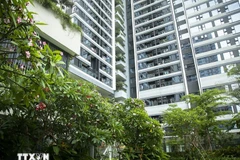
Architect Ngo Viet Nam Son noted that HCM City has overly focused on developing the central area with high concrete density, lacking green spaces and water surfaces, severely limiting water infiltration and drainage. Similar issues occur in urban areas in the central region such as Da Nang, Hue, and Quy Nhon, which face the combined effects of heavy rainfall and upstream floods.
Climate change has further intensified extreme rainfall, with frequency and volume far exceeding the design capacity of drainage systems, experts said, attributing these to inconsistent urban planning and inefficient operation.
Assoc. Prof. Dr. Vu Hoai Duc from Vietnam National University, Hanoi, attributed urban flooding to poor integration of ground elevation, drainage networks, and water storage, with newly developed higher-elevation areas causing water to accumulate in lower zones.
Sharing this view, architect Tran Tuan Anh added that if land elevation planning is not connected to the urban drainage network, flooding will persist regardless of the number of pumping stations or retention ponds invested in.
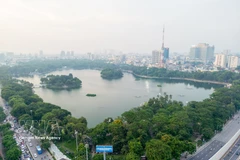
Statistics show that in Hanoi, many natural retention lakes have been filled in for construction, reducing natural water surfaces by over 15% in the past decade and diminishing their crucial regulation capacity. Aging and overloaded infrastructure, much of it from the French colonial era, was designed to handle only 100 mm of rain in two hours, while current storms often deliver 200–300 mm in just a few hours. Meanwhile, small and deteriorated drains clogged with debris further slow water flow, sometimes causing backflows.
Another factor identified by experts is climate change, which increases flooding risks. Experts from the Japan International Cooperation Agency (JICA) have warned that Vietnam is highly vulnerable to climate change, and they underscored the need for the country to have long-term drainage strategies and flood management plans rather than short-term reactive measures.
Flood control requires a multi-layered network
Dao Ngoc Nghiem, former Director of Hanoi’s Department of Planning and Architecture, emphasised that effective flood control requires restoring lakes, ponds, and wetlands that have been filled in. Water surfaces must be considered an essential component of modern urban planning.
According to the expert, many countries have adopted the "sponge city" model, which retains water on-site through permeable surfaces, ecological lakes, and green roofs. Nghiem suggested that new urban areas in Vietnam should apply this model from the outset, rather than trying to manage drainage after construction.
In addition, combining hard and soft infrastructure should be considered, as relying solely on pumping stations and underground reservoirs without channels, retention areas, and natural solutions is insufficient.
Assoc. Prof. Dr. Ho Long Phi, former Director of the Water and Climate Change Institute of Vietnam National University, Ho Chi Minh City, stated that flood-control infrastructure must be a multi-layered network, from sloped roads to underground drains, and retention ponds - with all components working together like a cohesive ecosystem.
Flood management remains highly challenging, as new urban areas have implemented only small and fragmented measures, while comprehensive solutions require both significant time and investments of billions of USD, compounded by the impacts of rapid urbanization on the construction of flood-control infrastructure facilities.
Long emphasised the importance of engaging the private sector, which offers strong financial resources and a flexible approach, to share responsibility with the government and jointly develop optimal solutions for flooding.
He recommended using highly permeable materials and porous asphalt in sidewalks and parking lots to improve drainage, alongside collecting rainwater in underground tanks, as successfully done in Thu Duc area./.
See more
Quang Tri province approves wildlife restoration project
The project has a total non-refundable grant value of 48,310 USD and will be implemented in Kim Ngan commune until December 31, 2027. This initiative aims to restore wildlife populations, enhance biodiversity, and reduce illegal hunting through patrolling and the removal of snares.
Draft Party document highlights climate and green development
A key highlight of the draft is the elevation of environmental protection to a central mission alongside economic and social progress, signalling a new and comprehensive understanding of sustainability in the current context.
Ministry to hold national conference on disaster response, recovery
Since the beginning of 2025, disasters have left 305 people dead or missing and caused economic losses estimated at 69 trillion VND (2.62 billion USD).
Typhoon Kalmaegi damages over 26,470 houses and causes extensive losses
The typhoon and its aftermath left five people dead, three missing, and 17 injured. It also damaged 3,721 ha of rice and crops, and 3,958 ha of industrial and perennial fruit trees, up by 14 ha from the previous report. For aquaculture, 54,335 cages and 18 ha of shrimp and fish farms were destroyed, along with 118 cattle and 3,593 poultry. Additionally, 21 boats were sunk and 44 others damaged.
Mild earthquakes recorded in three regions of Vietnam
Since 2021, scientists have recorded hundreds of small quakes across the region historically part of Kon Tum, especially around Kon Plong district, which is now part of Quang Ngai province.
Hue turns waste into resource through tech-enabled scrap collectors
Through the mGreen application, women who once earned their living by collecting recyclable waste have become “green warriors” connected to a digital recycling supply chain. The initiative is not only improving livelihoods and enhancing social status but also forming a sustainable waste circulation loop, reinforcing Hue’s image as a green city.
Hanoi forum targets green energy infrastructure for smart cities
In megacities like Hanoi, Ho Chi Minh City, Hai Phong and Da Nang, curbing vehicle exhaust, scaling clean energy infrastructure and embedding tougher environmental rules into urban planning form the backbone of “clean city” ambitions.
Hanoi strengthens ties with IRD to tackle air pollution
Vice Chairman of the Hanoi People’s Committee Nguyen Manh Quyen on November 6 received Sylvain Ouillon, Chief Representative of the French National Research Institute for Sustainable Development (IRD) in Vietnam, to discuss potential cooperation in air quality monitoring and pollution reduction in the capital city.
Central, Central Highlands localities race to recover from Storm Kalmaegi
According to Vietnam Disaster and Dyke Management Authority (VDDMA), the storm left five people dead and six injured. As of 7 a.m. on November 7, 52 houses had collapsed and 2,593 others were damaged or unroofed, including 2,412 in Gia Lai province. Nine fishing vessels were reported sunk.
Typhoon Kalmaegi causes 11 casualties, widespread damage in central region
Typhoon Kalmaegi, the 13th storm arising in the East Sea so far this year, along with its circulation had left five people dead and six injured as of early November 7, and caused widespread damage in central localities.
Typhoon Kalmaegi weakens into tropical depression, forecast to cause heavy rains
The tropical depression, which had weakened from Typhoon Kalmaegi – the 13th storm hitting the East Sea this year, has downgraded into a low-pressure area over southern Laos, on November 7 early morning, according to the National Centre for Hydro-Meteorological Forecasting (NCHMF).
Typhoon Kalmaegi weakens over Gia Lai–Dak Lak, continues to bring torrential rain
Typhoon Kalmaegi has been causing widespread heavy rain from southern Quang Tri to Dak Lak, with rainfall ranging from 100 to 250mm, and in some areas exceeding 300mm.
From awareness to action: Shifting consumer habits towards sustainability
Sustainable consumption is not simply a social trend but a vital requirement for Vietnam’s deeper international integration and sustainable development.
Central, Central Highlands localities respond to Typhoon Kalmaegi
As Typhoon Kalmaegi, the 13th storm to hit the East Sea this year, intensifies and heads toward Vietnam’s central coast, localities across the central and Central Highlands regions, including Dak Lak, Lam Dong, Da Nang and Quang Ngai, have activated their highest-level disaster response measures to ensure the safety of people and property.
Typhoon Kalmaegi moves faster, now about 310 km from Quy Nhon
By 7 a.m. on November 7, the storm is expected to continue moving west-northwest, make landfall, and weaken into a tropical depression over southern Laos.
Typhoon Kalmaegi to bring torrential rain to central region over next two days
Kalmaegi is a strong and fast-moving storm with a broad circulation, with a track and pattern of impact similar to Typhoon Damrey (2017) and Typhoon Molave (2020).
Typhoon Kalmaegi to hit central Vietnam on early November 7
By 1:00 am on November 7, the typhoon is predicted to make landfall along the coast from Quang Ngai to Dak Lak, sustaining winds at Level 12 with gusts up to Level 15.
PM urges proactive measures in response to Typhoon Kalmaegi
As Typhoon Kalmaegi is expected to enter the East Sea on the morning of November 5, with sustained winds of level 13–14 and gusts reaching level 17, Prime Minister Pham Minh Chinh has ordered ministries, sectors, and local authorities to implement the highest-level response measures to protect lives and minimise damage.
Vietnam’s central region on alert as typhoon Kalmaegi nears East Sea
Typhoon Kalmaegi has intensified as it is moving rapidly towards the central East Sea, bringing the risk of strong winds, heavy rain, and high waves to Vietnam’s central region in the coming days.
Vietnam's World Biosphere Reserves eye to become ideal destinations
Vietnam's World Biosphere Reserves have truly become a rendezvous for integration, cooperation, and the exchange of information and experiences among countries and international organisations in the field of conservation and sustainable development, as well as an ideal destination for domestic and international tourists, heard a conference in the central province of Khanh Hoa on November 3.