Dong Xuan market in Hanoi. (Source: www.vietnam-guide.com)
 Hanoi (VNA) - In an effort to overcome current shortcomings andimprove the efficiency of traditional markets, Hanoi will review and adjust themarket network in tandem with infrastructure planning.
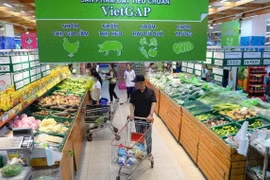
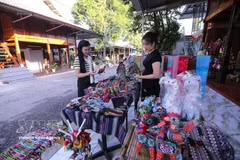
Hanoi has many modern supermarkets but many people still shop at traditional markets for their cultural value,out of habit and as they are priced well for lower-income people.
People in rural areas, meanwhile, are unfamiliarwith supermarkets.
Traditional markets, for them, are not just aplace to purchase necessities but also a place to sell products.
According to the Hanoi Department of Industry and Trade, the citybuilt 43 new markets, rebuilt 16 and about 95 others were upgraded from 2011-2016,with total investment of more than 3 trillion VND (133 million USD).
However, Le Hong Phong, the department’s director, said that mostof the built markets in this period were in inner-city areas while somedistricts and new urban areas in the city still don’t have traditional marketsdue to a lack of funds.
Individuals and enterprises are not interested in building andupgrading this market model as the system of legal documents issued by centralagencies related to markets have many inadequacies in building and managingtraditional markets, Phong said.
Some departments do not have any guidance related to constructioninvestment, mechanisms and policies to encourage enterprises and co-operativesto invest in building, trading and managing markets, he said.
It also caused difficulties for People’s committees in districtsto approve projects.
A survey from the economic and budget affairs department of the HanoiPeople’s Council showed inefficiency at some of the city’s markets.
Many traditional markets have been in place for a long time but donot operate efficiently.
Many of them have become dilapidated and are below fireprevention, food safety and hygiene standards.
Nge Tu So, the 8,000sq.m market located between Dong Da and ThanhXuan districts, with nearly 800 stores, has faced many problems in trading dueto infrastructure degradation, leading to less customers.
Traders have moved their business from the market, wasting landand finances.
Some trade centres such as Mo, Cua Nam and Hang Da have a combinedmodel of traditional and modern markets but still operate inefficiently.
To attract investment from individuals and enterprises in buildingmarkets, director Phong has petitioned the city People’s Committee andGovernment to devise more policies to support localities, investors andtraders.
According to experts, the maintenance and development oftraditional markets is necessary, but anydevelopment plan requires a feasibility study.
The city must identify what type of market willserve which demographic group, as well as the buying power each grouppossesses, avoiding a situation where markets are unoccupied while many tradersrush to streets to set up temporary markets, they said.
Pham Thi Thanh Mai, head of the economic and budget affairsdepartment has proposed the Hanoi People’s Committee use the State budget forinvestment, upgrading and exploitation of markets through public-privatepartnerships.-VNA
VNA