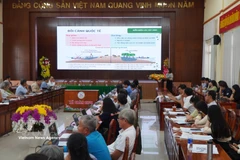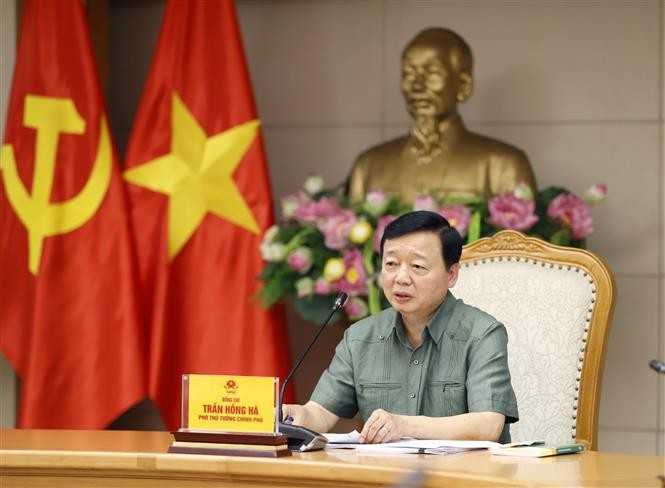
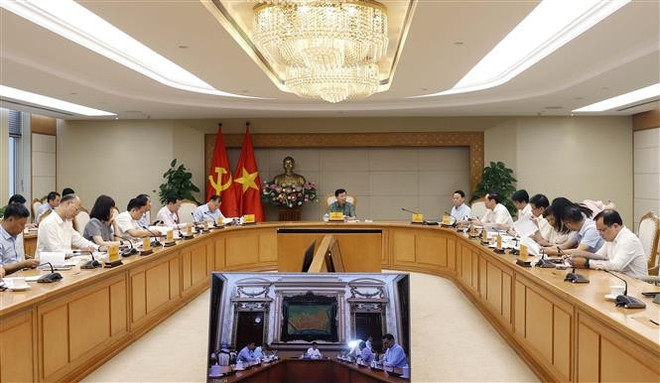
Hanoi (VNA) – Deputy Prime Minister Tran Hong Ha on May 21 chaired a meeting with leaders from several ministries, agencies, and the People’s Committees of Hanoi and Ho Chi Minh City to discuss a draft directive of the Prime Minister outlining urgent tasks to strengthen the effectiveness of environmental law enforcement and take decisive action against pollution.
According to the Ministry of Public Security, environmental protection has long been a priority of the Party and State as it was recognised as one of the three key pillars of sustainable development.
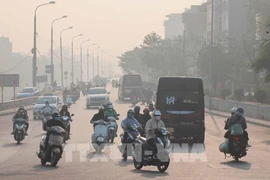
Despite notable progress, environmental pollution remains poorly controlled in many areas. Several regions are facing severe conditions, particularly air pollution in major cities, along with land and water pollution in densely populated areas, industrial zones, service hubs, and craft villages.
Each year, the police uncover and address over 600 criminal cases and more than 20,000 cases of administrative violations related to environmental harm.
To address this problem, the ministry, in coordination with other ministries and local authorities, has drafted a Prime Minister directive detailing urgent measures to improve law enforcement and combat pollution.
Lieutenant General Nguyen Van Long, Deputy Minister of Public Security, said the draft directive focuses on inspecting and addressing polluting facilities, while proposing legal reforms to ensure stricter enforcement and clarify the responsibilities of relevant agencies. The draft also highlights the need for stronger leadership accountability and encourages proactive engagement from all levels of government and the wider community.
At the meeting, Minister of Agriculture and Environment Do Duc Duy outlined short-term solutions to deal with pollution hotspots. These include tackling air and wastewater pollution in Hanoi, environmental degradation in craft villages, contamination in river basins, and pollution from industrial facilities. The goal is to prevent the spread and worsening of pollution, he said.
He said that his ministry, in coordination with the Ministry of Public Security, is prioritising urgent environmental issues such as air and surface water pollution. It is finalising emission standards for motorbikes and proposing clearer responsibilities for certain ministries.
Vice Chairman of the Hanoi People’s Committee Duong Duc Tuan backed the draft directive, highlighting the city’s efforts to restrict fossil fuel vehicles. He recommended broadening pollution source categories and clarifying the city's responsibilities for declaring pollution emergencies and building the environmental monitoring system.
Meanwhile, Vice Chairman of the Ho Chi Minh City People’s Committee Bui Xuan Cuong confirmed the city’s commitment to environmental monitoring and low-emission zone identification. He advocated stronger decentralisation, a unified national environmental information system, green transport initiatives, and greater private investment in clean technologies.
Acknowledging all feedback, Deputy PM Ha instructed the drafting committee to revise and finalise the directive. He stressed that the directive must point out the worsening pollution in big cities such as Hanoi and Ho Chi Minh City, particularly air pollution, river basin contamination, solid waste issues, and pollution from industrial zones and craft villages.
He noted that the directive should prioritise urgent actions to tackle severe pollution. It must not replace existing policies but reinforce and enhance the implementation of the previously issued resolutions and directives.
The Deputy PM tasked the Ministry of Construction, the Ministry of Agriculture and Environment, and the Ministry of Industry and Trade with quickly issuing detailed environmental standards, identifying pollutants such as fine dust, CO₂, and carbon emissions, managing vehicles, fuel and emissions, and setting pollution reduction targets for the period from now to 2030.
He assigned the Ministry of Agriculture and Environment to lead the creation of a national environmental monitoring database, propose the police take legal action against serious polluters, and devise mechanisms for funding inspections and attracting private investment.
The official stressed that all actions must be aligned with existing directives, with clear roles and no overlap. Localities must act immediately, or face inspection. Besides, Hanoi and Ho Chi Minh City need to develop tailored pollution control plans./.