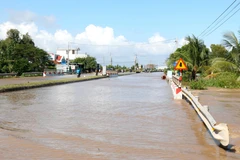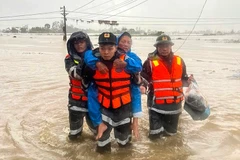
Hanoi (VNA) - Vietnam has made significant progress in disaster prevention and control, from improving the legal framework and strengthening forecasting and early warning capacity, to promoting the application of science and technology, enhancing international cooperation, and mobilising community participation. These efforts have helped minimise losses and improve community resilience to disasters.
Vietnam, as a key participant in regional disaster risk management mechanisms, strongly supports ASEAN and the ASEAN Coordinating Centre for Humanitarian Assistance on Disaster Management (AHA Centre), particularly the “One ASEAN, One Response Roadshow” vision, according to the Ministry of Agriculture and Environment,
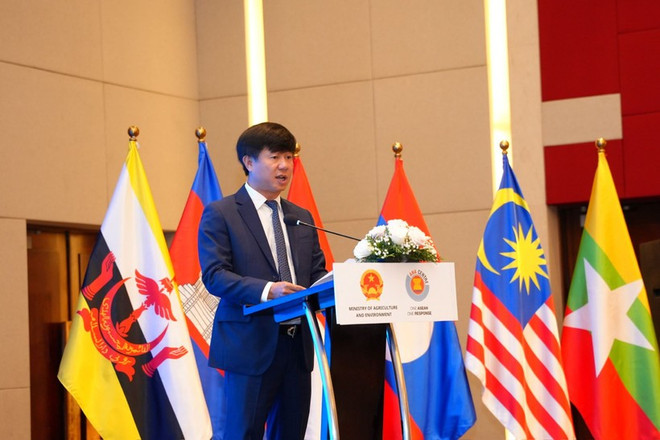
Speaking at the “One ASEAN One Response Roadshow” programme on August 15, Pham Duc Luan, Director of the Department of Dyke Management and Natural Disaster Prevention and Control, highlighted that Vietnam is among the countries most severely affected by natural disasters, which are becoming more frequent and intense due to climate change.
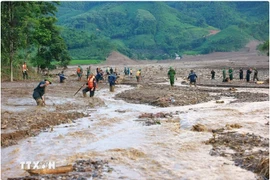
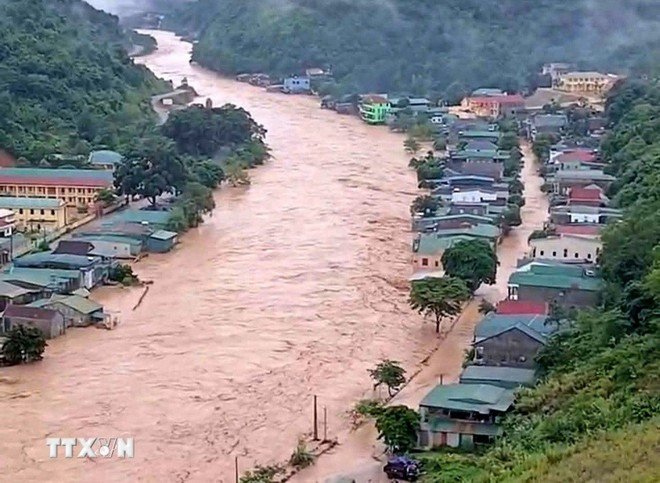
Each year, disasters such as storms, floods, droughts, landslides, and saltwater intrusion cause heavy losses of life and property, disrupt socio-economic activities, and directly impact the livelihoods of millions of people.
Nevertheless, Luan noted that Vietnam’s disaster management has achieved important progress, from legal improvements and enhanced forecasting and early warning capacity, to greater application of science and technology, stronger international cooperation, and broader community involvement, contributing to reduced damage and greater resilience.
Addressing the event, EU Ambassador to Vietnam Julien Guerrier affirmed the EU’s support for ASEAN’s regional cooperation mechanisms on disaster management, in which Vietnam plays an active role.
He said since 2020, the EU has supported regional disaster management initiatives, such as the ASEAN Regional Disaster Emergency Response Simulation Exercise (ARDEX), the ASEAN Joint Disaster Response Plan (AJDRP), the ASEAN Information Management Network (AIM-Net), and the “One ASEAN One Response Roadshow.”
These activities demonstrated the EU’s strong commitment to disaster risk management and enhancing the capacities of member states, the diplomat said.
Sithu Pe Thein, Director of Operations at the AHA Centre, noted that ASEAN is one of the regions most heavily affected by disasters worldwide, posing challenges to the response capacities of member states as well as to coordination and mutual support.
The 2004 Indian Ocean tsunami, he said, was a turning point that drove the establishment of ASEAN’s regional mechanisms for disaster management and emergency response.
Subsequent major disasters such as Cyclone Nargis in 2008 and Typhoon Haiyan in 2013 further tested these mechanisms, while reaffirming ASEAN leaders’ commitment through the 2016 “One ASEAN One Response Roadshow” Declaration, which emphasised ASEAN’s unified disaster response in the region and beyond.
It is therefore essential that stakeholders in each ASEAN member state fully understand regional mechanisms and their respective roles, while clarifying how domestic actors can participate in and support regional response. This is also the goal of the “One ASEAN One Response Roadshow” held in Vietnam.
During the event, delegates were briefed on Vietnam’s disaster management efforts; ASEAN’s regional cooperation mechanisms and joint initiatives coordinated by the AHA Centre; and the United Nations’ role in supporting these regional cooperation frameworks.
Participants also engaged in exchanges and discussions on coordination within the framework of ASEAN’s regional disaster management cooperation./.