Vietnam proposes three pillars for ASEAN Socio-Cultural Community

A Vietnamese official has highlighted the country's unwavering commitment to science-technology development, innovation, and digital transformation as a top national policy, describing them as decisive forces for achieving fast and sustainable development.

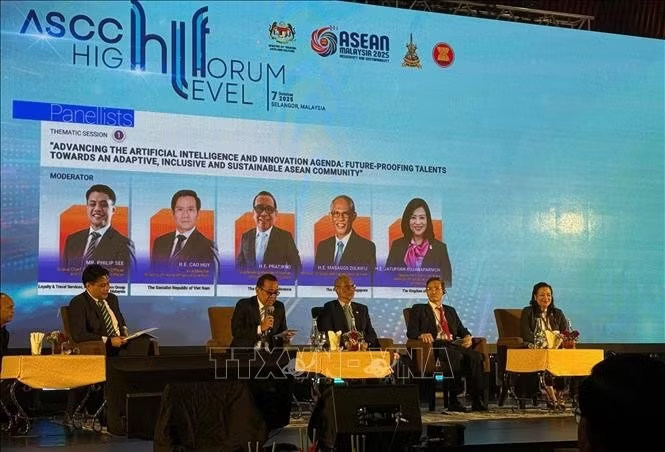
Deputy Minister of Home Affairs Cao Huy (second from right) at the ASCC High-Level Forum in Selangor, Malaysia, on October 7 (Photo: VNA)

Kuala Lumpur (VNA) – Deputy Minister of Home Affairs Cao Huy led a Vietnamese delegation to the ASEAN Socio-Cultural Community (ASCC) High-Level Forum, which opened in Selangor, Malaysia, on October 7 with a focus on an inclusive and sustainable regional community.

Initiated by the Malaysian Ministry of Tourism, Arts and Culture in its role as ASCC Chair, the forum brought together officials to advance shared goals amid rapid technological shifts.

In his speech, Huy underscored the strategic and urgent importance of ensuring inclusiveness in the age of artificial intelligence (AI) and digital transformation.

He highlighted Vietnam's unwavering commitment to science-technology development, innovation, and digital transformation as a top national policy, describing them as decisive forces for achieving fast and sustainable development. Vietnam is targeting a spot among the world's top 30 in the Global Innovation Index by 2045.
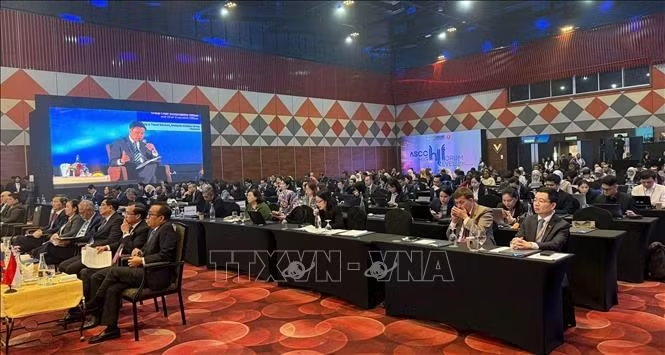
An overview of the event (Photo: VNA)

An overview of the event (Photo: VNA)

To ensure fair access to education and jobs across ASEAN, he outlined three key priorities that Vietnam is pursuing. The first is digital education equity. He called on regional governments to roll out concrete and practical policies quickly to bridge the digital gap, especially for vulnerable groups like women, ethnic minorities and those living in remote areas.

The second is fair job access. With AI displacing conventional roles, he urged stepping up workforce reskilling and upskilling, insisting that recruitment and promotions must stay transparent and fair to maintain social stability.

The third is inclusive governance. He urged that AI solutions applied in national and corporate governance embed ethical standards, accountability, and human rights protection, ensuring all citizens reap the rewards of technological advances to minimise deepening social inequalities.

Huy reaffirmed Vietnam's steadfast support for ASEAN's vision of a responsive, inclusive, and sustainable community, one that empowers every individual to fully unlock their potential.

The forum delved into the AI and innovation agenda, with delegates exchanging in-depth views on nurturing future talent to bolster a responsive, inclusive and sustainable ASEAN Community.

Discussions also covered youth empowerment and unlocking investment for climate action and creative cultural industries.

Participants highlighted challenges and opportunities in safeguarding ASEAN’s shared cultural heritage, plus tapping traditional sports and games. They mapped out concrete actions to boost accessibility and social inclusion among communities across ASEAN member states./.

VNA

See more

ASEAN signs Digital Economy Framework Agreement

ASEAN signs Digital Economy Framework Agreement

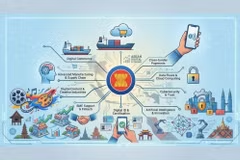
The Digital Economy Framework Agreement (DEFA), the bloc’s first standalone and legally binding digital economy agreement, establishes common rules covering digital trade, cross-border data flows, electronic payments, cyber security and artificial intelligence (AI).

Minister Counsellor Nguyen Hai Luu, Deputy Permanent Representative of Vietnam to the UN, speaks at the discussion on November 12, 2026. (Photo: VNA)

Vietnam supports peace, reconstruction efforts in Gaza: diplomat

Minister Counsellor Nguyen Hai Luu, Deputy Permanent Representative of Vietnam to the UN, expressed deep concern over the dire humanitarian situation in Gaza, particularly as recent heavy rains and flooding have worsened living conditions for residents.

Thailand diversifies oil sources to ensure energy security

Thailand diversifies oil sources to ensure energy security

Although the diversification of oil import sources has helped reduce the risk of domestic oil shortage, it has not immediately reduced energy costs because import prices depend on market mechanisms, transportation costs, foreign exchange rates and the terms of oil contracts.

ST Telemedia Global Data Centres (Thailand), an affiliate of Singapore Telecom, is developing three data cehtres in Thailand including this facility on Rama IX Road in Bangkok. (Photo: bangkokpost)

Thailand tightens regulations on data centres

The new rules focus on controlling investment scale, electricity and water consumption, environmental impacts, and preventing investors from reserving resource quotas beyond their actual needs.

A road is under construction in Dong Nai city, Vietnam. (Photo: VNA)

ADB: Southeast Asia needs 7.1 trillion USD in infrastructure investment by 2040

ADB estimates that the region will need an average of 476 billion USD in infrastructure investment annually during 2026–2040, equivalent to 8.7% of GDP. However, at current investment levels, government budget resources would cover only around 45% of this demand, leaving an annual financing gap of 264 billion USD.

Kyodo News publishes an article titled “Sculptures by Japanese, Vietnamese artists on display in Yokohama,” (Screenshot photo)

Japanese media widely cover top Vietnamese leader ’s visit

Japanese media have continued extensive coverage of General Secretary of the Communist Party of Vietnam (CPV) Central Committee and President To Lam’s activities in Japan, highlighting his meetings with representatives of leading financial institutions at the Tokyo Stock Exchange, witnessing of cooperation agreement signing and participation in cultural exchanges.

Thailand pushes for establishment of ASEAN emergency public health centre

Thailand pushes for establishment of ASEAN emergency public health centre

The draft agreement stipulates that ACPHEED will comprise three specialised centres based in three ASEAN member states. Vietnam will oversee the centre for prevention and preparedness; Indonesia will host the centre for detection and risk assessment; and Thailand will be responsible for the centre for response and risk communication.

Indonesia designates 31 mln ha of waters as conservation areas

Indonesia designates 31 mln ha of waters as conservation areas

Head of the Convention and Marine Resource Balance working team at the ministry’s Directorate of Ecosystem Conservation Ahmad Sofiullah said this week that it is a strategic effort to ensure the sustainability of Indonesia’s marine ecosystems.