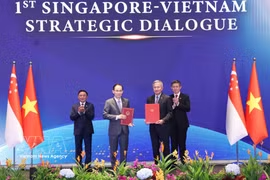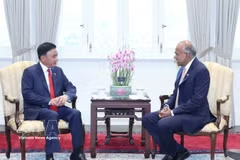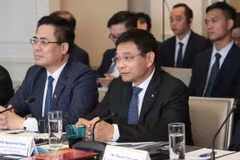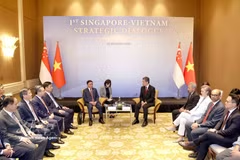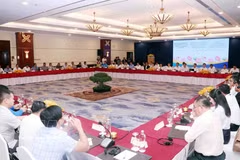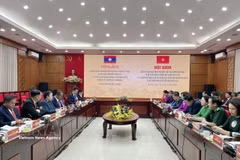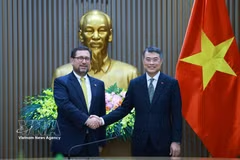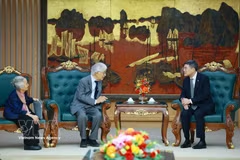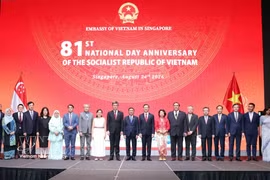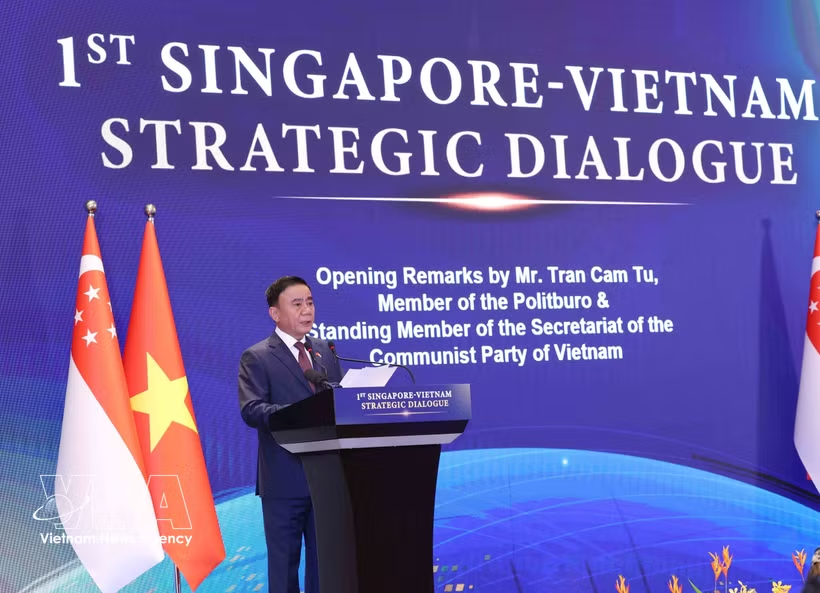
Singapore (VNA) - Politburo Member and Standing Member of the Communist Party of Vietnam (CPV) Central Committee’s Secretariat Tran Cam Tu and Assistant Secretary-General of Singapore’s People’s Action Party (PAP), Coordinating Minister for Public Services and Minister for Defence of Singapore Chan Chun Sing co-chaired the first Vietnam-Singapore Strategic Dialogue on August 25.
Themed “Towards a Resilient Future: Elevating Singapore-Vietnam Partnership for Technology and Capacity Building to New Height”, the dialogue marked a new mechanism for strategic exchanges between the two ruling Parties.
Addressing the event, Tu praised the two sides’ coordination and preparations, saying the organisation of the inaugural dialogue soon after the mechanism was established demonstrated the Parties’ special attention and strong political determination to put the new cooperation framework into practice, helping concretise the major orientations of the Vietnam-Singapore Comprehensive Strategic Partnership.
He said focusing the dialogue on human resources development and technology connectivity is “right and timely”, as both areas are strategically important to each country’s competitiveness, resilience and long-term development.
Tu called on the two Parties to strengthen frank and substantive exchanges, share development visions and experience, continue supporting one another, enhance their capacity to adapt and jointly seek new growth drivers.
Given the considerable potential for cooperation between the two Parties, he proposed maintaining regular exchanges at all levels, especially high level, and stepping up the sharing of experience in building a modern public administration and effective national governance, formulating and implementing policies, and identifying, training and effectively utilise talented personnel, and developing a contingent of visionary future leaders.
The two sides should also promote exchanges among young and promising leaders and expand cooperation among mass organisations, youth organisations and localities, thereby further strengthening the social foundations of bilateral ties, he said.
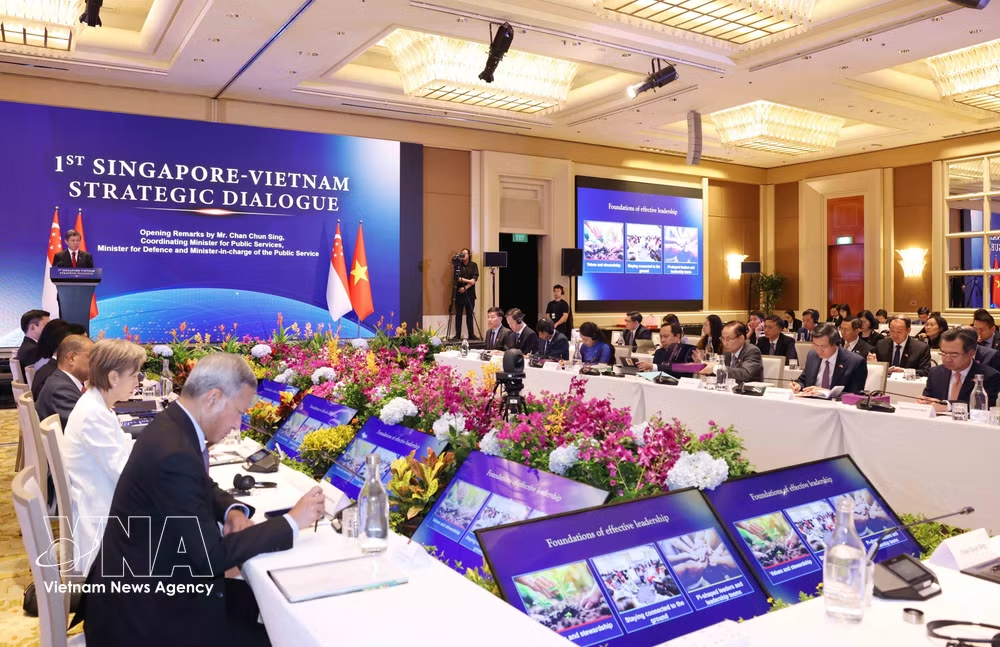
Echoing Tu’s views, Chan praised the two Parties for swiftly operationalising the Strategic Dialogue mechanism through concrete cooperation plans.
He stressed the importance of candid exchanges on approaches and experience in governance, human resource development, science and technology, and innovation, while exploring ways to better connect the strengths of the two countries to meet development requirements in the new period.
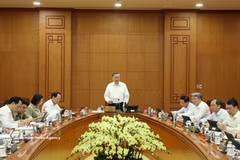
Within two sub-themes “Leading for Tomorrow: Developing Future-Ready Talent,” and “Building a New Model for Technology Cooperation: Towards a Shared Innovation Space”, participants discussed strategic issues concerning the development of both countries, including personnel training, human development and capacity building, as well as connectivity in science and technology and innovation.
The two sides agreed to make cooperation in human resource development and cadre training one of the key pillars of cooperation between the two Parties, aiming to build a contingent of officials with strategic thinking, modern governance capacity, and and the ability to formulate policies and organise effective implementation. Cooperation in training should be conducted in a long-term and systematic manner with interconnected programmes, closely aligned with practical requirements and focusing on potential cadres, leaders and managers at all levels.
Speaking at a session on human resource training cooperation, Politburo Member, Secretary of the CPV Central Committee and Chairman of its Commission for Organisation Nguyen Duy Ngoc affirmed that Vietnam has identified science and technology, innovation and digital transformation as its top strategic breakthroughs, with people remaining the decisive factor for success. Human resource training is therefore a strategic priority, he said, expressing Vietnam’s wish for Singapore to accompany and share its experience with Vietnam to meet the development requirements of both sides.
Sharing the same view, Politburo Member and President of the Ho Chi Minh National Academy of Politics Doan Minh Huan said investing in governance capacity and public policy means investing in sustainable development and stronger strategic autonomy. He noted that cooperation in human resource training and capacity building between the academy and Singaporean partners already has a substantive foundation, while expressing his hope for a more long-term and systematic cooperation framework to establish a network for theoretical research and exchanges and knowledge sharing between Vietnam and Singapore.
At a session on science and technology connectivity, Member of the CPV Central Committee and Minister of Science and Technology Vu Hai Quan said Vietnam is stepping up the transition to a growth model increasingly driven by science and technology, innovation and digital transformation, moving from technology adoption and application to strengthening its capacity for technology improvement, mastery and co-creation.
This requires stronger links among the State, businesses, research institutions and universities, and a greater role played by businesses in bringing technologies to market, he said, adding the State should focus on creating institutions, sharing risks and facilitating the development of new technologies and products.
From a policy perspective, Politburo Member, Secretary of the CPV Central Committee and Chairman of its Commission for Policy and Strategy Nguyen Thanh Nghi highlighted Resolution No. 19-NQ/TW recently adopted by the 14th CPV Central Committee on renewing Vietnam’s development model, which sets out a comprehensive transformation towards a resilient, creative, humane, sustainable and integrated development model, placing people at the centre and taking science and technology, innovation, digital transformation and artificial intelligence as key drivers.
The goal of building a “shared development space” is an appropriate approach for a new phase of Vietnam-Singapore cooperation, he noted.
Le Hoai Trung, Politburo Member and Minister of Foreign Affairs, underscored the important and practical significance of the Strategic Dialogue mechanism between the two Parties, particularly amid complex developments in the regional and global situation. As the coordinating agency, the Ministry of Foreign Affairs will work closely with relevant agencies, ministries and sectors to effectively implement key conclusions reached during the Strategic Dialogue, he said.
Singaporean Minister of State for Defence Desmond Choo shared Singapore’s experience in developing human resources in line with economic needs, strengthening the capacity of public-sector personnel and preparing a workforce capable of adapting to rapid technological change.
Singaporean Minister for Foreign Affairs Vivian Balakrishnan said Singapore had learned from many countries, including Vietnam, throughout its development. He expressed his hope that the two Parties would take the lead in promoting comprehensive connectivity between the two countries, particularly in science-technology and education-training, building on 30 years of practical cooperation in these fields.
Singaporean Minister for Digital Development and Information Josephine Teo shared the country’s experience in building an innovation ecosystem, linking research with businesses and markets, and developing a technology workforce. She agreed on the need to strengthen connections between the two countries’ innovation ecosystems, leverage their complementary strengths, and promote links among government agencies, research institutions, universities and businesses.
Based on the shared view that the two sides should focus on strengthening strategic thinking, governance and policymaking capacity, digital transformation, green transition, and sustainable development, while closely linking human resource development with the development and mastery of science and technology, Standing Member of the CPV Central Committee’s Secretariat Tran Cam Tu called for the implementation of the Vietnam-Singapore joint statement on technology connectivity strategy with a long-term vision.
He urged specific solutions and mechanisms to be identified so that the technology connectivity strategy for 2026-2030 could be agreed on and implemented soon.
According to the key Vietnamese leader, the new cooperation model should bring into full play the roles of the State, scientists and businesses. The goal should go beyond simply attracting investment and transferring technology to jointly conducting research, co-developing technologies, gradually building shared technological capabilities, and creating new products and value.
At the end of the event, the two sides adopted the conclusions of the first Vietnam-Singapore Strategic Dialogue, agreeing to continue working together to translate their shared perceptions and orientations into concrete cooperation programmes, plans and outcomes. They also issued a Vietnam-Singapore Joint Statement on Technology Connectivity Strategy.
The successful organisation of the first Vietnam-Singapore Strategic Dialogue marked a new development in relations between the CPV and the PAP, creating an additional channel for in-depth political exchanges and policy consultations.
The dialogue's outcomes demonstrated that bilateral cooperation is expanding from economic, investment and production connectivity to deeper links in knowledge, technology and human resources, and from experience sharing to jointly enhancing capacity and developing new cooperation models.
The dialogue also helped translate political trust between the two Parties into practical cooperation orientations and programmes, contributing to substantive and sustainable development of the Vietnam-Singapore Comprehensive Strategic Partnership and meeting the development needs of both countries in the new era./.