Hanoi (VNA) – Professor Tran Xuan Bach at Vietnam National University, Hanoi, has been appointed as a member of the Technical Advisory Panel (TAP) of the Pandemic Fund operated by the World Bank Group (WB) and the World Health Organisation (WHO).
Bach, who is also a Health Economist and Adjunct Professor at Johns Hopkins University, specialises in decision-analytic modeling to guide the development and assessment of health technologies and policies. With extensive experience consulting for United Nations agencies, international organisations, and governments across Asia, his work focuses on identifying cost-effective interventions, evaluating health services and innovations, and strengthening health systems. His efforts address critical global health challenges, including HIV/AIDS, substance use, mental health, and pandemic preparedness and response.
He has received numerous international research awards, including the 2025 CUGH’s Velji Faculty Leader in Global Health Innovation Award, the 2024 IBTN LMIC Investigator Award, the 2023 ISPOR LMIC Research Excellence Award, the Hopkins Center for AIDS Research’s International Research Award, and was a runner-up for the 2022 APEC Research Prize on Healthy Women, Healthy Economies.
The Pandemic Fund was established in September 2022, with 2 billion USD in support from G20 countries, the WB, the WHO, and international organisations. This is an initiative to increase investment in the field of pandemic prevention and response (PPR) through the provision of additional long-term financing, towards key areas such as infectious disease surveillance, laboratory systems, diagnostics, and health team capacity building.
As of November 2024, the fund has allocated nearly 1 billion USD to 47 projects in 75 countries, mobilising an additional 6 billion USD from domestic and foreign partners.
The TAP provides technical advice to the Pandemic Fund's Governing Board. The TAP supports the Pandemic Fund with its goal of financing projects and activities that help strengthen capacity building and implementation of pandemic prevention, preparedness, and response (PPR) under International Health Regulations (IHR) (2005) and other internationally endorsed legal frameworks, consistent with a One Health approach.
The key functions of the TAP include to ensure that the Governing Board is kept apprised of the latest knowledge and developments related to PPR, including the status of PPR capacity at country, regional and global levels, emerging lessons and priorities, and significant developments in the areas of broader PPR governance and oversight.
The TAP also advises the Governing Board on funding priorities and critical gaps in pandemic PPR, as well as on funding allocation decisions, by providing analysis and evidence-based recommendations, based on an evaluation of individual funding proposals submitted to the Pandemic Fund through the Call for Proposals process.
The TAP comprises of a core group of 30 multidisciplinary experts and is chaired by Dr. Chikwe Ihekweazu, Assistant Director-General, WHO./.
See more
Ho Chi Minh City to offer annual health check-ups for residents
In the initial phase in 2026, priority will be given to children under 24 months old, students, out-of-school minors, contracted employees, probationary workers, apprentices, public officials, members of the armed forces, social protection beneficiaries and people aged 60 and above.
Integration of tuberculosis screening into routine health check-ups proposed
The TB burden in Vietnam remains high. The World Health Organisation (WHO) estimates that in 2025, the country recorded around 184,000 new TB cases, including 9,400 drug-resistant cases, with approximately 12,000 deaths annually.
Inter-hospital coordination saves cardiac arrest patients from acute heart attacks
The cases highlight the effectiveness of rapid coordination between frontline healthcare facilities and specialised hospitals in optimising the “golden time” for emergency treatment.
Vietnam performs first-ever domino multi-organ transplant
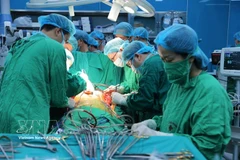
Vietnam has successfully carried out its first domino multi-organ transplant, a landmark medical achievement that underscores the country’s rapidly advancing organ transplantation expertise
Ho Chi Minh City: 350 essential medicines included in price stablisation programme
Under a plan issued on March 17, the programme encompasses 20 groups of essential drugs commonly used in treating prevalent and chronic conditions.
Hue provides free surgery for disadvantaged children with cleft lips, palates
Medical specialists and professors from Germany, Italy, Austria, and Spain conducted screenings for 80 children with cleft lips and palates and other congenital deformities. Following medical assessments, nearly 40 cases were selected for reconstructive surgery.
Robotic surgery takes a leap forward in Vietnam with new FV centre
FV Hospital aims to develop into a leading robotic surgery hub in Southeast Asia, with the long-term goal of making the world’s most advanced treatment technologies more accessible to patients across Vietnam.
Ho Chi Minh City targets free basic hospital fees for residents by 2030
Under the programme, the southern largest economic hub has set several key health targets to be achieved by 2030. The average height of children and adolescents under 18 is expected to increase by at least 1.5cm, while the average life expectancy of residents is projected to reach around 77 years, including at least 68 years of healthy living.
Vietnam conducts clinical trials of first oral antiviral drug to treat dengue fever
In Vietnam, dengue fever consistently records cyclical increases, especially during the rainy season. In recent years many localities have recorded high numbers of cases, putting significant pressure on the healthcare system and directly impacting the health, daily lives and economy of the people.
Refining rare disease management policies needed to ensure equitable health care
In Vietnam, an estimated 6 million people live with rare diseases, about 58% of whom are children, while nearly 30% of affected children die before the age of five due to delayed diagnosis or limited access to appropriate treatment.
Vietnamese doctors in Laos help foster bilateral solidarity
Commending the Hanoi – Vientiane General Hospital’s 13-year development, Ambassador Nguyen Minh Tam noted that prioritising conscience and virtue has helped it build a strong reputation among Lao citizens, the Vietnamese community and international friends in Laos.
Health sector requested to ensure timely, equitable medical services to every citizen
Human resources remain decisive, as no matter how advanced equipment becomes, it is doctors who directly deliver care and sustain patients’ confidence, said Party General Secretary To Lam.
Professional excellence, dedication define Vietnam’s healthcare system
When patients pull through from the brink of death, when their vital signs stabilise and transplanted hearts begin beating strongly in new bodies, the joy shared by the entire medical team is overwhelming. And when the country welcomes the New Year, saving lives takes on an even more profound significance — offering patients and their families a new spring of hope.
Vietnam fosters maternal and child healthcare, advances toward 2035 goals
The under-five mortality rate in Vietnam in 2025 was estimated at below 16 per 1,000 live births, more than three times lower than the 1990 level. The infant mortality rate (under one year) declined fourfold to below 11 per 1,000, while the neonatal mortality rate dropped fivefold, from 44 per 1,000 in 1990 to 8.8 per 1,000 in 2025.
Over 6,000 patients receive free medicines
The schemes focus primarily on cancer, rare diseases and severe chronic conditions, areas where treatment costs are high and often require expensive biological and originator drugs.
Vietnam reaches new height in organ transplantation
From demanding cross-country transplants to highly specialised procedures nearing regional and international standards, the sector has created new chances of survival for thousands of patients. However, persistent bottlenecks in organ donation and the legal framework highlight the urgent need to further perfect the national donation–transplantation system. In the era of advanced medicine, progress is measured not only by surgical mastery, but also by the ability to turn loss into hope and sustain life.
University Medical Centre performs ninth heart transplant from brain-dead donor
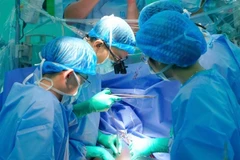
The surgery was carried out in the early morning of February 23 (the seventh day of the Lunar New Year), marking the hospital’s ninth heart transplant from a brain-dead donor.
Measures rolled out to ensure adequate medicine supply during Tet
Accordingly, provincial and municipal health departments are required to direct hospitals, centres for disease control and health care facilities to urgently develop plans and carry out medicine procurement to ensure sufficient supply, absolutely avoiding shortages. Medicines must meet quality standards and be sold at reasonable prices, with no sudden price increases allowed.
Vietnam, China open “green lane” for ambulance transfer on humanitarian grounds
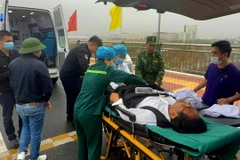
At around 16:20 the same day, the lane was activated at Bac Luan II Bridge area to allow an ambulance bearing license plate 15N-049.80 to transfer 63-year-old Chinese man Zhang Huizhong, who had suffered a cerebral infarction, to China for immediate treatment.
Resolution 72 opens path to a modern, sustainable healthcare system
To build a resilient healthcare system capable of meeting the challenges of ageing, emerging diseases and rising expectations for quality care, Vietnam must continue to strengthen primary and preventive care, invest in human resources, accelerate digitalisation and big data development, and refine healthcare financing mechanisms.