Da Nang meeting promotes Internet development in Asia-Pacific

The 60th meeting of the Asia Pacific Network Information Centre (APNIC 60) opened in the central city of Da Nang on September 9, seeking ways to promote Internet safety and development.

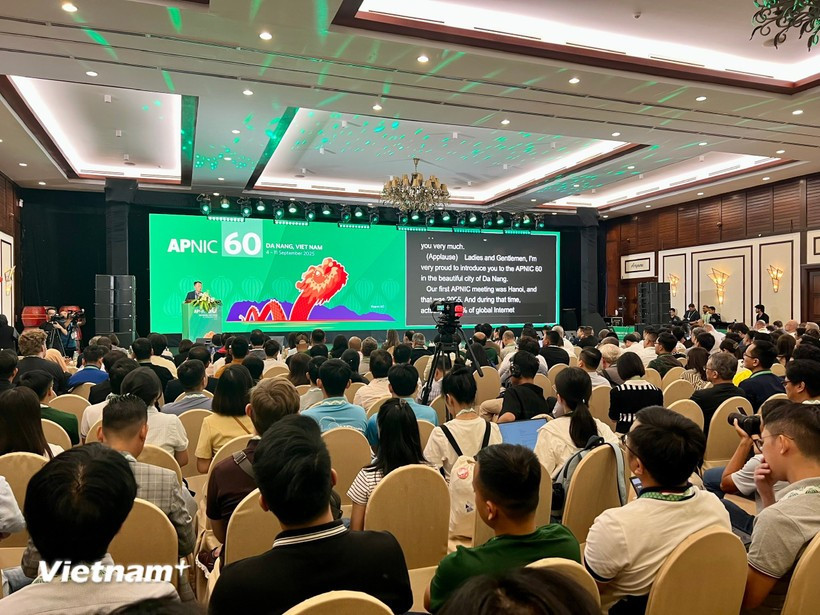
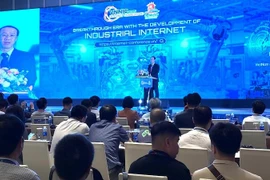
An overview of the 60th meeting of the Asia Pacific Network Information Centre (Photo: VietnamPlus)

Da Nang (VNA) – The 60th meeting of the Asia Pacific Network Information Centre (APNIC 60) opened in the central city of Da Nang on September 9, seeking ways to promote Internet safety and development.

The event, hosted by the Vietnam Internet Network Information Centre (VNNIC) under the Ministry of Science and Technology, attracted the participation of 500 domestic and international delegates.

It focused on policies for Internet Protocol (IP) addresses and Autonomous System Numbers (ASN), along with orientations for developing and ensuring global Internet safety, including such issues as quantum Internet, the utilisation of Internet resources, IPv6 deployment, artificial intelligence (AI) application, and secure routing.

Nguyen Hong Thang, Director of the VNNIC, stressed that hosting APNIC 60 provides Vietnam with an opportunity to showcase its pioneering role in policy making in the region, develop next-generation Internet infrastructure, advance technical cooperation, share experience, and connect with global initiatives, and towards a safe, open, and innovative Internet. He noted that the Internet today is not merely a technology but an essential infrastructure underpinning socio-economic development, innovation, and digital transformation. It has become a vital space connecting people, nations, and ideas.

For decades, the APNIC has played a central role in the Asia-Pacific Internet ecosystem by managing digital resources, building communities, and strengthening capacity, thereby contributing to trust, resilience, and sustainable Internet growth across the region.

Founded in 1993, the Asia Pacific Network Information Centre is one of the world’s five Regional Internet Registries. The APNIC convenes two meetings annually. It is the region’s highest-level meeting on developing policies for IP/ASN management and also serves as a forum for the Internet community. Here, experts meet and share experiences on policies and technologies related to Internet resources in the Asia-Pacific region.

Since 2003, the Vietnam Internet Network Information Centre has been recognised as Vietnam’s National Internet Registry and has repeatedly hosted the APNIC’s major regional conferences. APNIC 60 is of particular significance as it marks the 25th anniversary of the VNNIC and more than 27 years since Vietnam’s first global Internet connection.

With an IPv6 adoption rate of 65%, Vietnam now ranks among the world’s top 10 countries in deploying next-generation Internet protocols.

The conference provided a platform for Vietnam to update new technologies, share challenges and solutions, and strengthen community ties.
internet-2.jpg
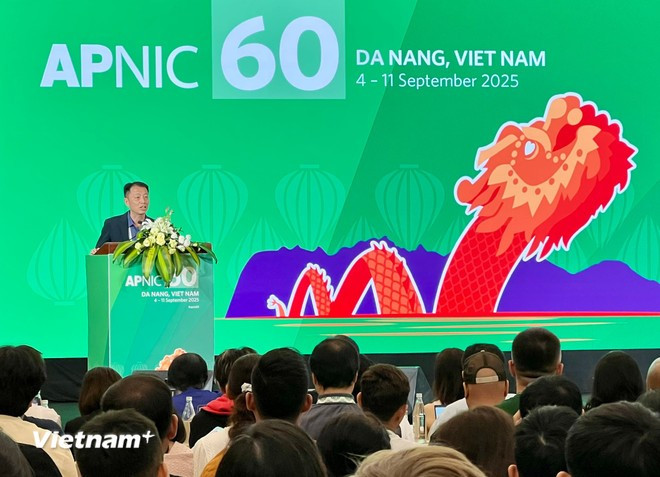
Kenny Huang, Chair of the APNIC Executive Council, speaks at the meeting. (Photo: VietnamPlus)

The September 9 plenary session featured speeches by prominent international speakers including Kenny Huang, Chair of the APNIC Executive Council; Jia Rong Low, APNIC Director General; Leslie Daigle, Chief Technical Officer and Internet Integrity Programme Director at the Global Cyber Alliance; and René Fichtmüller, expert at Flexoptix, among others.

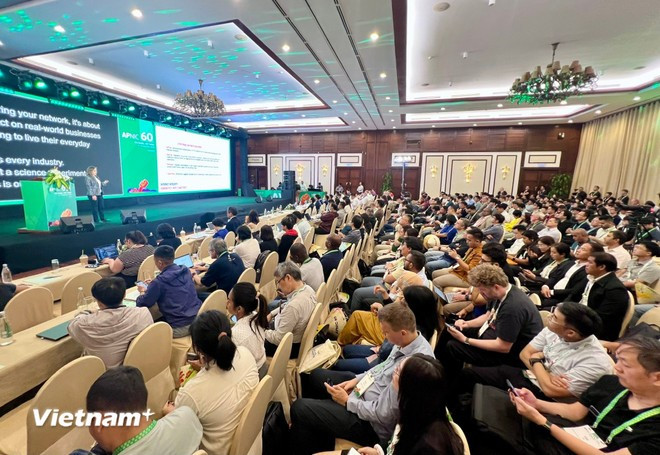
Delegates proposed regional Internet resource management policies and joined Special Interest Group (SIG) discussions on emerging trends such as IPv6/IPv6-only deployment, DNS security, RPKI, the application of AI in Internet networks, as well as data centre development and Internet exchange ecosystems.
internet-3.jpg
A panel discussion at the 60th meeting of the Asia Pacific Network Information Centre (Photo: VietnamPlus)

Within the APNIC 60 framework, the 32nd meeting of the Asia Pacific Internet Exchange Association (APIX 32) was also held. This is the region’s premier forum on Internet exchange (IX) connectivity, drawing leading organisations, experts, and businesses from across Asia-Pacific. At this meeting, the VNNIC stepped up international cooperation to further develop VNIX – Vietnam’s National Internet Exchange.

On the sidelines, the VNNIC organised bilateral meetings and signed memoranda of understanding with several international organisations to strengthen collaboration.

According to the VNNIC, 27 years since first connecting to the Internet, Vietnam has achieved remarkable milestones. The rate of the Route Origin Authorisation (a high-level Internet security mechanism) is very high, with 96% of IPv4 routes being valid. Vietnam also ranks among the world’s top 10 countries in IPv6 deployment, with a rate of 65%. The Vietnamese Internet community continues to grow strongly, with a highly skilled technical workforce, closer cooperation, and deeper integration into global initiatives./.
VNA

See more

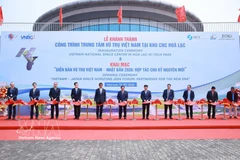
Prime Minister Pham Minh Chinh (C) and delegates cut a ribbon to innaugurate the Vietnam National Space Centre (VNSC) at Hoa Lac Hi-Tech Park in Hanoi on March 13 (Photo: VNA)

PM calls for accelerated space technology development in Vietnam

Vietnam aims by 2030 to achieve a mid-level position in space science and technology development within Southeast Asia, and after 2030 to build national capabilities to independently develop satellite technologies and apply space data to address global challenges and national security needs.

Students control robots at the FPT Schools AI & Robotics Challenge (Photo: VNA)

National AI ethics framework issued to guide safe, responsible rollout

According to the circular taking effect on March 10, the framework imposes specific obligations on entities and individuals involved in AI activities. In particular, the AI use must ensure safety, reliability, while preventing harm to human life, health, dignity, honour, and mental well-being.

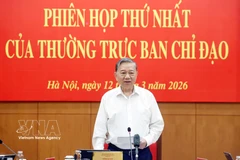
Party General Secretary To Lam speaks at the first meeting in 2026 of the Central Steering Committee for the Development of Science, Technology, Innovation and Digital Transformation on March 12. (Photo: VNA)

Party chief urges stronger, result-oriented implementation of Resolution 57

Turning science, technology, innovation and digital transformation into the main drivers of a new growth model requires substantial efforts. In the coming period, the focus must shift from merely carrying out tasks to delivering tangible and measurable outcomes, while concentrating resources on addressing strategic national challenges, said Party General Secretary To Lam.

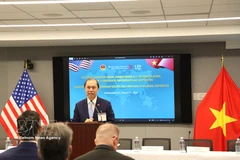
Vietnamese Ambassador to the US Nguyen Quoc Dung addresses the forum. (Photo: VNA)

High-level forum advances Vietnam–US technological cooperation

The ambassador highlighted that Vietnam and the US are highly complementary. Vietnam offers a dynamic economy, a young and increasingly skilled workforce and rapidly growing innovation ecosystem, while the US offers frontier technologies, world class research institutions, capital and leading global companies.

Participants at the first meeting of the National Steering Committee on Semiconductor Industry Development in 2026 (Photo: VNA)

Vietnam becomes vital player in global semiconductor value chain: Deputy PM

Vietnamese companies have also gradually joined the global value chain by improving their capabilities in chip design, production and related services. Notably, a semiconductor chip manufacturing plant project developed by the Viettel Military Industry and Telecoms Group (Viettel) has already commenced.

Young voters in Ho Chi Minh City scan an QR code to participate in an online quiz about the Election Law. (Photo: VNA)

Digital technology helps enhance transparency, trust in elections

The use of technology in this election is not merely a short-term measure but reflects Ho Chi Minh City’s broader commitment to comprehensive digital transformation and smart urban governance, reinforcing public trust in the democratic process and administration.

Information about candidates for the Khanh Hoa provincial People's Council for the 2026-2031 term is published on digital information channels, making it convenient for voters to explore. (Photo: VNA)

Technology breakthrough ensures voters' access, rights

Digital platforms such as the national population database and the VNeID application have been widely applied to streamline election management and improve accuracy in voter registration, helping citizens exercise their civic rights more conveniently.

Mang But commune area in Quang Ngai province. (Photo: VNA)

3.9-magnitude earthquake recorded in Mang But, Quang Ngai

According to the Vietnam Earthquake Information and Tsunami Warning Centre under the Institute of Earth Sciences, the tremor occurred at 11:35:06 (Hanoi time) with coordinates of 14.864 degrees North latitude and 108.210 degrees East longitude, at a depth of about 8.1 km. The event was assessed as having a level-0 disaster risk.

Illustrative photo: AFP

AI Law takes effect, anchors national governance framework

Taken together, the new AI Law and its implementation roadmap not only complete Vietnam’s legal architecture for AI, but also lay a structured foundation for risk management, innovation and ecosystem development, aiming to ensure coherent and effective enforcement in the years ahead.