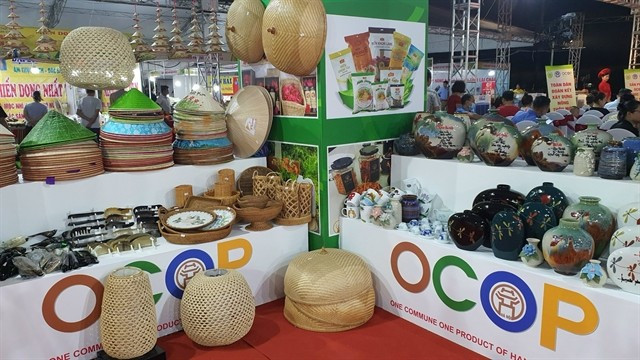
Hanoi (VNS/VNA) - The ongoing process of merging provinces and cities in Vietnam is creating new momentum for the development of the One Commune One Product (OCOP) Programme.
While the changes bring potential benefits, such as expanded markets and improved branding opportunities, many OCOP producers are concerned about the implications for their product identities, legal certifications and market recognition.
Policymakers and experts believe that with the right strategies, the OCOP Programme can evolve to reach a broader scale and achieve more sustainable growth.
Since its inception, the OCOP Programme has aimed to promote high-quality, value-added products originating from local raw materials and traditional knowledge.
According to the Ministry of Agriculture and Environment, Vietnam now has 16,855 certified OCOP products rated three stars or higher. Of these, 76.2% are three-star products, 22.7% are four-star and 126 products have achieved five-star national recognition.
The programme has attracted widespread participation from 9,822 OCOP entities nationwide. These include cooperatives (32.9%), small enterprises (25.3%) and production households and business establishments (33.5%), with the remainder being cooperative groups. Notably, 40% of the participants are women and 17.1% are from ethnic minority groups, demonstrating the programme’s inclusive reach and community-level impact.
Deputy Minister of Agriculture and Environment Tran Thanh Nam confirmed that OCOP products are not just a driver of rural economic restructuring, but also serve as powerful tools for preserving cultural identity and promoting indigenous knowledge.
Looking forward, the ministry aims to develop OCOP into a nationally recognised brand with strong intellectual property protection, improved market access and robust promotional support.
However, as Vietnam restructures its administrative map, concerns are emerging about how the disappearance or renaming of localities might affect OCOP product branding. For many producers, a product’s origin is deeply linked to its identity and consumer appeal.
Vu Van Dinh, an artisan from Thuong village in Hanoi, voiced concerns shared by many traditional craftsmen. His lacquerware and mother-of-pearl inlay products carry the reputation of a 1,000-year-old craft village.
“When a local name disappears, it’s not just a bureaucratic change. It threatens to erase the origin tied to our brand,” he said.
Similarly, Ha Thi Vinh, Director of the Quang Vinh Ceramics Joint Stock Company in Hanoi's Bát Tràng pottery village, stressed that OCOP products represent more than just economic value.
“Each product is a story of the land, the people and the tradition. These are cultural ambassadors. Changing the locality’s name may disrupt that story,” she explained.
To ease the transition, the Ministry of Agriculture and Environment has issued clear guidance. OCOP certifications remain legally valid even after administrative units are merged. Entities are not required to reapply for certification, but must simply update their administrative information in the official records.
For example, a four-star product originally from Ly Nhan or Binh Luc districts in former Ha Nam province (now incorporated into the new Ninh Binh province), can retain its current certification. Only the address needs to be amended, ensuring minimal disruption to operations.
Many OCOP products are associated with raw material zones and unique geographical features, which remain unchanged despite administrative restructuring. For instance, Shan Tuyet tea from Suoi Giang in former Yen Bai province or from Hoang Su Phi in former Ha Giang province is still recognised for its quality and geographical indication, regardless of changes in provincial boundaries.
Far from being just a bureaucratic adjustment, administrative mergers also create new possibilities for OCOP entities. The expansion of administrative areas can help producers access broader markets, develop regional value chains and tap into stronger trade promotion resources.
“In the past, many products were confined to local authorities and could only be certified at the commune or district level,” said Giang Ngoc Luan, deputy head of the Department of Cooperative Economy in Ho Chi Minh City.
“Now, with larger administrative units, products can grow into regional brands and benefit from provincial or even national-level support.”
Producers may also enjoy lower marketing costs, as provincial authorities are now better positioned to support unified branding and promotional efforts.
In addition, electronic traceability systems and QR code-based labelling allow businesses to update administrative data seamlessly, without having to destroy old packaging or disrupt their supply chains.
While the merging of provinces and cities presents real challenges, experts emphasise that proactive adaptation is the key to success. Entities are encouraged to maintain product quality, preserve traditional stories, and update legal documentation as required. During this transition, flexibility in packaging updates and traceability will ensure business continuity.
Moreover, the ministry and related agencies have committed to supporting OCOP producers with clear guidance, promotional platforms and assistance in upgrading from local trademarks to protected geographical indications or certification marks, tools that can significantly increase market reach and product value./.
VNA