Hanoi (VNA) – Situated some 20 kilometres from central Hanoi, Nghia Trai in Hung Yen province has long been regarded as Vietnam’s only dedicated “herbal village”, where the practice of traditional medicine remains deeply woven into daily life.
From the moment one arrives at the village entrance, a distinctive fragrance fills the air – the scent of leaves, roots and sun-dried blossoms mingling with the countryside breeze. It is not merely the aroma of plants, but of tradition itself: a living repository of folk remedies passed down through generations.
A millennium of heritage and legend
According to village elders, Nghia Trai’s medicinal tradition stretches back nearly a thousand years. Oral accounts trace its origins to around 1572, when three generals under King Ly Thanh Tong, after victorious campaigns against Champa forces, settled in the area. They cleared land, established a community, cultivated medicinal plants and practised healing.
In gratitude, villagers later built a temple in their honour, venerating them as guardian deities. From that point onwards, the cultivation and processing of medicinal herbs took root, not only as a livelihood, but as a moral calling embraced by generations.
Chrysanthemum flowers: the soul of the village
Nghia Trai is perhaps best known for its vast stretches of medicinal crops, among which chrysanthemum holds pride of place.
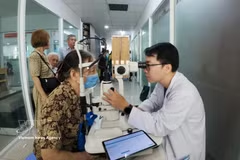
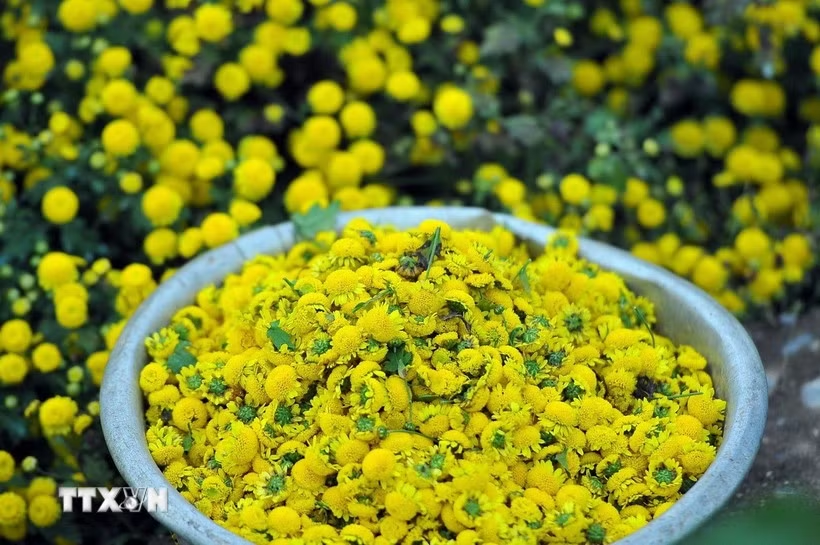
Known locally as “cuc tien vua” (tribute chrysanthemum), the flower is prized for its bright yellow hue and gentle fragrance. Slightly bitter with a subtle sweetness, it is widely used in traditional remedies to support eye health, regulate blood pressure, or simply brewed as a calming herbal tea.
In late winter, when the chrysanthemum fields burst into bloom, the village is transformed into a sea of gold. Beyond their visual charm, the flowers provide a stable source of income for local households.
Folk knowledge and a code of ethics
Today, of the roughly 560 households in Nghia Trai, around 80% are engaged in cultivating medicinal plants. Nearly every family is involved in some stage of the herbal trade, from growing and harvesting to processing and selling traditional remedies.
Each year, the village supplies an estimated 4,500 – 5,000 tonnes of Vietnamese medicinal herbs and 2,000 – 3,000 tonnes of Chinese herbal ingredients, encompassing hundreds of different species. Herbal medicine is not simply an occupation here; it is the lifeblood of the community.
Every available patch of land is utilised for cultivation. From fertile fields to roadside verges and garden plots, medicinal plants flourish throughout the village. Remarkably, many of these crops require little to no chemical pesticides, as they possess natural resistance to pests, ensuring both quality and purity.
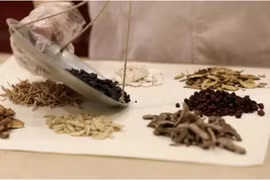
Following harvest, herbs are carefully washed, sliced, and dried under natural sunlight or in kilns. While the process may appear straightforward, it demands patience and precision to preserve their medicinal properties.
Beyond cultivation, Nghia Trai is also renowned for its practitioners of traditional medicine, who diagnose and prescribe remedies in accordance with age-old methods. Central to their practice is the principle of “nghia” (righteousness), reflected in the village’s name. Treating the sick is regarded not merely as a profession, but as a moral duty, especially in times of hardship.
The village is home to four principal family lineages – Do, Nguyen, Tran, and Le – each safeguarding its own proprietary remedies. Notably, even during periods of poverty and adversity, the people of Nghia Trai have never abandoned their craft.
Over time, the herbal trade has improved livelihoods and supported education, with many descendants going on to become doctors, teachers and professionals. While income from medicinal cultivation often exceeds that of rice farming, it is the sense of pride and cultural identity that remains most enduring.
Amid the pace of modern life, Nghia Trai continues to preserve the fragrance of its fields, the golden glow of its chrysanthemum blooms, and the spirit of community that defines it. More than a supplier of thousands of tonnes of herbs each year, the village stands as a custodian of invaluable folk knowledge.
Its enduring commitment to herbal medicine serves as a quiet yet powerful testament: when both skill and virtue guide a craft, it can stand the test of time./.