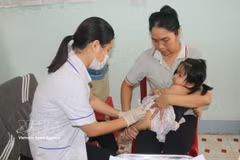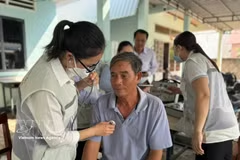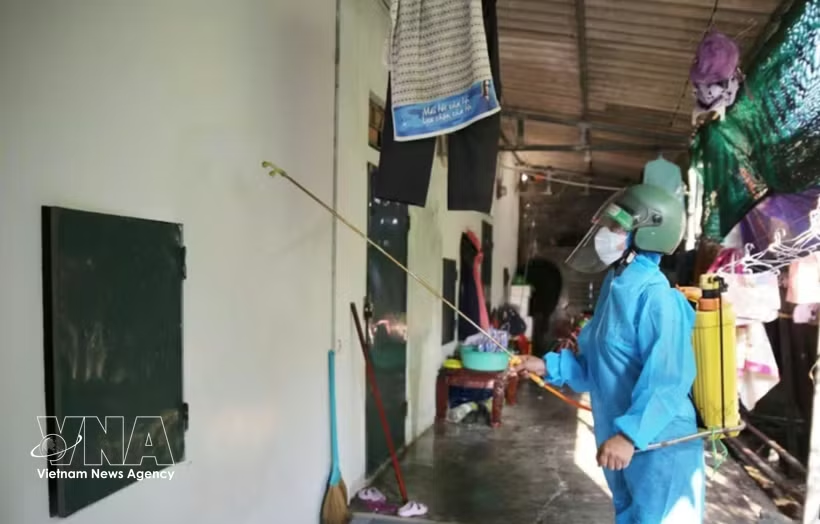
Gia Lai (VNA) – Vietnam is intensifying nationwide efforts to eliminate malaria by 2030, focusing on stronger surveillance, early detection and treatment, and mobilising resources from both domestic and international partners.
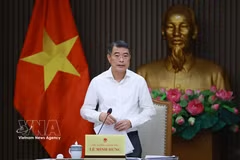
At a conference on resource mobilisation for malaria prevention and elimination in 2026, held in Gia Lai province on April 21, health authorities and representatives from 15 project-supported localities reviewed progress and outlined priorities for the next phase. According to Dr. Ngo Duc Thang from the National Institute of Malariology, Parasitology and Entomology (NIMPE), malaria remains a major global public health threat, with an estimated 282 million cases and 610,000 deaths worldwide in 2024, an increase of over 9 million cases from the previous year.
Vietnam, however, has recorded significant progress during the 2021–2025 period, with malaria cases dropping sharply. In 2025, the country reported 246 cases with no deaths, down more than 30% year-on-year. In the first months of 2026, only 25 cases were recorded, again with no fatalities. So far, 26 out of 34 provinces and cities have been officially recognised as malaria-free.
Despite these gains, the risk of resurgence persists, particularly in remote, border, and mountainous areas where socio-economic conditions remain difficult, and population mobility is high.
For the 2026–2030 period, the health sector aims to eliminate malaria nationwide while sustaining achieved results. Key measures include strengthening disease surveillance, ensuring early diagnosis and prompt treatment, tightly controlling transmission hotspots, reinforcing grassroots healthcare networks, and boosting public awareness alongside community engagement.
Local experiences presented at the conference highlighted practical approaches to achieving elimination.
According to Nguyen Dai Vinh, Director of the Da Nang Centre for Disease Control, said the central city has achieved significant results in malaria prevention, control, and elimination. By June 2025, the locality was officially certified malaria-free.
This achievement stems from proactive mobilisation of local budget resources, effective integration of malaria efforts into socio-economic development plans, and strengthened surveillance, early detection, and thorough case management, he noted.
Meanwhile, Lam Dong province - following the administrative merger with Dak Nong and Binh Thuan provinces - has also reported encouraging results. With a population exceeding 3.8 million, the province recorded just eight malaria cases in 2025, more than 20 times lower than in 2020. The infection rate has dropped to 0.002 cases per 1,000 people. Currently, 21 out of 28 areas have been declared malaria-free, with the remainder continuing targeted interventions.
From practical implementation, Lam Dong has drawn key lessons - aligning closely with the Ministry of Health’s guidance, improving reporting systems to inform investment decisions, and ensuring effective coordination with international donors to streamline procedures and maintain project timelines.
Vietnam plans to strengthen international cooperation and mobilise resources from organisations such as the World Health Organisation (WHO) and the Global Fund to Fight AIDS, Tuberculosis and Malaria, aiming to enhance the effectiveness of malaria prevention and control and move toward eliminating the disease by 2030./.
See more
Vietnam warns of HiPP baby food after Austria’s recall
The Austrian Agency for Health and Food Safety (AGES) has announced that HiPP – a German-Swiss baby food producer – and supermarket chain SPAR had recalled all 190g-jars of HiPP Vegetable Carrot with Potato from 1,500 stores in Austria due to suspected contamination with rat poison.
Hai Phong advances specialised health care for coastal, insular communities
Hai Phong authorities consistently recognise the role of central-level healthcare institutions, including VINIMAM, which plays a particularly important role in providing health care for fishermen and residents in coastal and insular areas.
Community-based child nutrition care model benefits Thanh Hoa’s locality
After more than one year of implementation with the support of World Vision, the model has delivered positive outcomes in improving nutrition and enhancing the quality of childcare. Household livelihoods have improved, mothers’ awareness and caregiving skills have been strengthened, and notably, the rate of child malnutrition in Coc has declined markedly.
Second campuses of Bach Mai, Viet Duc hospitals must open in Q2: PM
Regarding the second campuses of Bach Mai and Viet Duc hospitals, the PM pointed out that the remaining hurdles are largely coordination-related and fall within the purview of the Ministry of Health (MoH) and relevant ministries.
Ho Chi Minh City ready to provide mass health checkups for over 15 million residents
The initiative is designed to bring multi-specialty healthcare closer to communities, with an emphasis on vulnerable and high-risk groups, including the elderly, those with chronic conditions, and disadvantaged populations, enabling early detection and sustained health management.
Hue hospital performs successful bone marrow transplants for three children
With 2,000–2,500 severe thalassemia cases diagnosed each year in Vietnam, expanded access to stem cell transplantation is opening up new prospects for patients to lead healthier, more independent lives.
Cashless payment navigates Vietnam’s hospitals
From the cash-only days, plenty of hospitals have made a fast switch to modern payment options like QR code scans, bank cards, e-wallets, and payments straight through healthcare apps.
Vietnam eyes silver economy to fuel growth amid rapid aging
The silver economy offers a new perspective on population ageing: instead of treating it as a burden, it is seen as a major economic opportunity
British teen’s organ donation saves three Vietnamese lives
A 19-year-old British tourist who died during a trip to Vietnam has saved the lives of three Vietnamese patients with end-stage organ failure, in a deeply moving act of compassion. The young woman is the first foreign national to donate organs in Vietnam.
Bayer, Long Chau join force to advance stroke prevention and management at National Health Day 2026
Bayer Vietnam, in strategic partnership with FPT Long Chau Pharmacy Chain and Vaccination Centre, took part in the 2026 National Health Day event at Thong Nhat Park in Hanoi on April 5, joinning a wide range of stakeholders in advancing public health awareness and preventive care across the country.
Vietnam backs global One Health commitments at Lyon summit
The MAE welcomed the French Government’s organisation of the One Health Summit, describing it as an important forum to advance global political commitments and strengthen international cooperation in preventing zoonotic diseases.
Vietnam emerges as “One Health” frontrunner in disease control
A France-based expert has described Vietnam's “One Health Partnership” as a notable and distinctive platform with strong potential for replication elsewhere.
Maternal, child healthcare remains cornerstone of Vietnam’s sustainable development
Child healthcare is both a humanitarian priority and a long-term investment in population quality and human resources. Early interventions in maternal care, nutrition, immunisation, and neonatal services play a decisive role in shaping physical and intellectual development.
National Health Day: Community-based continuous healthcare model launched
The “Community-based continuous healthcare teams” model not only improves primary healthcare effectiveness but also marks a transition from passive to proactive healthcare delivery at the grassroots level.
Vietnamese scientists unlock genetic insights into rare diseases
Prof. Dr. Nguyen Huy Hoang, Deputy Director of the Institute of Biology under the Vietnam Academy of Science and Technology, and his research team conducted a project titled “Genetic mutation analysis in Vietnamese patients with selected rare diseases using whole-exome sequencing technology.” The project, implemented from 2022 to 2024, aims to clarify the genetic causes of these diseases within the Vietnamese population.
Ho Chi Minh City targets modern, inclusive healthcare system
On April 5 alone, 58 hospitals and health centres conducted screening programmes across 64 wards and communes, with a focus on outlying areas. Beyond early detection, residents receive consultations, long-term health monitoring guidance, and access to specialised services locally.
Healthy lifestyles, disease prevention highlighted on national health day
Vice Chairwoman of the National Assembly Nguyen Thi Thanh emphasised the need for consistent and effective implementation of the resolution across the political system, with priorities including refining healthcare policies and institutions, strengthening preventive and grassroots healthcare networks, expanding population health management, promoting early detection, and improving school-based physical education and nutrition.
Ho Chi Minh City rolls out free health screenings for residents
The initiative aims to bring healthcare services closer to residents and strengthen grassroots medical care, with a long-term goal of extending preventive health services to the city’s nearly 15 million people.
All People’s Health Day promotes early disease prevention
The launch marked the first year the activity has been implemented in a coordinated manner nationwide. Members of the public were able to visit free screening areas, receive nutritional advice, participate in mass exercise performances, enjoy artistic programmes, and join a walk in response following the ceremony.
Vietnam’s medical tourism services eye nearly 4 billion USD in revenue by 2033
Vietnam’s medical tourism market was valued at approximately 700 million USD in 2024 and is projected to expand to nearly 4 billion USD by 2033, representing an average annual growth rate of around 18%. The figures underscore the sector’s considerable potential.