Vietnam to join clinical trials of mRNA cancer vaccines

Vietnam is expected to collaborate with international partners, including Russia and France, in conducting clinical trials for new-generation vaccines, particularly those using mRNA technology for cancer treatment.

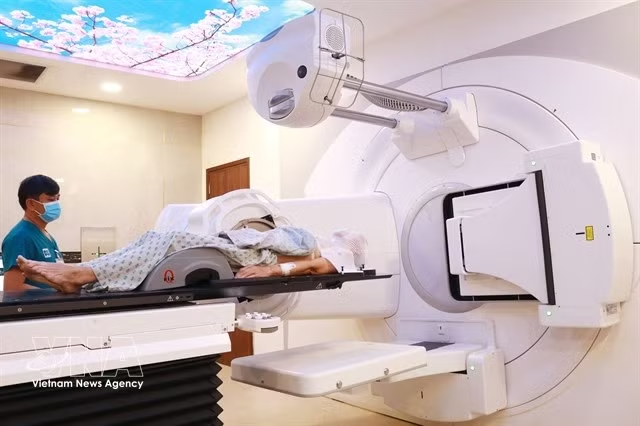
A modern equipment for cancer diagnosis and treatment in the Ho Chi Minh City Oncology Hospital. (Photo: VNA)

Hanoi (VNS/VNA) – Vietnam plans to join international clinical trials of mRNA-based cancer vaccines and other next-generation vaccines starting in 2026, in a move aimed at strengthening its capacity in advanced biomedical research and treatment.

The information was shared by Minister of Health Dao Hong Lan, as the health sector steps up implementation of the Politburo’s Resolution 57 on breakthroughs in science, technology, innovation and national digital transformation.

The sector has identified several strategic technologies that both meet public demand and align with long-term development goals.

Among the priority areas are vaccines and biological products, advanced therapies, and the application of artificial intelligence in health care. Vietnam is expected to collaborate with international partners, including Russia and France, in conducting clinical trials for new-generation vaccines, particularly those using mRNA technology for cancer treatment.

In parallel with research efforts, Vietnam is accelerating technology transfer to strengthen its domestic vaccine production capacity.

A cooperation agreement is expected between the Ministry of Health, the Tam Anh General Hospital, and the French pharmaceutical company Sanofi to transfer advanced technologies for producing three types of vaccines in Vietnam. These include a six-in-one combination vaccine, an influenza vaccine and a meningococcal vaccine, all based on modern French manufacturing technologies.

Beyond vaccines, the health sector is prioritising the development and application of advanced therapies. These include clinical research and efforts to master CAR-T cell therapy, stem cell therapy, being implemented through cooperation with Japan, as well as the use of 3D technology and personalised approaches in orthopaedic trauma treatment.

Artificial intelligence is also being increasingly integrated into medical practice, particularly in next-generation gene sequencing for cancer treatment and prenatal screening.

To support these ambitions, efforts are underway to strengthen high-quality human resources in the medical field. A proposal is being developed to invest in five key medical universities, including the Hanoi Medical University, Hanoi University of Pharmacy, University of Medicine and Pharmacy in Ho Chi Minh City, Can Tho University of Medicine and Pharmacy, and Vietnam University of Traditional Medicine.

The plan is expected to be submitted for government approval later in 2026, alongside the rollout of standardised professional competency frameworks across the healthcare sector./.

VNA

See more

A kidney transplant performed at the Hue Central Hospital. (Photo published by VNA)

Six lives extended through single organ donation

When one heart stops beating so that others may live on, it represents not only a medical transfer but also a continuation of compassion and humanity, said Professor Dr Pham Nhu Hiep, Director of the Hue Central Hospital.

Doctors at the University Medical Center Ho Chi Minh City perform colorectal cancer surgery on the Indonesian patient. (Photo: published by VNA)

Indonesian patient travels to Vietnam for colorectal cancer surgery

The successful colorectal cancer surgery for an Indonesian patient once again demonstrates the advances in the professional expertise of Vietnamese doctors and has further strengthened the country’s medical reputation and the trust of patients across the region and beyond.

Illustrative photo (Photo: VNA)

Vietnam intensifies efforts to end malaria by 2030

In 2025, the country reported 246 cases with no deaths, down more than 30% year-on-year. In the first months of 2026, only 25 cases were recorded, again with no fatalities. So far, 26 out of 34 provinces and cities have been officially recognised as malaria-free.

Illustrative image -(Source: Internet)

Vietnam warns of HiPP baby food after Austria’s recall

The Austrian Agency for Health and Food Safety (AGES) has announced that HiPP – a German-Swiss baby food producer – and supermarket chain SPAR had recalled all 190g-jars of HiPP Vegetable Carrot with Potato from 1,500 stores in Austria due to suspected contamination with rat poison.

The caregivers’ club in Coc village, Pu Luong commune, the north-central province of Thanh Hoa, has established a livelihood support fund, helping households develop their economies through models such as rice cultivation, vegetable growing, fish farming and poultry raising. (Photo: VNA)

Community-based child nutrition care model benefits Thanh Hoa’s locality

After more than one year of implementation with the support of World Vision, the model has delivered positive outcomes in improving nutrition and enhancing the quality of childcare. Household livelihoods have improved, mothers’ awareness and caregiving skills have been strengthened, and notably, the rate of child malnutrition in Coc has declined markedly.

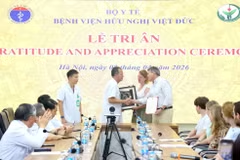
Assoc. Prof. Dr. Duong Duc Hung, Director of Viet Duc University Hospital, presents a token of appreciation in recognition of the noble gesture of the organ donor’s family. (Photo: baochinhphu.vn)

British teen’s organ donation saves three Vietnamese lives

A 19-year-old British tourist who died during a trip to Vietnam has saved the lives of three Vietnamese patients with end-stage organ failure, in a deeply moving act of compassion. The young woman is the first foreign national to donate organs in Vietnam.

A workshop at the One Health Summit, held in Lyon, France, from April 5 to 7, 2026. (Photo: VNA)

Vietnam backs global One Health commitments at Lyon summit

The MAE welcomed the French Government’s organisation of the One Health Summit, describing it as an important forum to advance global political commitments and strengthen international cooperation in preventing zoonotic diseases.

Ilustrative image (Photo: pngtree.com)

Vietnamese scientists unlock genetic insights into rare diseases

Prof. Dr. Nguyen Huy Hoang, Deputy Director of the Institute of Biology under the Vietnam Academy of Science and Technology, and his research team conducted a project titled “Genetic mutation analysis in Vietnamese patients with selected rare diseases using whole-exome sequencing technology.” The project, implemented from 2022 to 2024, aims to clarify the genetic causes of these diseases within the Vietnamese population.

Health workers and residents perform mass wellness exercises, promoting healthy lifestyles in the community. (Photo: VNA)

Ho Chi Minh City targets modern, inclusive healthcare system

On April 5 alone, 58 hospitals and health centres conducted screening programmes across 64 wards and communes, with a focus on outlying areas. Beyond early detection, residents receive consultations, long-term health monitoring guidance, and access to specialised services locally.