Northern localities brace for Typhoon Matmo

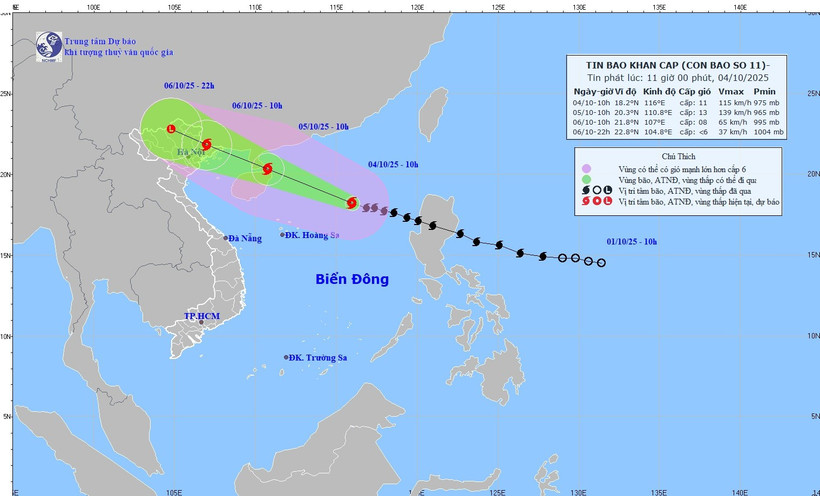
According to the National Centre for Hydro-Meteorological Forecasting, as of 2 pm on October 4, the storm’s eye was located at 18.4 degrees North latitude and 115.1 degrees East longitude, about 330 km east-northeast of Hoang Sa special zone. Winds near the centre reached level 12 (118–133 km/h), with gusts up to level 15.

The forecast path of Typhoon Matmo in the next few days. (Photo: The National Centre for Hydro-Meteorological Forecasting)

Hanoi (VNA) – Provinces in the northern region are ramping up emergency measures as Typhoon Matmo, the 11th storm to hit the East Sea this year, continues to strengthen on its way towards the mainland.

Typhoon Matmo, has moved closer to Vietnam’s northern coast, prompting the Government to issue urgent directives to ensure safety for people and property.

According to the National Centre for Hydro-Meteorological Forecasting, as of 2 pm on October 4, the storm’s eye was located at 18.4 degrees North latitude and 115.1 degrees East longitude, about 330 km east-northeast of Hoang Sa special zone. Winds near the centre reached level 12 (118–133 km/h), with gusts up to level 15. The storm was moving west-northwest at around 25 km/h and was expected to gain further strength.

By 1 pm on October 5, the typhoon is forecast to reach the eastern waters of China’s Leizhou Peninsula with sustained winds of level 12–13 and gusts up to level 16, before weakening gradually as it approaches northern Vietnam. It is projected to affect Quang Ninh, Hai Phong and nearby provinces between late October 5 and October 6, bringing heavy rains, strong winds, and dangerous sea conditions.

Forecasters warned that the northern East Sea would experience waves 6–8 metres high and extremely rough seas. From October 5, winds in the northern Gulf of Tonkin are expected to strengthen to level 8–9, with areas near the storm’s eye reaching level 10–11 and gusting to 14. Coastal areas from Quang Ninh to Hai Phong may face water surges of 0.4–0.6 metres, raising the risk of flooding in low-lying zones.

On land, coastal provinces from Quang Ninh to Hung Yen will experience winds of level 6–9, with gusts up to level 11. Inland areas of the northeast may also record strong winds capable of causing tree damage, roof losses and property destruction. From October 5–7, mountainous and midland provinces in the north are forecast to see heavy rainfall of 150–250 mm, with some locations exceeding 400 mm, raising the risk of flash floods and landslides.

The Red River Delta, Thanh Hoa and Nghe An are expected to receive 70–150 mm of rain, locally higher. Hanoi is likely to see moderate to heavy rainfall of 70–120 mm during October 6–7.

In response, Deputy Prime Minister Tran Hong Ha signed an urgent dispatch on behalf of the Prime Minister on October 4, directing ministries, agencies and localities to prepare for Typhoon Matmo. The document emphasised the storm’s severity, especially as it comes immediately after two earlier storms, creating a “compound disaster” scenario of storm-on-storm and floods-on-floods.

The PM urged authorities to recognise the high risks of flash floods, landslides, and severe flooding in northern and north-central provinces, and to implement decisive and timely measures to safeguard lives and minimise losses.

Coastal provinces from Quang Ninh to Ninh Binh were instructed to ensure the safety of vessels, aquaculture farms, and coastal tourism activities, while preparing for possible evacuations. Local leaders in mountainous provinces such as Lao Cai were ordered to promptly relocate households in areas at risk of landslides, with evacuation already underway in Bao Ha commune.

The Government also tasked the Ministry of Agriculture and Environment with monitoring rainfall and river flows, including transboundary water sources, and updating forecasts based on international data to provide the most accurate warnings possible.

The Ministry of Foreign Affairs was directed to coordinate with China to share flood discharge information from upstream reservoirs to avoid unexpected incidents downstream.

Authorities stressed the importance of applying the “four on-the-spot” approach with on-the-spot command, manpower, means, and logistics while pre-positioning forces and materials in vulnerable locations. The PM also requested localities to update and refine disaster response scenarios for different levels of risk, ensuring readiness for multiple types of disasters occurring simultaneously./.
VNA

See more

Air pollution in Hanoi. (Photo: VNA)

Hanoi to launch 5,000 public electric bicycles

In a move to reduce air pollution and promote green mobility, Hanoi has approved a plan to deploy 5,000 public electric bicycles, alongside restrictions on petrol- and diesel-powered vehicles in the city’s central area.

Official heritage plaque i sinstalled on the 12 recognised Shan Tuyet tea trees in Dong Phuc commune. (Photo: VNA)

Thai Nguyen: 12 ancient Shan Tuyet tea trees win national heritage status

The recognition honours the biological, cultural and historical values of these centuries-old Shan Tuyet tea trees – natural treasures deeply woven into the livelihoods, traditions and identity of local ethnic communities. The title affirms the community’s commitment to preserving and promoting the value of this iconic local tea variety.

Sarus cranes at Tram Chim National Park (Photo: VNA)

Return of sarus cranes: Hope takes wing in Dong Thap wetland

Beneath the wide Mekong Delta sky, Tram Chim National Park is racing against time, pouring heart and science into a decade-long (2022–2032) plan to rescue the Eastern sarus crane – an elegant, scarlet-headed bird listed as endangered on the International Union for the Conservation of Nature (IUCN) Red List and a living emblem of both the park and all of Dong Thap province

French Ambassador Olivier Brochet speaks at the press conference in Hanoi on December 11 to mark the 10th anniversary of the Paris Agreement on climate change and highlighting the COP30 outcomes. (Photo: VNA)

International community ready to support Vietnam in energy transition, climate response

In a video message to the press conference, UN Resident Coordinator in Vietnam Pauline Tamesis said the UN is ready to support Vietnam in building a pipeline of projects capable of absorbing financing mobilised under the Political Declaration on establishing the Just Energy Transition Partnership (JETP), as well as from global climate finance sources, including the Green Climate Fund and the Loss and Damage Fund.

Forest rangers in Son La province apply technological devices and software to forest management, monitoring, and protection. (Photo: nhandan.vn)

Digital technology application enhances forest management, protection

With a total forest area of over 14 million hectares, including more than 10 million hectares of natural forests, forests exist in all 34 provinces and cities across the country. Given the large area and limited workforce, applying digital solutions in forest management and protection has become a top priority for the forestry sector.

Sunda pangolins (Manis javanica), also known as the Javan pangolin, are listed in Group IB – critically endangered and strictly protected from all commercial exploitation (Photo: VNA)

Quang Ngai releases rare pangolin back into nature

Initial verification showed that the animal weighed 3.7kg and measured over 60cm. It was identified as a Sunda pangolin (Manis javanica), also known as the Javan pangolin, listed in Group IB – critically endangered and strictly protected from all commercial exploitation.

Residents of Tuyen Quang province take part in the One Billion Trees Programme. (Photo: VNA)

Tree-planting programme exceeds one-billion-tree goal

The total comprises 573.9 million scattered trees and 865.2 million trees grown in concentrated plantations, equivalent to 429,125 hectares of forest. Provinces posting the strongest results include Phu Tho with 177.9 million trees, Lao Cai with 108.8 million, and An Giang with 98.5 million.

Construction activity is one of the causes of air pollution in Hanoi. (Photo: VNA)

Hanoi takes urgent measures to curb air pollution

The city requires the enhanced application of advanced technologies and remote monitoring systems, including satellite remote sensing, drones, and AI-integrated traffic cameras, to monitor, detect, and strictly address the illegal burning of garbage, straw, and agricultural by-products.