Thailand improves competitiveness ranking but faces pressure for reform

Thailand's business efficiency improved from 24th to 21st place, supported by gains in the labour market, finance, productivity and corporate governance. However, the TMA warned that labour productivity remains one of the biggest risks to the country's long-term competitiveness.

Bangkok (VNA) – Thailand has climbed four places to 26th out of 70 economies assessed in the International Institute for Management Development (IMD) World Competitiveness Ranking 2026. However, experts believe the country still faces many structural challenges, while Vietnam's debut at 27th place is adding further pressure on Thailand to accelerate reforms.

​The new ranking reflects improvements in business efficiency and infrastructure, according to the Thai Management Association (TMA). Specifically, business efficiency rose by three places and infrastructure by two places, contributing to Thailand's overall improvement. Meanwhile, government efficiency remained unchanged, while economic performance fell by two places compared to the previous year.

​The IMD ranking is based on four groups of criteria: economic performance, government efficiency, business efficiency and infrastructure, with a total of 264 indicators.

​Thailand’s economic performance fell from eighth to 10th place, weighed down by weaker rankings in international trade and employment.

​The country’s ranking for international trade dropped five places to ninth, while employment slipped from third to fourth. However, international investment rose six places to 24th, while the price index improved to 12th.

​In terms of government efficiency, Thailand maintained its 32nd position. Several indicators, including tax policy, public finance, the institutional framework and the social framework, improved. However, the TMA noted that public sector governance remains a weakness, with Thailand ranking only 57th in the rule of law, 52nd in corruption control and 51st in government transparency.

​Thailand's business efficiency improved from 24th to 21st place, supported by gains in the labour market, finance, productivity and corporate governance. However, the TMA warned that labour productivity remains one of the biggest risks to the country's long-term competitiveness.

​Within ASEAN, Thailand ranks third behind Singapore and Malaysia. Singapore continues to lead the global competitiveness rankings, while Malaysia ranks 15th. Vietnam, included in the ranking for the first time, placed 27th globally, just one position behind Thailand. Notably, Vietnam ranked two places higher than Thailand in government efficiency and six places higher in business efficiency. The Philippines and Indonesia ranked 47th and 48th, respectively./.


VNA

See more

Thailand forecasts sharp decline in longan, lychee output due to El Niño

Thailand forecasts sharp decline in longan, lychee output due to El Niño

Thailand’s longan production is forecast at around 1.4 million tonnes in 2026, down nearly 9% from the previous year. The harvested area is expected to reach about 1.61 million rai (over 257,000 hectares), a decline of 1.27%, while average yields are projected to fall by 7.57% to 867 kg per rai.

Malaysia climbs eight places in 2026 World Competitiveness Ranking

Malaysia climbs eight places in 2026 World Competitiveness Ranking

The IMD said improvements across all four competitiveness pillars contributed to Malaysia's stronger standing. The country ranked fourth globally in economic performance, while government efficiency rose 11 places to 14th, business efficiency advanced 16 places to 16th, and infrastructure improved two places to 33rd.

A view of Kuala Lumpur, Malaysia. (Photo: AFP/VNA)

Malaysia’s trade breaks growth record in May

The Malaysian Ministry of Investment, Trade and Industry (MITI) said exports rose 45.3% to an all-time high of 184 billion MYR, surpassing the previous record set in April and registering the fastest export growth since August 2022.

(Photo: Thai Enquirer)

Thailand's government pushes gaming industry as new economic engine

Thailand's Government Spokesperson Rachada Dhanadirek stated that the Prime Minister views the gaming industry as a high-value sector driven by creativity and digital skills. The industry can generate jobs, income, and career opportunities for Thai workers, especially younger generations.

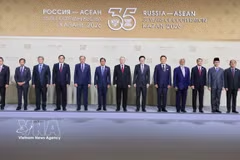
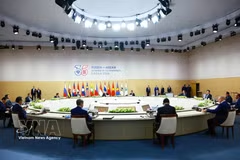
Leaders attend the opening ceremony of the ASEAN-Russia Business Forum, held in Kazan on June 17, 2026, on the sidelines of the ASEAN-Russia Commemorative Summit. (Photo: VNA)

ASEAN, Russia promote broad-based economic cooperation

In a message delivered to the ASEAN-Russia Business Forum, held in the city of Kazan on the sidelines of the ASEAN-Russia Commemorative Summit, Putin said the sides have accumulated substantial experience in multifaceted cooperation, built strong partnerships, and laid a solid foundation for further expanding cooperation.

Indonesia eyes becoming regional gold finance hub

Indonesia eyes becoming regional gold finance hub

In the long term, Indonesia aims not only to export raw gold but also to establish itself as a regional gold finance hub, generating greater value-added for its economy and enhancing its role in the global financial system.