Indonesia faces mounting maritime logistics challenges

For months, domestic shipping routes, particularly those outside Java, have suffered from container shortages, while soaring freight rates have disrupted supply chains and affected businesses and consumers alike.

Jakarta (VNA) – Indonesia's maritime logistics system is facing mounting pressure as container shortages, rising freight costs, and severe sedimentation at major ports threaten the competitiveness of Southeast Asia's largest economy.

For months, domestic shipping routes, particularly those outside Java, have suffered from container shortages, while soaring freight rates have disrupted supply chains and affected businesses and consumers alike.

One of the key causes is worsening sedimentation at seaports, which has reduced channel depth and limited the ability of ports to accommodate large container vessels.

Under Indonesian regulations, dredging activities fall under the authority of the Ministry of Transportation and are financed through non-tax state revenue managed by local harbour master and port authority offices (KSOPs). Port operators are not allowed to carry out dredging independently.

Delays in dredging have rendered many port channels unsafe for commercial ships. To avoid running aground, shipping companies have reduced cargo loads to around 70% of vessel capacity.

The decline in operational efficiency has driven up shipping costs, extended delivery times, and weakened supply chain performance, ultimately increasing prices for consumers.

The sector is also being affected by global geopolitical tensions, particularly in the Middle East, which have pushed up fuel prices. Meanwhile, government limits on adjustments to basic freight rates have left many shipping companies facing financial losses.

To offset rising costs, some firms have imposed emergency fuel surcharges exceeding contractual agreements with shippers, leading to disputes and shipping delays.

At the same time, shipping companies are increasingly restricting the return of empty containers to major transshipment ports such as Tanjung Priok in Jakarta, Tanjung Perak in Surabaya, and Belawan in Medan due to high costs, worsening container shortages on domestic routes./.


VNA

See more

Malaysia promotes digital banking transparency

Malaysia promotes digital banking transparency

Under the revised regulations, operators of digital platforms are required to disclose key information throughout the entire product lifecycle, while ensuring that advertising and promotional materials are clear, accurate and not misleading to customers.

Malaysians increasingly embrace national EV brand

Malaysians increasingly embrace national EV brand

According to a Proton statement issued on May 22, strong demand for the company’s electric and hybrid vehicle models resulted in the delivery of 11,617 Proton e.MAS vehicles nationwide during the first four months of the year, driving sales up by 329.5%.

Key advantages underpin growth of Malaysia’s semiconductor industry

Key advantages underpin growth of Malaysia’s semiconductor industry

Malaysia’s semiconductor industry is benefiting from accelerating China+1 supply chain diversification, deeper localisation by global semiconductor equipment makers and rising demand for optical and power semiconductors tied to artificial intelligence (AI)-driven data centre expansion.

Thailand strengthens cooperation with IEA to enhance energy security

Thailand strengthens cooperation with IEA to enhance energy security

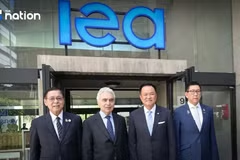
Government spokeswoman Rachada Dhnadirek said after the meeting that IEA Executive Director Fatih Birol praised Thailand’s energy policy direction, describing it as being on the right track and in line with the global energy situation, which is facing growing challenges.

Malaysia tightens social media regulations

Malaysia tightens social media regulations

In the first four months of this year alone, Malaysia recorded more than 23,300 online fraud cases, with total losses reaching 680.3 million MYR (approximately 170 million USD).

Following the approvals, the two companies are now conducting internal procedures to complete the deal. (Photo:Reuters)

Malaysia, Indonesia approve asset transfer to new oil and gas joint venture

The Indonesian and Malaysian governments have approved the transfer of production-sharing contracts for these assets from Petronas and Eni to SEARAH. Following the approvals, the companies are completing internal procedures to finalise the transaction. The new venture is expected to commence operations on July 1.

Malaysia’s trade expanded 28.6% year-on-year in April 2026, the fastest growth since September 2022, driven by strong export demand across key markets and products. (Photo: NSTP)

Malaysia’s trade surges amid AI boom

Malaysia has cemented its position in the global AI value chain, with exports of AI-enabling products surging 42.9% to 319 billion MYR, now commanding over half (52.4%) of the nation's total exports.

The aftermath of one of two traffic accidents that left at least 13 factory workers dead (Photo: phnompenhpost)

Cambodia road accidents leave dozens dead, injured

At least 13 people were killed and dozens injured in two serious road accidents that occurred on May 23 in Cambodia’s Kampong Chhnang and Svay Rieng provinces, according to the country’s Ministry of Labour and Vocational Training.

Malaysia targets energy supply security until December

Malaysia targets energy supply security until December

Fadillah, who is also Minister of Energy Transition and Water Transformation, said on May 22 that the country’s energy supply is currently expected to be sufficient until July, and efforts are being intensified to extend this, including sourcing additional supplies from abroad.

Head of the National Food Agency (Bapanas) and concurrently Minister of Agriculture Andi Amran Sulaiman. (Photo: ANTARA)

Indonesia cracks down on rice speculation and price manipulation

Head of Indonesia’s National Food Agency (Bapanas) and Agriculture Minister Andi Amran Sulaiman said that tighter monitoring remains necessary despite the country’s currently secure rice supply. As of mid-May, rice reserves managed by Indonesia’s State Logistics Agency (Bulog) had reached around 5.3 million tonnes.

The expected return of El Niño later this year and soaring fertiliser prices due to the Middle East conflict are raising concerns over declining rice production in the Philippines. (Photo: AP)

El Niño, Middle East conflict threaten Philippine rice output

The Philippine agriculture sector estimates El Niño could cut the country’s rice output by up to 4 million tonnes this year. The Department of Agriculture has lowered its production forecast for 2026 from 20.28 million tonnes to 19.87 million tonnes.

Charging infrastructure gaps slow EV shift in Philippines

Charging infrastructure gaps slow EV shift in Philippines

Data from the Philippine Department of Energy shows that as of end-April, the country had around 1,600 accredited charging stations, including 781 alternating current chargers, 291 direct current chargers, and 528 battery-swapping stations.