Hanoi (VNA) – Despite rising fuel prices driven by global conflicts boosting interest in electric vehicles (EVs) in the Philippines, limited charging infrastructure could hinder the transition, according to a study by global advisory firm Deloitte.
In its 2026 Southeast Asia Automotive Consumer Study, Deloitte found that the lack of public charging infrastructure remained the top concern among Filipinos considering battery EVs, cited by 48% of respondents.
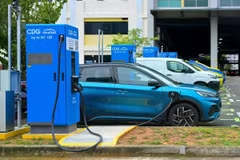
Data from the Philippine Department of Energy shows that as of end-April, the country had around 1,600 accredited charging stations, including 781 alternating current chargers, 291 direct current chargers, and 528 battery-swapping stations.
Such gaps in infrastructure also feed into Filipinos’ next biggest concern. Around 40 % of respondents identified driving range as a key concern, while 41% cited charging time, and another 41% pointed to the eventual cost of battery replacement.
Carlo Navarro, consumer industry leader at Deloitte Philippines, said these concerns highlight that electrification is not just about vehicles, it is about building a resilient ecosystem that thoroughly supports customers throughout their vehicles’ lifecycle.
Deloitte said that 20% of Filipinos prefer hybrid electric vehicles for their next purchase, while 11% are eyeing plug-in hybrids and 3% are considering fully battery-powered EVs.
However, petrol and diesel vehicles, still dominate at 62%. This was the second-highest preference rate in Southeast Asia, next only to Malaysia’s 65%, indicating that Filipino consumers still largely favour conventional internal combustion vehicles. /.
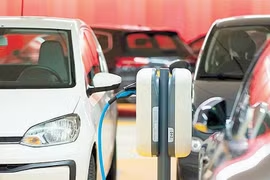
Philippines moves closer to launching EV incentive programme
Secretary of Finance Frederick Go said on May 13 the EV Incentive Strategy (EVIS) may be released soon. The EVIS has already been presented to President Marcos, but the Board of Investments (BOI) is still working with other agencies in the Fiscal Incentives Review Board (FIRB) on the details of the programme.