Bangkok (VNA) – Thailand's Joint Standing Committee on Commerce, Industry and Banking (JSCCIB) has urged the government to act swiftly to tackle worker shortages in its labour-intensive industries.
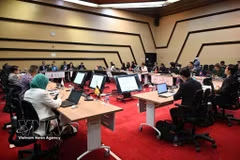
At a meeting on May 19, the JSCCIB stated that easing legal barriers and renewing work permits for migrant workers from neighbouring countries are crucial to maintaining competitiveness, economic growth and exports.
Chairing the meeting, newly appointed Chairwoman of the Federation of Thai Industries (FTI) Pimjai Leeissaranukul said the federation has requested the government to simplify recruitment and work permit renewal procedures to prevent disruptions in the manufacturing and export sectors.
She emphasised the need for a strategic framework for migrant labour recruitment to stabilise essential industries, ensure appropriate regulations, and support both economic development and social order.
The JSCCIB plans to meet with government officials soon to outline short-, medium- and long-term measures to address the labour issue.
Despite these challenges, as well as consequences of the prolonged conflict in the Middle East driving up oil prices, shipping costs and global instability, the committee maintains its GDP growth forecast for 2026 at 1.2–1.6%. Inflation is projected at 2–3% while exports are expected to decline by 0.5–1.5%.
Thailand's economy remained resilient in the first quarter, with GDP expanding by 2.8% year-on-year, up from 2.5% in the previous quarter, according to the committee. Total investment grew by 9.9%, the strongest growth in 44 quarters while government spending also accelerated.
Exports between January and March remained robust, fuelled by strong demand for digital and artificial intelligence products. Technology shipments surged by more than 45%, marking the sector's 12th consecutive quarter of growth. However, Pimjai cautioned that export growth remains concentrated in the technology sector and has not evenly benefited the wider manufacturing base./.