Indonesia hopes to expand access to North American market through ICA-CEPA

bilateral trade between Indonesia and Canada in 2025 reached 4.36 billion USD, a sharp increase from 3.57 billion in 2024. Meanwhile, Indonesia's exports to Canada rose from 1.44 billion USD to 1.69 billion USD in the same year.

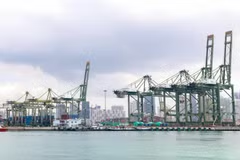
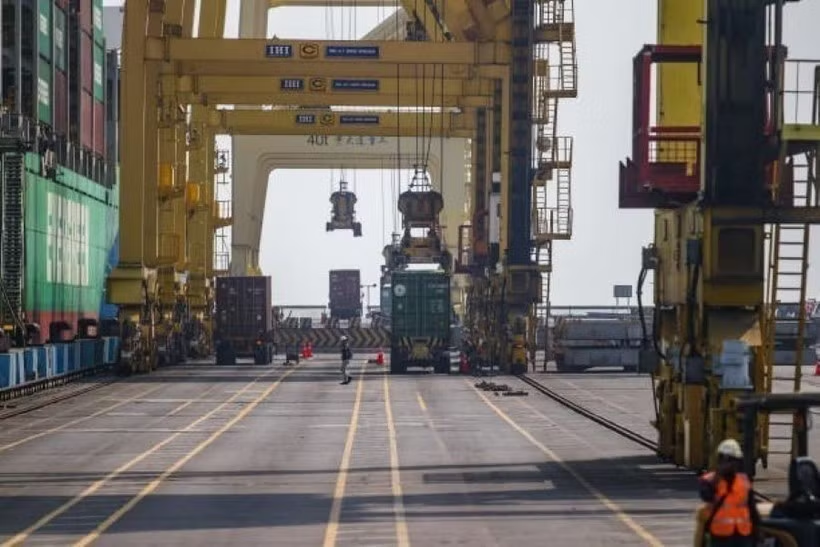
A cargo port in Semarang, Central Java province, Indonesia (Illustrative photo: Getty Images/VNA)

Jakarta (VNA) – Indonesia expects the Indonesia-Canada Comprehensive Economic Partnership Agreement (ICA-CEPA) to serve as a strategic springboard for expanding its presence in the North American market, amid ongoing geopolitical volatility and rising protectionist trends in global trade.

Indonesian Trade Minister Budi Santoso stated on May 19 that ICA-CEPA is expected not only to reduce trade barriers and improve access to the Canadian market, but also to create new opportunities for Indonesian goods to penetrate deeper into North America, a region with a combined population of around 500 million.

According to the official, Canada is a strategic entry point for Indonesian products into the North American market, particularly as US tariff policies remain unpredictable. The agreement is also viewed as a tool for Indonesia to diversify its export markets and reduce reliance on traditional trading partners.

He said that Indonesia's trade relations with Canada are complementary, thus not causing direct competition with domestic industries.

Canada has a high purchasing power with a Gross Domestic Product (GDP) of 2.28 trillion USD and a GDP per capita of around 65,000 USD per year. Additionally, Canada's consumer preferences for natural, healthy, halal, and environmentally friendly products align with Indonesia's flagship products.

Indonesia’s data showed that the bilateral trade between the two nations in 2025 reached 4.36 billion USD, a sharp increase from 3.57 billion in 2024. Meanwhile, Indonesia's exports to Canada rose from 1.44 billion USD to 1.69 billion USD in the same year.

In the service sector, the total trade of services between the two countries in 2024 reached over 506 million USD, with a surplus of about 103 million USD for Indonesia.

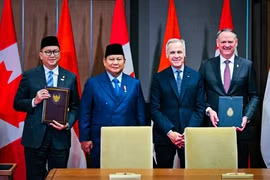
Under the agreement signed at Ottawa in September last year, Canada commits to eliminating tariffs on approximately 90.55% of tariff lines covering 6,573 Indonesian products, while Indonesia will remove tariffs on about 85.54% of tariff lines applied to 9,764 Canadian products.

Beyond goods trade, ICA-CEPA also expands opportunities in services and the digital economy. The two sides have agreed to facilitate the movement of professionals such as engineers, architects, IT specialists, and healthcare workers. The agreement also includes provisions on electronic document recognition, personal data protection, and cross-border data flows, aiming to further promote the growth of digital trade in the future./.
VNA

See more

Philippines, US boost economic cooperation, develop Luzon economic corridor

Philippines, US boost economic cooperation, develop Luzon economic corridor

Philippine President Ferdinand R. Marcos Jr. met with US Undersecretary of State for Economic Growth, Energy, and the Environment Jacob Helberg in Malacañang Palace on May 19 to discuss expanding bilateral economic cooperation. The meeting reaffirmed both countries’ commitment to strengthening economic and trade ties amid growing cooperation in strategic industries and emerging technologies.

Malaysian Foreign Minister Mohamad Hasan (Photo: Bernama)

Malaysia, Myanmar move towards diplomatic reset

Malaysia and Myanmar are moving to restore diplomatic relations following the inauguration of Myanmar President Min Aung Hlaing on April 10, Malaysia’s national news agency Bernama reported on May 20.

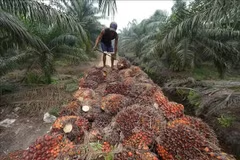
Workers harvest palm oil fruit in Pelalawan, Riau province, Indonesia. (Photo: AFP/VNA)

Indonesia tightens controls on coal, palm oil exports

Indonesian President Prabowo Subianto on May 20 announced new controls on the export of several strategic resources, including crude palm oil, coal, and iron-containing alloys, in a bid to boost state revenues and curb foreign exchange losses amid economic pressures stemming from conflict in the Middle East and global financial volatility.

OpenAI opens first applied AI lab in Singapore

OpenAI opens first applied AI lab in Singapore

At the heart of the partnership is the OpenAI Singapore Applied AI Lab, a first outside the US. The lab will support work aligned with Singapore’s AI missions and national priorities, particularly in the areas of public services, finance, healthcare and digital infrastructure.

Screenshot of the article titled “President Ho Chi Minh – A National Hero of Vietnam” on Cambodian Express News (Photo: VNA)

Cambodian newspaper praises President Ho Chi Minh as National Hero of Vietnam

The article provided an in-depth introduction to the life, career and revolutionary journey of National Hero, President Ho Chi Minh. It also highlights the achievements and legacy he left to the Vietnamese nation and people, as well as his contributions to fostering friendship, cooperation and prosperity among peoples in the region and around the world.

President Ho Chi Minh visits and inspects a southern military unit regrouped in the North during a training exercise before returning to the southern battlefield in June 1957. (Photo: VNA)

Italian Communist Party honours Ho Chi Minh’s lasting legacy

The Italian Communist Party on May 19 published an article paying tribute to President Ho Chi Minh on the occasion of his birth anniversary, describing him as a pivotal leader of Vietnam’s liberation struggle and a global symbol of anti-colonial resistance and anti-imperialist movements.

Malaysia's Economy Minister Akmal Nasrullah Mohd Nasir. (Photo: Bernama)

Malaysia rolls out four strategies to tackle supply chain crisis

Malaysia’s gross domestic product (GDP) growth of 5.4% in the first quarter of 2026, coupled with the unemployment rate remaining at full-employment levels, provides a strong foundation for the government to implement more structured, proactive and responsive measures to address current economic challenges.

Singapore: Illegal e-cigarette market persists despite ban

Singapore: Illegal e-cigarette market persists despite ban

In a report published on May 18, the EU-ASEAN Business Council (EU-ABC) and market research firm Euromonitor International said illicit tobacco sales in Singapore, comprising mainly illicit cigarettes and e-vaporisers, resulted in an estimated 156 million SGD in lost government revenue over the same period.

Thailand tightens durian quality control

Thailand tightens durian quality control

Durian is not only a key agricultural export but also an important economic asset, contributing to incomes for farmers, exporters and the logistics sector, while promoting Thailand’s culinary image in the global market, according to Thai Minister of Agriculture and Cooperatives Suriyas Junrungreangkit.

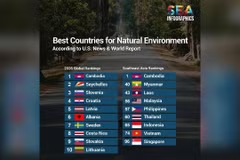
Cambodia has been ranked the world’s leading country for natural environment in 2026 by US News & World Report. (Photo: phnompenhpost.com)

Cambodia ranked world’s top country for natural environment in 2026

Cambodia currently manages 73 protected natural areas covering more than seven million hectares, equivalent to about 41% of the country’s total land area. These protected areas play a vital role in forest conservation, wildlife habitat protection and biodiversity preservation through stricter law enforcement and conservation measures.

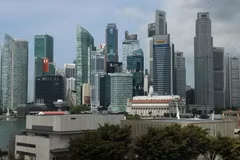
AI-related demand pushes Singapore exports in April

AI-related demand pushes Singapore exports in April

Singapore's exports to the US surged 59.6%, reversing a fall of 2.8% in March. Shipments to China climbed 37.8% from 20.3% the previous month and those to the European Union rose 33.4% after shrinking 12.2% in March.

Pressure on the rupiah has mounted as global oil prices surge amid Middle East tensions and developments involving Iran, increasing Indonesia’s energy import costs. (Photo: AFP/VNA)

Indonesia’s rupiah hits record low amid market turmoil

The Indonesian rupiad at one point on May 18 dropped more than 1% to around 17,668 IDR per USD, its weakest level on record. Indonesia’s benchmark stock index also plunged more than 4% after a long holiday, reflecting growing investor concerns.