Thailand enforces seasonal fishing ban to protect spawning stocks

Under Thailand’s 2015 Fisheries Act, violators may face fines ranging from 5,000 to 50,000 THB (approximately 150–1,500 USD), or penalties of up to five times the value of illegally caught fishery products.

Bangkok (VNA) – The Department of Fisheries under Thailand’s Ministry of Agriculture and Cooperatives has introduced nationwide fishing restrictions under the “Red Water Season 2026” programme to protect freshwater species during their breeding and larval development periods.

The measures took effect on May 16 and will be implemented nationwide in three phases.

Thitiporn Laoprasert, Director-General of the Fisheries Department, stated that the department has continuously implemented management measures during the spawning season of freshwater aquatic animals, known as the “Red Water Season,” since 1964 to protect and conserve these species, allowing them to reproduce.

Most recently, in 2025, the department issued a new announcement granting provincial fisheries committees authority to designate areas, tools, fishing methods, and conditions tailored to local circumstances, effective for five years (May 16, 2025 to November 30, 2029).

An assessment of the 2025 measures collected samples of mature female fish with fully developed reproductive organs, covering 155 species from 60 water sources across 40 provinces and 18 river basins nationwide. The study evaluated key spawning periods, their relation to rainfall, and the effectiveness of the measures. It found freshwater fish spawn predominantly from late May to late August, peaking in late July when 124 species were entering spawning phases.

The department noted that freshwater spawning activity typically lasts from late April through September, extending beyond the start of the rainy season. Meteorological forecasts also indicate that weather conditions in 2026 may gradually shift towards El Niño from mid-year, potentially affecting rainfall and river flows.

Based on these assessments, Thailand will continue enforcing fishery protection measures during the early and mid-rainy season, with implementation divided into three phases tailored to regional ecological conditions.

Phase one runs annually from May 16 to August 15 in 33 provinces and at the Lam Pao reservoir in Kalasin province. Phase two, from June 1 to August 31, covers 39 provinces, including Bangkok and provinces in the Central, Northeastern and Eastern regions. Phase three will be enforced from September 1 to November 30 in five southern provinces: Phatthalung, Songkhla, Pattani, Narathiwat and Yala.

During the restriction periods, fishing is prohibited in rivers, canals, ponds, reservoirs, swamps, natural wetlands and connected waterways, regardless of whether they are located on public or private land.

Some small-scale fishing gear and traditional methods, including single-hook fishing rods, limited-size nets, fish traps, spears and harpoons, remain permitted. However, provincial authorities may impose stricter controls where necessary, and fishers must comply with local regulations.

Under Thailand’s 2015 Fisheries Act, violators may face fines ranging from 5,000 to 50,000 THB (approximately 150–1,500 USD), or penalties of up to five times the value of illegally caught fishery products./.

VNA

See more

Malaysia's Economy Minister Akmal Nasrullah Mohd Nasir. (Photo: Bernama)

Malaysia rolls out four strategies to tackle supply chain crisis

Malaysia’s gross domestic product (GDP) growth of 5.4% in the first quarter of 2026, coupled with the unemployment rate remaining at full-employment levels, provides a strong foundation for the government to implement more structured, proactive and responsive measures to address current economic challenges.

Singapore: Illegal e-cigarette market persists despite ban

Singapore: Illegal e-cigarette market persists despite ban

In a report published on May 18, the EU-ASEAN Business Council (EU-ABC) and market research firm Euromonitor International said illicit tobacco sales in Singapore, comprising mainly illicit cigarettes and e-vaporisers, resulted in an estimated 156 million SGD in lost government revenue over the same period.

Thailand tightens durian quality control

Thailand tightens durian quality control

Durian is not only a key agricultural export but also an important economic asset, contributing to incomes for farmers, exporters and the logistics sector, while promoting Thailand’s culinary image in the global market, according to Thai Minister of Agriculture and Cooperatives Suriyas Junrungreangkit.

Cambodia has been ranked the world’s leading country for natural environment in 2026 by US News & World Report. (Photo: phnompenhpost.com)

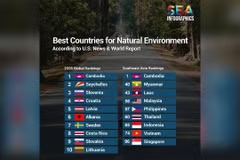
Cambodia ranked world’s top country for natural environment in 2026

Cambodia currently manages 73 protected natural areas covering more than seven million hectares, equivalent to about 41% of the country’s total land area. These protected areas play a vital role in forest conservation, wildlife habitat protection and biodiversity preservation through stricter law enforcement and conservation measures.

AI-related demand pushes Singapore exports in April

AI-related demand pushes Singapore exports in April

Singapore's exports to the US surged 59.6%, reversing a fall of 2.8% in March. Shipments to China climbed 37.8% from 20.3% the previous month and those to the European Union rose 33.4% after shrinking 12.2% in March.

Pressure on the rupiah has mounted as global oil prices surge amid Middle East tensions and developments involving Iran, increasing Indonesia’s energy import costs. (Photo: AFP/VNA)

Indonesia’s rupiah hits record low amid market turmoil

The Indonesian rupiad at one point on May 18 dropped more than 1% to around 17,668 IDR per USD, its weakest level on record. Indonesia’s benchmark stock index also plunged more than 4% after a long holiday, reflecting growing investor concerns.

Malaysian Deputy Minister of Communications Teo Nie Ching. (Photo: Bernama)

Malaysia records sharp rise in online scam losses

Teo revealed on May 16 that online scam losses in Malaysia reached 2.77 billion RM (about 700 million USD) last year, compared with 1.28 billion RM in 2023 and 1.57 billion RM in 2024. Investment scams accounted for the largest share of the losses.

Scientists discover largest dinosaur species ever found in Thailand

Scientists discover largest dinosaur species ever found in Thailand

According to the researchers, Nagatitan Chaiyaphumensis belonged to the Titanosauridae family, a group of herbivorous dinosaurs characterised by their long necks and tails. The species is estimated to have measured between 27 and 30 metres in length and weighed more than 26 tonnes.

Cambodia lowers 2026 economic growth forecast to 4.2%

Cambodia lowers 2026 economic growth forecast to 4.2%

According to the medium-term fiscal framework for 2027-2029 recently published by Cambodian Prime Minister Hun Manet, Cambodia is navigating a transition against a backdrop of protracted global crises, including rising protectionism, trade wars, geopolitical and geo-economic tensions, and increasingly severe impacts of climate change and natural disasters as well.

Agriculture Minister Andi Amran Sulaiman (second from the right) checked the Bulog's rental warehouse in the Romokalisari Warehouse Complex, Surabaya, East Java on May 13, 2026. (Photo: Antara)

Indonesia records highest-ever rice reserves

The figure marks the highest level of rice stocks in Indonesia’s history as the country steps up policies aimed at boosting agricultural output and strengthening national food security.

Philippines warns of power cuts as heat strains grids

Philippines warns of power cuts as heat strains grids

The National Grid Corporation of the Philippines (NGCP) issued a red alert, warning of potential outages of up to seven hours in 32 areas across the Visayas grid, and hour-long outages in nine areas across Luzon, including the capital Manila.