Indonesia cracks down on rice speculation and price manipulation

Head of Indonesia’s National Food Agency (Bapanas) and Agriculture Minister Andi Amran Sulaiman said that tighter monitoring remains necessary despite the country’s currently secure rice supply. As of mid-May, rice reserves managed by Indonesia’s State Logistics Agency (Bulog) had reached around 5.3 million tonnes.

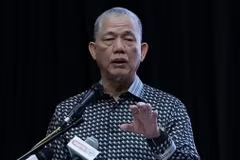
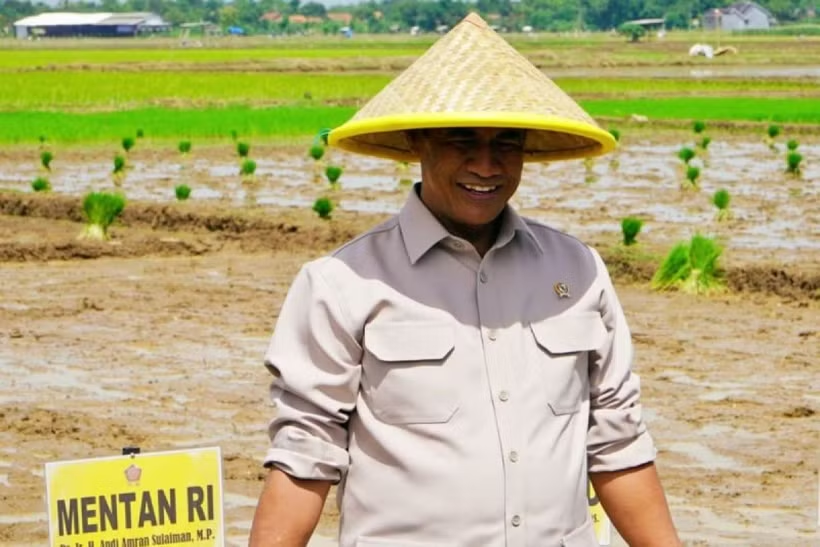
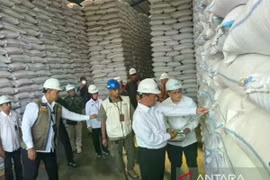
Head of the National Food Agency (Bapanas) and concurrently Minister of Agriculture Andi Amran Sulaiman. (Photo: ANTARA)

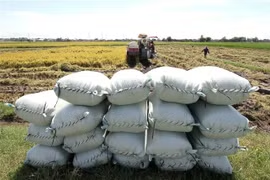
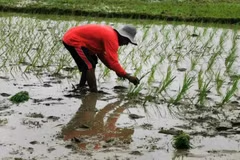
Jakarta (VNA) – The Indonesian government is stepping up supervision of rice distribution to ensure food security, stabilise prices and prevent speculation and market manipulation.

Head of Indonesia’s National Food Agency (Bapanas) and Agriculture Minister Andi Amran Sulaiman said authorities are addressing a number of irregularities in the food sector, including the activities of so-called “food cartels” believed to influence rice prices and consumer markets.

He stressed that tighter monitoring remains necessary despite the country’s currently secure rice supply. As of mid-May, rice reserves managed by Indonesia’s State Logistics Agency (Bulog) had reached around 5.3 million tonnes.

Data from Statistics Indonesia showed that national rice production in the January–May period is projected at 16.8 million tonnes, while consumption demand is estimated at 12.8 million tonnes, creating a surplus of nearly 4 million tonnes.

Bapanas is also intensifying inspections of fortified rice products and plans to conduct laboratory tests to verify micronutrient content, including vitamins B1 and B12, folic acid, iron and zinc.

Earlier, President Prabowo Subianto signed Presidential Decree No. 19/2025 on the establishment of a coordinating team to oversee food, energy and water self-sufficiency programmes. The team is tasked with monitoring, evaluating and coordinating policies among ministries, agencies and local administrations.

The government is also maintaining policies to protect farmers through a minimum purchasing price mechanism for unhusked rice.

The government expects its food self-sufficiency programme to support the Free Nutritious Meals (MBG) initiative, which targets around 82.9 million beneficiaries, while creating stable demand for domestic agricultural products./.
VNA

See more

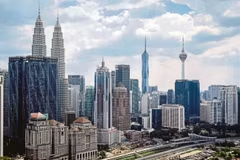
Malaysia’s trade expanded 28.6% year-on-year in April 2026, the fastest growth since September 2022, driven by strong export demand across key markets and products. (Photo: NSTP)

Malaysia’s trade surges amid AI boom

Malaysia has cemented its position in the global AI value chain, with exports of AI-enabling products surging 42.9% to 319 billion MYR, now commanding over half (52.4%) of the nation's total exports.

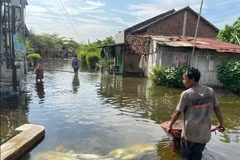
The aftermath of one of two traffic accidents that left at least 13 factory workers dead (Photo: phnompenhpost)

Cambodia road accidents leave dozens dead, injured

At least 13 people were killed and dozens injured in two serious road accidents that occurred on May 23 in Cambodia’s Kampong Chhnang and Svay Rieng provinces, according to the country’s Ministry of Labour and Vocational Training.

Malaysia targets energy supply security until December

Malaysia targets energy supply security until December

Fadillah, who is also Minister of Energy Transition and Water Transformation, said on May 22 that the country’s energy supply is currently expected to be sufficient until July, and efforts are being intensified to extend this, including sourcing additional supplies from abroad.

The expected return of El Niño later this year and soaring fertiliser prices due to the Middle East conflict are raising concerns over declining rice production in the Philippines. (Photo: AP)

El Niño, Middle East conflict threaten Philippine rice output

The Philippine agriculture sector estimates El Niño could cut the country’s rice output by up to 4 million tonnes this year. The Department of Agriculture has lowered its production forecast for 2026 from 20.28 million tonnes to 19.87 million tonnes.

Charging infrastructure gaps slow EV shift in Philippines

Charging infrastructure gaps slow EV shift in Philippines

Data from the Philippine Department of Energy shows that as of end-April, the country had around 1,600 accredited charging stations, including 781 alternating current chargers, 291 direct current chargers, and 528 battery-swapping stations.

Vietnamese Ambassador to Australia Pham The meeting between the ASEAN–Australia Centre (AAC) under the DFAT and the ASEAN Committee in Canberra (ACC). (Photo published by VNA)

ASEAN, Australia step up connectivity, cooperation initiatives

Vietnamese Ambassador to Australia Pham Hung Tam highlighted that the establishment of the AAC at the ASEAN–Australia Special Summit in Melbourne in March 2024 reflected the shared commitment of ASEAN and Australia to upgrading their partnership, deepening people-to-people ties and expanding substantive cooperation in strategic areas such as education, economic collaboration and socio-cultural exchange.

RoK expands cultural promotion in Southeast Asia

RoK expands cultural promotion in Southeast Asia

“The 2026 Korea Season” begins this month with a tour by the Yoon Byul Ballet Company, presenting "Gat," a production that reinterprets traditional Korean headwear through Western classical dance. The performance is scheduled for May 23 in Bangkok before moving to Hanoi on May 27.

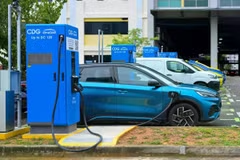
Singapore’s Green Plan 2030 means converting all public and private transport to electric vehicles so the government is working with the private sector to prompt infrastructure investment in fast-charging points such as these. (Photo: Handout)

EV growth puts pressure on Singapore charging network

Electric vehicles (EVs) made up nearly 60% of new car registrations in the first quarter of 2026, overtaking combustion engine and hybrid models for the first time, and a jump from 45% in 2025 and 3.8% in 2021.

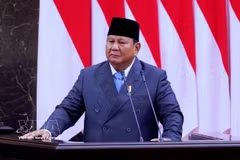
Indonesian President Prabowo Subianto presents the Macroeconomic Framework and Fiscal Policy Points during a plenary session of the House of Representatives. (Photo: VNA)

Indonesia pushes reforms, targeting 6.5% economic growth in 2027

Indonesia’s key strategy in the coming period will focus on leveraging its natural resource advantages, promoting downstream processing industries and restructuring the export system to prevent the outflow of national wealth abroad, President Prabowo stressed.

Thailand strives to solve labour shortages

Thailand strives to solve labour shortages

The JSCCIB stated that easing legal barriers and renewing work permits for migrant workers from neighbouring countries are crucial to maintaining competitiveness, economic growth and exports.

Singapore evaluates potential deployment of nuclear energy

Singapore evaluates potential deployment of nuclear energy

Starting in 2027, with support from international experts, Singapore will conduct a formal assessment aimed at informing any future decision on advanced nuclear technologies. The review will form Phase 1 of the Integrated Nuclear Infrastructure Review (INIR) mission.

ASEAN, EU step up cooperation to promote multilateralism

ASEAN, EU step up cooperation to promote multilateralism

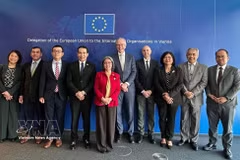
Ambassadors from the Association of Southeast Asian Nations (ASEAN) have reaffirmed their commitment to close coordination with the European Union (EU) in safeguarding the multilateral system and strengthening cooperation in digital transformation, sustainable development, cybersecurity, science-technology, and innovation, thereby contributing to peace, stability and development in the region and beyond.