Three years into EVFTA: Vietnam’s agricultural exports grow impressively

Since the EU-Vietnam Free Trade Agreement (EVFTA) took effect in August 2020, most commitments in the agreement have been implemented and left positive impacts on business activities, especially trade, said Do Viet Ha of the Trade Office of the Vietnamese Embassy in Germany.
Three years into EVFTA: Vietnam’s agricultural exports grow impressively ảnh 1Vietnamese lemon is sold at a supermarket in Germany. (Photo: VNA)

Berlin (VNA) – Since the EU-Vietnam Free Trade Agreement (EVFTA) took effect in August 2020, most commitments in the agreement have been implemented and left positive impacts on business activities, especially trade, said Do Viet Ha of the Trade Office of the Vietnamese Embassy in Germany.

She cited statistics from the General Department of Vietnam Customs which showed Vietnam’s total export turnover to 27 member countries of the European Union (EU) in the period 2020-2022 recorded good growth.

Specifically, in 2022, total value of Vietnam’s export to the EU reached 46.83 billion USD, marking a year-on-year increase of 16.7%, and accounting for 12.6% of Vietnam's total export turnover. Particularly, exports to Germany totalled 8.97 billion USD, up 23.1% compared to 2021.

Meanwhile, data from the German Federal Statistical Office (Destatis) showed Germany's import turnover from Vietnam reached 15.4 billion USD, up 21% compared to 2021, Ha said, explained that the difference between the figures is due to statistical methods and different rules of origin applied.

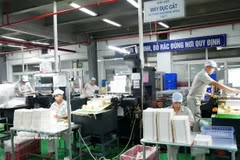
Three years into EVFTA: Vietnam’s agricultural exports grow impressively ảnh 2Mango processing for export at Nafoods Group Joint Stock Company. (Photo: VNA)

She listed some Vietnamese export items that recorded impressive growth to Germany, which were cameras, camcorders, and components, up 265.9%; toys and sports equipment up 126%; footwear 53.8%; textiles 37%.

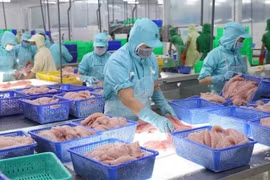
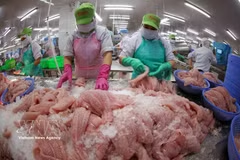
The export of some agricultural and aquatic products grew steadily, with aquatic products increasing by 26.1%; vegetables by 8%; coffee by 13.1%; tea by 14.6%.

The EU is Vietnam's third-largest trading partner and an import market for agricultural products with strong growth after the EVFTA came into effect. Vietnam's agricultural sector is considered one of the biggest beneficiaries of the EVFTA.

Vietnam's key agricultural products exported to the EU are seafood, rice, and vegetables, which all enjoy preferential tax rates right after the EVFTA comes into effect, while rules on origin and protection of geographical indications give Vietnamese agricultural and aquatic products opportunities to enhance their brands and product value on the EU market.

The official noted that rice is not a key item in export to the EU, but its export turnover in this market has increased steadily in recent years. This shows that EVFTA has actively supported Vietnam's exports. Businesses also make the most of the rice quotas to enjoy the 0% tax rate that the EU gives Vietnam.

Last year, rice exports to the EU market increased sharply, reaching 94,510 tonnes and exceeding the annual quota of 80,000 tonnes set in the EVFTA. Rice exports to some EU markets posted strong growth such as the Netherlands (44%), Poland (68%), Spain (89%), and Belgium (149%).

Regarding the benefits of the agreement for EU countries, Ha said that Vietnam has made a strong commitment to cutting taxes under the EVFTA,  thereby offsetting the high transport costs from EU to Vietnam and increasing EU products' competitiveness.

Products from Germany/EU enjoy tariff reduction under EVFTA including vehicles, electrical machinery and equipment, plastic products, iron and steel, mineral oil, meat and poultry, sausages, milk, and dairy products.

In addition, Vietnam's commitments related to customs reform and trade facilitation, food hygiene and safety, animal and plant quarantine, technical measures for trade, and trade remedies make it easier for EU goods to access the Vietnamese market.

However, when entering the EU market, Vietnamese goods still face difficulties, particularly in meeting the rules of origin to enjoy preferential tariffs, and the risk of increasing trade remedies, Ha said.

To overcome these difficulties and maximise benefits from the EVFTA, the official said that businesses need to proactively study the guidelines of the agreement, the standards of goods exported to the EU market, as well as the EU market, people's tastes and consumption need, with a view to suitably improving product quality and design.

According to Ha, the government needs to develop an overall strategy to provide orientations and roadmaps for ministries, sectors, and localities to fully and promptly implement the commitments of the EVFTA; develop mechanisms to facilitate the development of domestic enterprises, prepare solutions to support industries under great competitive pressure when implementing the agreement.

More policies are also needed to attract foreign investment from the EU to Vietnam, she said./.
VNA

See more

Deputy Prime Minister Nguyen Van Thang (L) and René van Vlerken, CEO of Euronext Amsterdam in the Netherlands on July 31, 2026. (Photo: VNA)

Netherlands ready to support Vietnam in deeper integration into global financial markets

The working sessions between Deputy PM Nguyen Van Thang and Dutch partners helped strengthen the foundation of financial cooperation between Vietnam and the Netherlands, opening up opportunities for experience sharing, market connections and new initiatives in finance, technology and innovation, thereby making positive contributions to the comprehensive partnership.

Luxury riverside apartment complex near Ho Chi Minh City centre remains in high demand. (Photo: VNA)

Real estate data seen as key to market transparency

The biggest risk facing the real estate market is liquidity, while the biggest risk associated with technology lies with its users. Technology can only deliver its full value when it addresses practical market and human needs.

Secretary of the Hanoi Party Committee Tran Duc Thang (L) meets with Central Retail Vietnam CEO Olivier Bernard R. Langlet on July 30. (Photo: hanoimoi.vn)

Hanoi welcomes Central Retail Vietnam's plans to expand modern retail investment

Central Retail Vietnam will continue investing in its supermarket network while increasing the share of Vietnamese products in its distribution system. The group will also deepen support for farmers, cooperatives and producers across the supply chain, from cultivation and harvesting to packaging and product standardisation.

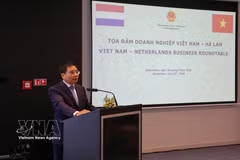
Deputy Prime Minister Nguyen Van Thang speaks at the Vietnam-Netherlands Business Roundtable in Amsterdam on July 30. (Photo: VNA)

Dutch businesses upbeat about Vietnam's growth prospects

Dutch businesses welcomed Vietnam's reform agenda and showed strong interest in expanding collaboration in finance and international financial services, semiconductors, artificial intelligence, logistics, ports, shipbuilding, water management, renewable energy and green transition.

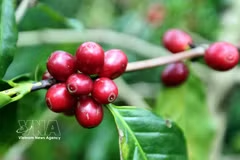
Vietnam's coffee cherries (Photo: VNA)

Vietnamese coffee exports shine in EC’s agri-food trade report

Vietnam and Argentina emerged as notable exceptions in the European Commission’s (EC) latest agri-food trade report. Imports from Argentina increased 10% thanks to higher sunflower seed shipments, while imports from Vietnam climbed 9%, driven by robust coffee exports.

Agricultural and OCOP products from Nhan Co commune in Lam Dong province have their information digitised, are labelled with QR codes for traceability, and put on e-commerce platforms. (Photo: VNA)

New e-commerce law strengthens accountability across digital marketplace

Instead of focusing mainly on protecting consumers as previously, the Law on E-commerce clearly defines the legal responsibilities of all participants in the digital marketplace, including e-commerce platforms, businesses, online sellers, key opinion leaders (KOLs), key opinion consumers (KOCs) and affiliate marketers.

Canadian importers view Vietnamese coffee and cocoa products at a trade promotion event in Canada. (Photo: VNA)

Vietnamese retailer helps expand market access in Canada

Established in 1981 as a family-run grocery store, Lucky Supermarket and Dong Phuong Group have grown into one of the largest Asian food retail and distribution networks in Western Canada. Over the past 45 years, the business has evolved beyond serving the Vietnamese community to become an important distribution channel for Vietnamese agricultural products, food and consumer goods.

Deputy Prime Minister Le Tien Chau and delegates at the launch ceremony of the Hai Phong Free Trade Zone. (Photo: VNA)

Northern port city of Hai Phong launches free trade zone

Following its July 2025 merger with Hai Duong province, Hai Phong city has become one of the largest economic hubs in the country, with an expanded development space and direct connectivity between industrial and agricultural production regions, and urban areas in the west with the seaport and logistics system in the east.

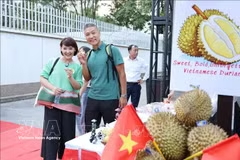
Visitors pose with durian at an event promoting Vietnam’s renowned and distinctive fruit. (Photo: VNA)

India officially opens market to Vietnamese fresh durian

The amended regulations add Vietnam to the list of countries permitted to export fresh durian to India. The South Asian nation also waives additional phytosanitary declaration requirements on the phytosanitary certificate and does not impose any special import conditions for the product.