Typhoon Wipha enters northern Gulf of Tonkin

By 10:00 pm on July 21, the storm will remain in northern waters of the Gulf of Tonkin, potentially intensifying as it continues west-southwestward.

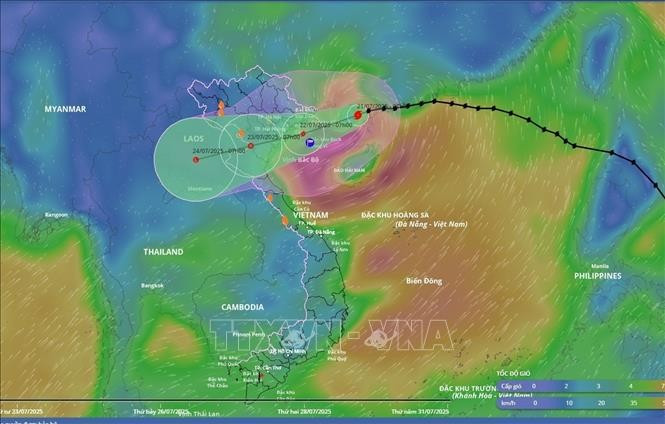
The position and movement direction of Typhoon Wipha from the disaster monitoring system as of 10:00 am on July 21, 2025. (Photo published by VNA)

Hanoi (VNA) – Storm No. 3, internationally known as Typhoon Wipha, passed north of China’s Leizhou Peninsula on the morning of July 21 and entered the northern Gulf of Tonkin, posing a growing threat to Vietnam’s northern and north-central coastal regions, according to the National Centre for Hydro-Meteorological Forecasting.

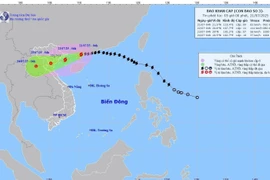
At 10:00 am, the storm’s centre was positioned at around 21.2 degrees North and 109.6 degrees East, approximately 190km southeast of Quang Ninh, 310km east of Hai Phong, and 360km east-northeast of Ninh Binh. Maximum sustained winds near the storm’s centre reached Level 9 (75–88 km/h), with gusts up to Level 11. Wipha was moving west-southwest at a speed of 10–15 km/h.

Forecasts indicate that by 10:00 pm on July 21, the storm will remain in northern waters of the Gulf of Tonkin, potentially intensifying as it continues west-southwestward. Wind speeds may increase to Levels 10–11, with gusts reaching Level 14. Areas likely to be affected include northern parts of the East Sea, the Gulf of Tonkin, and inshore zones from Quang Ninh to Ninh Binh.

By 10 am on July 22, the storm will be on the waters between Hai Phong and Thanh Hoa, continuing in a west-southwest direction at 10–15 km/h. Wind warnings remain at Levels 10–11, with gusts up to Level 14. Coastal and inland regions from Quang Ninh to Nghe An are within the high-risk zone.

It is projected to be in northern Laos by 4 pm on July 23 and weaken into a low-pressure area.

Meteorologists warn that sea and coastal areas are in extreme danger, and all maritime vessels and structures in the storm’s path are unsafe. Boats and structures risk capsizing, damage, or submersion from strong winds, thunderstorms, tornadoes, and high waves.

From the evening of July 21, coastal areas from Quang Ninh to Nghe An are forecast to experience increasing winds of Levels 7–9, with gusts up to Level 11. In areas near the storm’s centre, gusts could reach Level 14. Inland areas, including those of Hai Phong, Hung Yen, Ninh Binh, and Thanh Hoa, may encounter wind levels of 6, gusting up to Levels 7–8.

Heavy rainfall is expected from July 21 through the night of July 22 across the Northeast, Red River Delta, and the north-central provinces of Thanh Hoa and Nghe An, with accumulations ranging from 170 to 280 mm, and some areas exceeding 450 mm. Other places in the North and central Ha Tinh province may record 80–160 mm, even over 250 mm.

Authorities warn of significant flooding risks in low-lying, urban, and industrial areas, especially in the Red River Delta, Thanh Hoa, and Nghe An. Flash floods in small streams and landslides on mountain slopes are also of concern. The Vietnam Meteorological and Hydrological Administration has activated real-time warnings for flash floods and landslides at https://luquetsatlo.nchmf.gov.vn.

Experts emphasise that landslides can continue to occur even after the storm has passed due to lingering soil saturation. Additionally, prolonged rainfall in the storm’s wake is forecast to continue affecting northern Vietnam and parts of northern Laos as the weather system broadens its influence./.
VNA

See more

Construction workers reinforce steel and pour concrete to cover the underground drainage channel, helping collect rainwater and tackle flooding in Da Nang. (Photo: VNA)

A new “shield” against climate change

Smart urban areas are no longer simply about technology; they are becoming a tool that enables authorities to forecast risks, adapt quickly and protect their residents.

Vietnam is exerting efforts to cope with climate change. (Illustrative photo: VNA)

Vietnam approves carbon credit pact with Singapore under Paris Agreement

Signed on September 16, 2025, the Implementation Agreement on carbon credits collaboration under Article 6 of the Paris Agreement on climate change affirms Vietnam and Singapore’s pioneering role and commitment to close cooperation in the international carbon market, making a substantive contribution to global climate response.

A view of Vo Cuong ward, Bac Ninh province (Photo: VNA)

Bac Ninh earmarks over 1.7 billion USD for environmental protection

By 2030, Bac Ninh aims to ensure that all operating industrial clusters and industrial parks have centralised wastewater treatment systems meeting standards, while at least 95% of wastewater in Grade-I urban areas and 70% in Grade-II urban areas is collected and treated to required standards.

Many inland canals in Can Tho city dries up following a prolonged period of extreme heat. (Photo: VNA)

Government adopts action programme on environmental protection, climate resilience

The programme aims to translate the Party's orientations into concrete actions while strengthening environmental governance, enhancing climate resilience, and promoting a green, circular and low-carbon economy. It will serve as the basis for ministries, sectors and localities to formulate implementation plans for the 2026–2030 period, with a vision to 2045.

Dray Sap Waterfall lies within the UNESCO Dak Nong Global Geopark in Nam Da commune, Lam Dong province. (Photo: VNA)

Lam Dong steps up efforts to retain UNESCO global geopark status

Covering nearly 4,760 square kilometres across 22 communes and wards in western Lam Dong (equivalent to 73.1% of the former Dak Nong province's natural area), the geopark was shaped by millions of years of geological activity and successive volcanic eruptions.

A stump-tailed macaque (Macaca arctoides) is handed over to the Cam Lo–Dong Ha forest ranger station in Quang Tri province on January 27, 2026 (Photo: VNA)

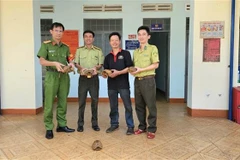
Rare primate handed over to Phong Nha - Ke Bang National Park

A stump-tailed macaque (Macaca arctoides) was handed over to the Centre for Rescue, Conservation, and Development of Creatures under the Management Board of Phong Nha - Ke Bang National Park in Quang Tri province on July 21, for rehabilitation and eventual release into the wild.

Two Red Lories (Eos rubra) found among the 104 wild animals being kept without documentation proving their lawful origin in Phuoc Thanh commune, Tay Ninh province. (Photo published by VNA)

Criminal proceedings launched against case of illegal keeping, trading of 104 wild animals

They recorded a total of 104 wild animals, comprising 92 African spurred tortoises (Geochelone sulcata) of various sizes, six Red Lories (Eos rubra) and six Green-cheeked Parakeets (Pyrrhura molinae). Authorities said the animals are subject to management under Vietnam's forestry legal regulations and are listed in Appendix II of the Convention on International Trade in Endangered Species of Wild Fauna and Flora (CITES).

BUYO Bioplastics' biodegradable plastic products are made from brewer's grains and sugarcane bagasse. (Photo: nhandan.vn)

Vietnam urged to shift from plastic waste treatment to full life-cycle management

For years, efforts to tackle plastic pollution in Vietnam have focused mainly on waste collection, recycling and disposal. However, as sustainable development and green trade standards become increasingly important, specialists argued that a broader approach is needed, covering everything from product design and material selection to production, consumption and recycling.