UNDP: Mangrove forests are "climate warriors”

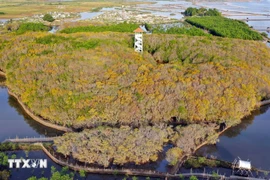
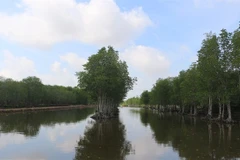
According to a UNDP representative, mangrove forests are referred to as "climate warriors," playing a particularly crucial role in protecting the environment and preserving a greener, more sustainable Vietnam.

khi-hau-1.jpg
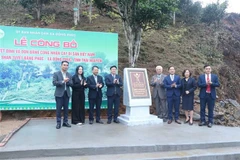
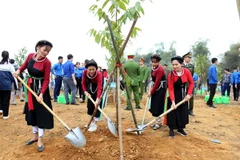
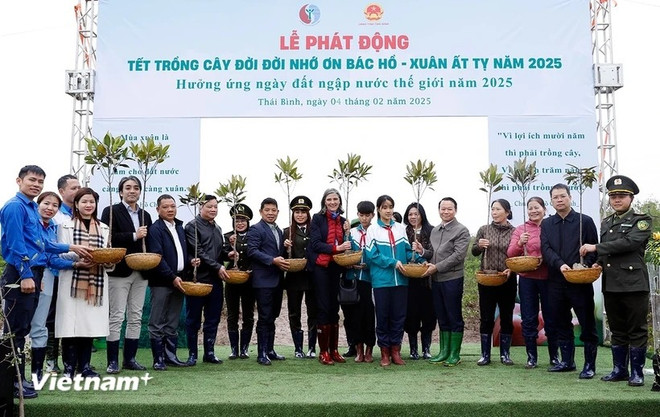
Minister Do Duc Duy; Ramla Khalidi, Resident Representative of UNDP Vietnam; leaders of Thai Binh province; and other delegates at a tree planting festival celebrating the Lunar New Year 2025 in Thai Binh province. (Photo: Vietnam+)

Thai Binh (VNA) - Ramla Khalidi, Resident Representative, UNDP Vietnam, has said that mangrove forests are "climate warriors," playing a particularly crucial role in protecting the environment and preserving a greener, more sustainable Vietnam.

She made the remarks at the Tree Planting Festival held in Thai Thuy Wetland Nature Reserve in the northern province of Thai Binh on February 4 as part of efforts to celebrate Vietnam’s decades-long tree planting tradition and World Wetlands Day (February 2).

According to Ramla Khalidi, wetlands and mangrove forests are more than just natural landscapes—they play a vital role in protecting coastal communities from storms and floods, storing carbon to fight climate change, and preserving rich biodiversity and ecosystem services.

The UNDP Resident Representative in Vietnam also expressed pride in the programme’s role in supporting Vietnam’s efforts to conserve and restore wetland and mangrove ecosystems. UNDP’s long-term collaboration with the Ministry of Natural Resources and Environment, the Ministry of Agriculture and Rural Development, and local authorities has resulted in the planting and restoration of over 4,000 hectares of mangroves since 2017, with plans to add another 1,000 hectares in the coming years.

Through the "Climate Promise" initiative, UNDP is assisting in developing a coastal mangrove carbon database, providing essential data to inform conservation and climate response policies.

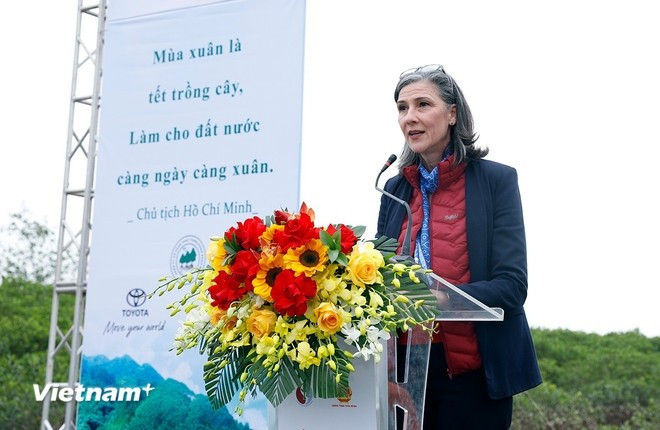
Ramla Khalidi emphasized that this year’s tree-planting event underscores the power of collaboration among government agencies, socio-political organisations, the private sector, and local communities in protecting natural heritage. She highlighted that partnerships at the local level are particularly crucial for achieving tangible results on the ground. It is these comprehensive solutions that drive long-term impact.
khi-hau-2.jpg
Ramla Khalidi, UNDP Resident Representative in Vietnam, speaks at the Tree-planting festival celebrating the Lunar New Year 2025 in Thai Binh province. (Photo: Vietnam+)

However, Ramla Khalidi also emphasized that despite the progress achieved, the persistent threats to wetlands and mangroves remain a serious concern. These risks weaken the resilience of coastal areas, endanger biodiversity, and affect the livelihoods of millions. Therefore, urgent action is needed.

Vietnam has around 12 million hectares of wetlands, accounting for approximately 37% of its natural land area. The areas, which include lakes, lagoons, mangrove forests, and coastal zones, are vital for biodiversity conservation, supporting numerous plant and animal species, some of which are globally endangered.

Wetlands also provide essential ecosystem services, such as water filtration, climate regulation, disaster prevention, and sustainable livelihoods for local communities.

Meanwhile, mangroves play a critical role in Vietnam’s wetlands by stabilizing coastlines, reducing erosion, and acting as natural barriers against storm surges and tsunamis.

They help combat saltwater intrusion, protect agricultural lands, and support marine biodiversity by serving as nurseries for fish and other aquatic species. Additionally, mangroves sequester carbon, contributing to climate change mitigation, while providing resources and sustainable livelihoods for coastal communities./.
See more

Houses in Xuan Canh commune, Dak Lak province, completely collapse. (Photo: VNA)

Typhoon Kalmaegi damages over 26,470 houses and causes extensive losses

The typhoon and its aftermath left five people dead, three missing, and 17 injured. It also damaged 3,721 ha of rice and crops, and 3,958 ha of industrial and perennial fruit trees, up by 14 ha from the previous report. For aquaculture, 54,335 cages and 18 ha of shrimp and fish farms were destroyed, along with 118 cattle and 3,593 poultry. Additionally, 21 boats were sunk and 44 others damaged.

Nguyen Thi Vang is the oldest member of the scrap-collecting cooperative group in An Dong ward in Hue city. (Photo: VNA)

Hue turns waste into resource through tech-enabled scrap collectors

Through the mGreen application, women who once earned their living by collecting recyclable waste have become “green warriors” connected to a digital recycling supply chain. The initiative is not only improving livelihoods and enhancing social status but also forming a sustainable waste circulation loop, reinforcing Hue’s image as a green city.

Vice Chairman of the Hanoi People’s Committee Nguyen Manh Quyen receives Sylvain Ouillon, Chief Representative of the French National Research Institute for Sustainable Development (IRD) in Vietnam (Photo: Hanoi Moi)

Hanoi strengthens ties with IRD to tackle air pollution

Vice Chairman of the Hanoi People’s Committee Nguyen Manh Quyen on November 6 received Sylvain Ouillon, Chief Representative of the French National Research Institute for Sustainable Development (IRD) in Vietnam, to discuss potential cooperation in air quality monitoring and pollution reduction in the capital city.

Houses inundated by storm-triggered flooding. (Photo: VNA)

Central, Central Highlands localities race to recover from Storm Kalmaegi

According to Vietnam Disaster and Dyke Management Authority (VDDMA), the storm left five people dead and six injured. As of 7 a.m. on November 7, 52 houses had collapsed and 2,593 others were damaged or unroofed, including 2,412 in Gia Lai province. Nine fishing vessels were reported sunk.

High waves in Ly Son island, Quang Ngai province due to Typhoon Kalmaegi. (Photo: VNA)

Central, Central Highlands localities respond to Typhoon Kalmaegi

As Typhoon Kalmaegi, the 13th storm to hit the East Sea this year, intensifies and heads toward Vietnam’s central coast, localities across the central and Central Highlands regions, including Dak Lak, Lam Dong, Da Nang and Quang Ngai, have activated their highest-level disaster response measures to ensure the safety of people and property.

A map released at 2pm on November 4, tracking the path of Typhoon Kalmaegi (Source: National Centre for Hydro-Meteorological Forecasting)

PM urges proactive measures in response to Typhoon Kalmaegi

As Typhoon Kalmaegi is expected to enter the East Sea on the morning of November 5, with sustained winds of level 13–14 and gusts reaching level 17, Prime Minister Pham Minh Chinh has ordered ministries, sectors, and local authorities to implement the highest-level response measures to protect lives and minimise damage.

Residents in the buffer zone of the UNESCO-recognised Western Nghe An Biosphere Reserve (Photo: VNA)

Vietnam's World Biosphere Reserves eye to become ideal destinations

Vietnam's World Biosphere Reserves have truly become a rendezvous for integration, cooperation, and the exchange of information and experiences among countries and international organisations in the field of conservation and sustainable development, as well as an ideal destination for domestic and international tourists, heard a conference in the central province of Khanh Hoa on November 3.

Heavy rain and prolonged flooding have caused deep inundation, making transportation difficult. (Photo: VNA)

Heavy downpours, floods leave 37 dead, five missing

In addition, floods have submerged and damaged 7,897 hectares of paddy and crops, and 64,356 livestock and poultry have died or been swept away. Across the nation, 103 houses have collapsed or been washed away, 451 others damaged, and 12,676 flooded.

Heavy rain causes severe flooding on many roads across Nghe An province on November 3. (Photo: VNA)

Storm Kalmaegi intensifies, authorities warn of flooding and landslides

From early November 3 to late November 4, areas from Ha Tinh to Da Nang and eastern Quang Ngai are expected to experience very heavy rainfall — 200–300mm on average, and up to 600mm in some places. Areas in Ha Tinh province, the northern part of Quang Tri province, and the eastern part of Quang Ngai province may see 100–200mm of rain, with localised totals exceeding 350mm.