Vietnam braces for Chikungunya risk as global outbreaks intensify

Vo Hai Son, Deputy Director of Vietnam’s Department of Preventive Medicine under the Ministry of Health, discussed the escalating global situation and Vietnam’s response in a recent interview

Deputy Director of Vietnam’s Department of Preventive Medicine Vo Hai Son (Photo: VietnamPlus)

Hanoi (VNA) - Vietnam remains free of community-transmitted Chikungunya cases, but with Aedes mosquitoes thriving at their seasonal peak, the nation is on high alert for potential outbreaks.

Chikungunya, a mosquito borne viral disease, is surging worldwide, with outbreaks reported on Indian Ocean islands like La Réunion and Mayotte, and spreading to Africa, South Asia, and parts of Europe.

Vo Hai Son, Deputy Director of Vietnam’s Department of Preventive Medicine under the Ministry of Health, discussed the escalating global situation and Vietnam’s response in a recent interview.

Reporter: The MoH is monitoring the global Chikungunya situation, especially the recent developments in China, notably Guangdong province. Could you provide an update?

Vo Hai Son: Chikungunya, caused by the Chikungunya virus (CHIKV), is transmitted by Aedes mosquitoes, the same vectors responsible for dengue. These mosquitoes are most active during daylight, particularly in early morning and late afternoon.

The World Health Organisation (WHO) first identified Chikungunya in Tanzania (East Africa) in 1952. On July 22, 2025, WHO flagged its rapid global spread, with major outbreaks on Indian Ocean islands such as La Réunion and Mayotte, now extending to Africa, South Asia, and Europe.

In China’s Guangdong province, the Centre for Disease Control and Prevention reported over 4,800 cases in the first half of 2025, the largest outbreak in the region. All cases were mild, with no severe illnesses or fatalities.

Singapore also saw a spike, with 17 confirmed cases by August 2, 2025, compared to eight in the same period last year. At least 13 of these were linked to travel in outbreak zones.

Vietnam’s Department of Preventive Medicine is working closely with WHO and international health agencies under the International Health Regulations (IHR) to monitor the situation, share information, and recommend timely prevention and control measures.

Reporter: Has Vietnam recorded any Chikungunya cases recently?

Vo Hai Son: So far, Vietnam’s infectious disease surveillance system has not detected any cases of the Chikungunya virus. However, the virus’s rise in neighboring China and the prevalence of Aedes mosquitoes domestically heighten the risk of imported cases sparking local transmission, particularly via infected travelers.

Reporter: Based on updated data, what factors have caused the rise or outbreaks of Chikungunya in China and other countries, and what contributes to its spread?

Vo Hai Son, Deputy Director of the Department of Preventive Medicine (Photo: VietnamPlus)

Vo Hai Son: In July 2025, WHO warned of Chikungunya’s rapid spread, with large outbreaks in La Réunion and Mayotte, later extending to Africa, South Asia, and Europe. In addition, case numbers have risen in Guangdong (China) and Singapore.

Chikungunya does not spread directly from person to person but through the Aedes mosquito. Currently, the rainy season in many Northern Hemisphere countries creates ideal conditions for mosquitoes, increasing their population and thus viral transmission. Summer’s peak travel season further amplifies the risk; as international visitors inadvertently carry the virus across borders.

Reporter: How does the ministry assess the risk of Chikungunya entering and spreading in Vietnam, and what response plans are in place?

Vo Hai Son: Despite no local cases, Vietnam faces elevated risks due to thriving mosquito populations and heavy summer travel.

To prevent outbreaks, the ministry has directed municipal and provincial authorities to strengthen disease surveillance at border checkpoints, medical facilities, and communities to detect suspected cases early, especially among travelers returning from affected areas. Relevant units also investigate outbreaks to prevent spread, monitor mosquito populations and vectors at border areas and in the community as guided by the ministry. They also ensure proper patient care, detailed medical history collection, timely treatment, and hospital capacity management to prevent overloading.

Reporter: What are the typical symptoms of Chikungunya, and how can people distinguish it from other mosquito-borne illnesses such as dengue fever?

Vo Hai Son: Symptoms emerge 4–8 days after an infected mosquito bite, typically presenting as sudden high fever and severe joint pain, often accompanied by joint stiffness, arthritis, headaches, fatigue, and rashes. While similar to dengue, Chikungunya is marked by more intense joint pain and swelling, whereas dengue often involves bleeding-related symptoms.

Self-diagnosis and self-treatment are strongly discouraged. Individuals with suspected symptoms should seek immediate medical attention at the nearest healthcare facility.

Travelers returning from outbreak areas should avoid mosquito bites, monitor their health, and report symptoms to health authorities promptly.

Reporter: Thank you very much!

VNA

See more

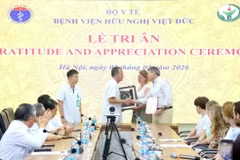
Assoc. Prof. Dr. Duong Duc Hung, Director of Viet Duc University Hospital, presents a token of appreciation in recognition of the noble gesture of the organ donor’s family. (Photo: baochinhphu.vn)

British teen’s organ donation saves three Vietnamese lives

A 19-year-old British tourist who died during a trip to Vietnam has saved the lives of three Vietnamese patients with end-stage organ failure, in a deeply moving act of compassion. The young woman is the first foreign national to donate organs in Vietnam.

A workshop at the One Health Summit, held in Lyon, France, from April 5 to 7, 2026. (Photo: VNA)

Vietnam backs global One Health commitments at Lyon summit

The MAE welcomed the French Government’s organisation of the One Health Summit, describing it as an important forum to advance global political commitments and strengthen international cooperation in preventing zoonotic diseases.

Ilustrative image (Photo: pngtree.com)

Vietnamese scientists unlock genetic insights into rare diseases

Prof. Dr. Nguyen Huy Hoang, Deputy Director of the Institute of Biology under the Vietnam Academy of Science and Technology, and his research team conducted a project titled “Genetic mutation analysis in Vietnamese patients with selected rare diseases using whole-exome sequencing technology.” The project, implemented from 2022 to 2024, aims to clarify the genetic causes of these diseases within the Vietnamese population.

Health workers and residents perform mass wellness exercises, promoting healthy lifestyles in the community. (Photo: VNA)

Ho Chi Minh City targets modern, inclusive healthcare system

On April 5 alone, 58 hospitals and health centres conducted screening programmes across 64 wards and communes, with a focus on outlying areas. Beyond early detection, residents receive consultations, long-term health monitoring guidance, and access to specialised services locally.

Vice Chairwoman of the National Assembly Nguyen Thi Thanh, Minister of Health Dao Hong Lan, and delegates attend the programme. (Photo: nhandan.vn)

Healthy lifestyles, disease prevention highlighted on national health day

Vice Chairwoman of the National Assembly Nguyen Thi Thanh emphasised the need for consistent and effective implementation of the resolution across the political system, with priorities including refining healthcare policies and institutions, strengthening preventive and grassroots healthcare networks, expanding population health management, promoting early detection, and improving school-based physical education and nutrition.

Politburo member, Secretary of the Party Central Committee and Chairman of the Commission for Information, Education and Mass Mobilisation Trinh Van Quyet (front row, fifth from left), together with delegates, participate in a walk after the launch of All People’s Health Day in Hanoi on April 5. (Photo: VNA)

All People’s Health Day promotes early disease prevention

The launch marked the first year the activity has been implemented in a coordinated manner nationwide. Members of the public were able to visit free screening areas, receive nutritional advice, participate in mass exercise performances, enjoy artistic programmes, and join a walk in response following the ceremony.

Volunteer young doctors are expected to provide free health screenings for around 10,000 residents (Photo: VNA)

Free cancer screening, health checks to benefit 10,000 people in Hanoi

Participants will receive comprehensive health checks through a streamlined one-stop process, including blood pressure measurement, height and weight assessment, BMI and cardiovascular risk evaluation, blood tests, general examinations and specialist consultations in internal medicine, paediatrics, obstetrics, ophthalmology, ENT, dentistry and oncology. Rapid blood glucose testing and biochemical screening will also be conducted to detect diabetes and metabolic disorders.

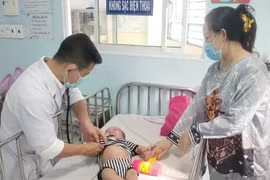
Dr Du Tuan Quy from the Children’s Hospital 1 in Ho Chi Minh City examines a patient with hand, foot and mouth disease. (Photo: VNA)

Over 25,000 hand, foot and mouth disease cases posted in 3 months

In the first three months, more than 25,000 cases of hand, foot and mouth disease have been recorded nationwide. Of the total cases, around 18,000, or nearly 72%, were concentrated in southern provinces. The disease has primarily affected children aged between one and five.

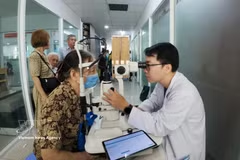
Early cancer screening at Da Nang Hospital. (Photo: VNA)

AI boosts early detection of non-communicable diseases

Deputy Minister of Health Nguyen Thi Lien Huong said NCDs pose a growing global challenge, accounting for over 70% of deaths worldwide, mainly from cardiovascular diseases, cancer, diabetes and chronic respiratory diseases. In Vietnam, the burden is rising rapidly, requiring urgent and sustained preventive strategies.