Vietnam plans university mergers to boost competitiveness

The Politburo’s Resolution 71 on breakthroughs in education and training development requests the consolidation and dissolution of underperforming universities, and the integration of research institutes with universities.

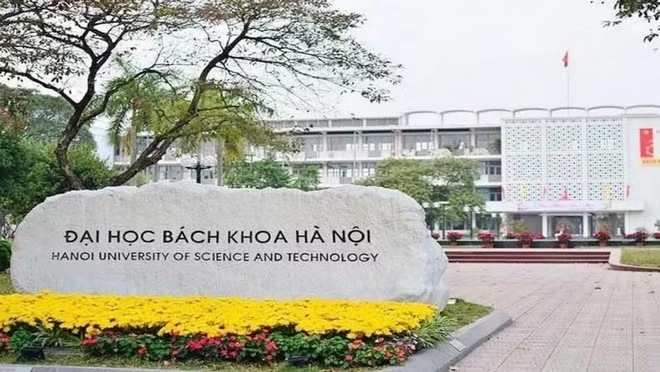
The mergers aim to provide resources for universities to develop and reach international standards. (Photo: hust.edu.vn)

Hanoi (VNA) – Vietnamese university leaders have affirmed that the merger of institutions is a correct policy to drive breakthroughs in higher education, while also emphasising the need to manage staff and student perceptions carefully.

Experts have noted that the merger and restructuring of universities is a timely and necessary measure to help Vietnam’s higher education system overcome its current fragmentation, make breakthroughs, and reach international standards.

A timely and right reform

The Politburo’s Resolution 71 on breakthroughs in education and training development requests the consolidation and dissolution of underperforming universities, and the integration of research institutes with universities. It also demands transferring some universities to local authorities for management to better meet local human resources needs.

Minister of Education and Training Nguyen Kim Son said the ministry had submitted a proposal to the Government for approval, describing it as “a major reorganisation of higher education institutions”. He noted that the restructuring would be mandatory rather than consultative.

Associate Professor Dr. Nguyen Thanh Chuong, Chairman of the Council of the University of Transport and Communications, called the policy both “timely and essential”. He said the mergers would enable universities to grow stronger and reach a new height, even the global level.

Likewise, Pham Thai Son, Director of the Admissions and Communications Centre at the Ho Chi Minh City University of Industry and Trade, voiced support for dissolving weak institutions and merging them to form stronger universities.

Professor Nguyen Dinh Duc from the University of Engineering and Technology, Vietnam National University - Hanoi, said the restructuring stems from the need to concentrate resources to enable Vietnam’s higher education to make breakthroughs in the new era with great ambitions.

The mergers are expected to reduce programme overlap, especially at smaller and less efficient institutions, while creating larger and multidisciplinary universities with stronger research and innovation ecosystems.

They are also seen as a way to enhance institutional autonomy, accountability, and interdisciplinary digital capacity, thus increasing chances to enter world rankings and attracting international scholars and students.

Ensuring no one is left behind

Experts acknowledge that university mergers and restructuring will inevitably affect staff and students. Associate Professor Chuong said that while changes might cause initial concern, adaptation would follow in time.

Professor Duc agreed, noting that apprehension about job security, income, new assessment standards, and cultural integration is understandable. He emphasised the importance of conducting the transition transparently and according to phases.

He stressed that mergers should protect staff and student interests and be treated as strategic restructuring rather than a simple combination, aiming to create strong, interdisciplinary, and highly accountable universities.

At the 2025 Higher Education Conference, Minister Son reiterated that the aim of the restructuring is not merely to reduce administrative units but to create new momentum for development. He urged public universities to “be ready for any scenario and remain devoted to the common good.”

According to the Ministry of Education and Training, Vietnam currently has 11 national or regional universities, along with 240 universities and academies (excluding the national and regional systems), including 173 public, 62 private, and five foreign universities. There are also 40 research institutes providing PhD training and several other postgraduate institutions, along with 40 defence and security universities./.

VNA

See more

Teams compete in the “Talented Family” contest at the 2026 Bac Ninh Family Festival. (Photo: VNA)

Vietnam Family Day: Investing in families for sustainable development

Despite strong family bonds, many households in Vietnam now live in separate “worlds” shaped by technology and global integration. The rapid expansion of digital information has placed traditional family education under pressure, as children increasingly turn to online sources of knowledge rather than learning from parents and grandparents.

Party General Secretary and State President To Lam delivers a keynote address at the congress. (Photo: VNA)

Ho Chi Minh Communist Youth Union convenes 13th National Congress in Hanoi

In his opening speech, First Secretary of the HCYU Central Committee and Vice President of the VFF Central Committee Bui Quang Huy pointed to a sweeping transformation in mindset, content, and operational methods, steering the HCYU toward greater practicality, tighter alignment with real-world conditions, and a sharp youth-centred focus. Sci-tech, innovation, and digital transformation have become standout hallmarks, dramatically improving outreach, education, youth engagement, and the union’s expanding footprint in the digital space.

The Hoa Lo Prison historical site is a popular destination among visitors (Photo: VNA)

Vietnam emerges as tourism hotspot on global map

According to online travel platform Agoda, searches for accommodation in Vietnam by Chinese travellers surged 164% year-on-year in the first five months of 2026, the fastest growth among international source markets.

Illustrative photo (Photo: Facebook Nam Can Tho University)

Can Tho universities gain international recognition in global rankings

As more universities from Can Tho gain international recognition, the city is reinforcing its role as a regional centre for education, science and technology, while contributing to the development of a highly skilled workforce and deeper international integration for the Mekong Delta.

An aerial view of Kinh Bac ward in Bac Ninh (Photo: VNA)

Politburo backs plan to turn Bac Ninh into centrally-run city

The conclusion sets out a vision for Bac Ninh as a model green, smart, modern, and affluent city that preserves the Kinh Bac region’s cultural identity, pushing economic expansion in parallel with environmental protection while leaning on sci-tech and innovation as core growth engines.

Hoan Kiem Lake, a cultural and historical symbol of the capital and also a key element of Hanoi’s distinctive urban landscape, is set to be preserved and enhanced as part of the city’s future development strategy. (Photo: VNA)

Hanoi’s Red River urban area development draws widespread attention

Located south of the Red River and extending from the historic inner city to newly developing areas in the south and the west, the central urban area along Red River’s right bank covers approximately 45,317 hectares and is projected to accommodate around 6.365 million residents by 2045 and 6.455 million by 2065.

Military personnel move the bomb to a designated disposal site. (Photo: VNA)

Wartime bomb safely detonated in Nghe An

The MK82 bomb, with its fuze still intact, was discovered on June 22 by workers excavating foundations for a primary school construction project. It was buried about 2.5 metres underground and measured 27.5cm in diameter and 1.55m in length.

The operation conducted by Vietnamese and Lao police forces, known as Case 135VL, results in the arrest of 16 suspects and the seizure of 50.7 tonnes of caffeine, a substance commonly used in illicit drug manufacturing. (Photo: vtv.vn)

Regional cooperation strengthened to combat cross-border drug crime

Vietnam, China, Laos and Myanmar face common challenges as drug syndicates increasingly exploit the Mekong River, cross-border transport networks, e-commerce platforms, international logistics services, cyberspace and cryptocurrencies to organise drug transactions and smuggling operations.

Efforts are stepped up to search for and recover remains of fallen soldiers at the Vi Xuyen battlefield. (Photo: qdnd.vn)

Campaign advances martyrs’ remains recovery in former Vi Xuyen battlefield

The martyrs’ remains recovery team under the Tuyen Quang provincial Military Command has strengthened its personnel, equipment and technical resources while coordinating with engineering units to clear unexploded ordnance and conduct recovery operations at key sites in Vi Xuyen, where fierce fighting took place during the northern border defence war.

The school's board of management receives a certificate of merit from the Vientiane Capital Association of Vietnamese People. (Photo: VNA)

Nguyen Du School reinforces Vietnamese language preservation in Laos

Nguyen Du Lao–Vietnamese Bilingual School in Vientiane occupies a particularly important position, contributing to Vietnamese-language education, cultural preservation and the development of a knowledgeable and skilled young generation, while helping strengthen the special ties between Vietnam and Laos.