Resolution 71 brings fundamental shift to national education: Expert

The Politburo’s Resolution No. 71-NQ/TW is expected to drive breakthrough development in education and training. (Photo: VietnamPlus)

Hanoi (VNA) – One of the highlights of the Politburo’s Resolution No. 71-NQ/TW on education and training is a shift in mindset, guiding institutions, management, policy and actions, according to Pro. Dr. Hoang Van Cuong, Vice Chairman of the State Council of Professors.

Prof. Cuong, deputy to the 15th National Assembly and former Vice Rector of the National University of Economics, said Resolution 71 aims to address the fundamental issues plaguing Vietnam’s education sector, from outdated teaching methods and insufficient investment to a lack of innovation in educational management.

Resolution 71 calls for a comprehensive overhaul of governance and institutional frameworks. The resolution's emphasis on education as the country’s top policy marks a pivotal moment for Vietnam’s educational future, he stated.

While the resolution sets bold targets, including making Vietnam’s education system a leading force in Asia by 2030 and having at least five Vietnamese universities in the top 100 globally by 2045, the road to achieving these goals is far from simple.
hoang-van-cuong.jpg
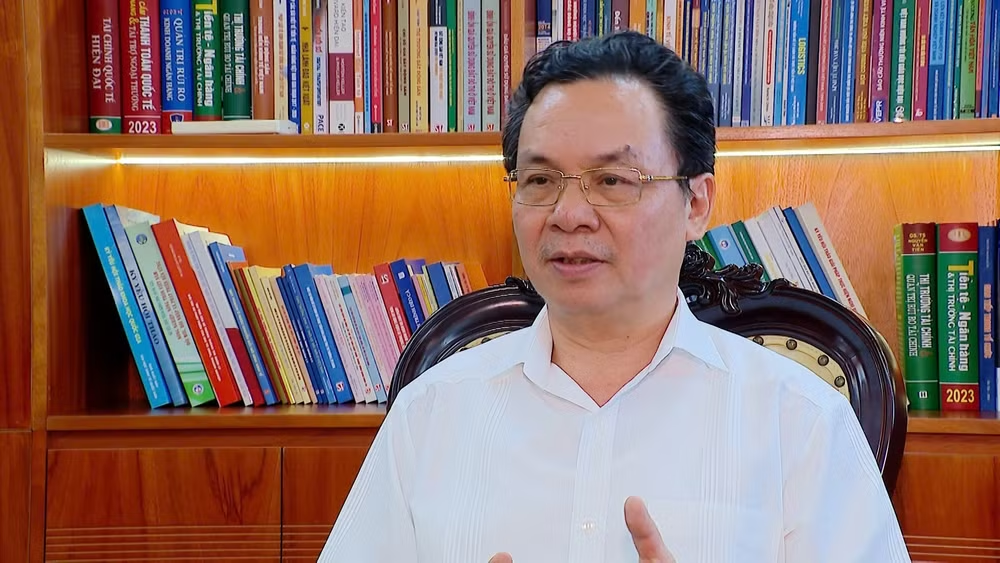
Prof. Dr. Hoang Van Cuong, Vice Chairman of the State Council of Professors. (Photo: VietnamPlus)

Vietnam has already made notable strides, with some universities already appearing in the QS World University Rankings. The latest PISA rankings also place Vietnam 34th globally and second in ASEAN, providing a solid foundation for the ambitious targets outlined in the Resolution. With sustained effort and decisive solutions, these goals are entirely achievable, setting the country on track to becoming a prosperous, strong, and happy nation.

Resolution 71 also advocates for a significant boost in investment, particularly for teachers. This includes proposed teacher allowances, aimed at improving the quality of education by offering incentives to educators while also providing better support for administrative staff.

Furthermore, the resolution mandates that at least 5% of the national budget should be allocated to basic infrastructure development, with at least 3% dedicated to higher education, demonstrating a strong commitment to providing modern educational facilities. These initiatives will help meet the growing demand for a skilled workforce capable of driving the nation’s development.

However, Prof. Cuong said that despite previous attempts, such as the 20% education budget target, which has often gone unmet, ensuring that Resolution 71’s financial goals are realised remains a challenge.

The resolution focuses on specific measures to attract social investment. The mechanisms outlined in Resolution 71 are designed to attract greater social investment, with incentives like tax exemptions for educational institutions.
resolution-71.jpg
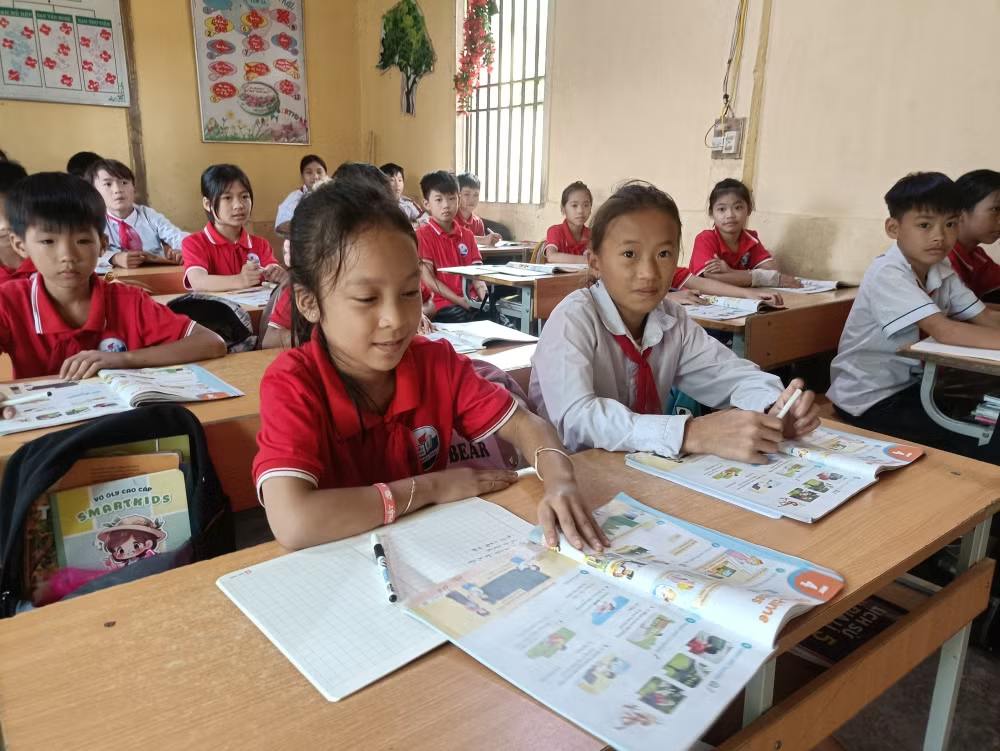
Students in a temporary classroom in the northern mountainous province of Lao Cai. (Photo: VietnamPlus)

However, the success of these measures will depend on a well-defined institutional framework that ensures resources are used effectively and ethically. This framework must also encourage active participation from families, communities, and private enterprises in building a learning environment that benefits all, he underlined.

One of the key components of Resolution 71 is its focus on holistic education, which seeks to develop not only the intellectual but also the physical, cultural, and moral facets of students. As Vietnam positions itself for the future, this vision includes the integration of traditional values with those necessary for global competitiveness. Core values such as patriotism, national pride, discipline, and innovation are essential, but so too is the capacity to embrace modern challenges and global opportunities.

Ultimately, the success of Resolution 71 will rest on the creation of a robust institutional framework that aligns national education goals with local management practices and financial structures. Achieving this will require a collective effort from all sectors of society, from government bodies to educational institutions and beyond. Only with broad societal involvement and a commitment to systemic change can Vietnam’s education system hope to achieve the vision laid out in Resolution 71, realising its goal of becoming a beacon of global excellence, he concluded./.
VNA

See more

Teams compete in the “Talented Family” contest at the 2026 Bac Ninh Family Festival. (Photo: VNA)

Vietnam Family Day: Investing in families for sustainable development

Despite strong family bonds, many households in Vietnam now live in separate “worlds” shaped by technology and global integration. The rapid expansion of digital information has placed traditional family education under pressure, as children increasingly turn to online sources of knowledge rather than learning from parents and grandparents.

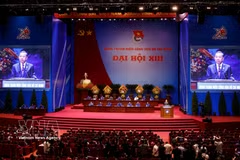
Party General Secretary and State President To Lam delivers a keynote address at the congress. (Photo: VNA)

Ho Chi Minh Communist Youth Union convenes 13th National Congress in Hanoi

In his opening speech, First Secretary of the HCYU Central Committee and Vice President of the VFF Central Committee Bui Quang Huy pointed to a sweeping transformation in mindset, content, and operational methods, steering the HCYU toward greater practicality, tighter alignment with real-world conditions, and a sharp youth-centred focus. Sci-tech, innovation, and digital transformation have become standout hallmarks, dramatically improving outreach, education, youth engagement, and the union’s expanding footprint in the digital space.

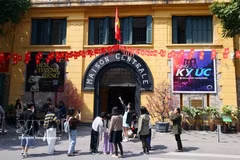
The Hoa Lo Prison historical site is a popular destination among visitors (Photo: VNA)

Vietnam emerges as tourism hotspot on global map

According to online travel platform Agoda, searches for accommodation in Vietnam by Chinese travellers surged 164% year-on-year in the first five months of 2026, the fastest growth among international source markets.

Illustrative photo (Photo: Facebook Nam Can Tho University)

Can Tho universities gain international recognition in global rankings

As more universities from Can Tho gain international recognition, the city is reinforcing its role as a regional centre for education, science and technology, while contributing to the development of a highly skilled workforce and deeper international integration for the Mekong Delta.

An aerial view of Kinh Bac ward in Bac Ninh (Photo: VNA)

Politburo backs plan to turn Bac Ninh into centrally-run city

The conclusion sets out a vision for Bac Ninh as a model green, smart, modern, and affluent city that preserves the Kinh Bac region’s cultural identity, pushing economic expansion in parallel with environmental protection while leaning on sci-tech and innovation as core growth engines.

Hoan Kiem Lake, a cultural and historical symbol of the capital and also a key element of Hanoi’s distinctive urban landscape, is set to be preserved and enhanced as part of the city’s future development strategy. (Photo: VNA)

Hanoi’s Red River urban area development draws widespread attention

Located south of the Red River and extending from the historic inner city to newly developing areas in the south and the west, the central urban area along Red River’s right bank covers approximately 45,317 hectares and is projected to accommodate around 6.365 million residents by 2045 and 6.455 million by 2065.

Military personnel move the bomb to a designated disposal site. (Photo: VNA)

Wartime bomb safely detonated in Nghe An

The MK82 bomb, with its fuze still intact, was discovered on June 22 by workers excavating foundations for a primary school construction project. It was buried about 2.5 metres underground and measured 27.5cm in diameter and 1.55m in length.

The operation conducted by Vietnamese and Lao police forces, known as Case 135VL, results in the arrest of 16 suspects and the seizure of 50.7 tonnes of caffeine, a substance commonly used in illicit drug manufacturing. (Photo: vtv.vn)

Regional cooperation strengthened to combat cross-border drug crime

Vietnam, China, Laos and Myanmar face common challenges as drug syndicates increasingly exploit the Mekong River, cross-border transport networks, e-commerce platforms, international logistics services, cyberspace and cryptocurrencies to organise drug transactions and smuggling operations.

Efforts are stepped up to search for and recover remains of fallen soldiers at the Vi Xuyen battlefield. (Photo: qdnd.vn)

Campaign advances martyrs’ remains recovery in former Vi Xuyen battlefield

The martyrs’ remains recovery team under the Tuyen Quang provincial Military Command has strengthened its personnel, equipment and technical resources while coordinating with engineering units to clear unexploded ordnance and conduct recovery operations at key sites in Vi Xuyen, where fierce fighting took place during the northern border defence war.

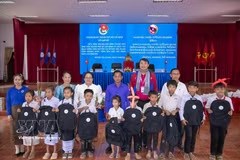
The school's board of management receives a certificate of merit from the Vientiane Capital Association of Vietnamese People. (Photo: VNA)

Nguyen Du School reinforces Vietnamese language preservation in Laos

Nguyen Du Lao–Vietnamese Bilingual School in Vientiane occupies a particularly important position, contributing to Vietnamese-language education, cultural preservation and the development of a knowledgeable and skilled young generation, while helping strengthen the special ties between Vietnam and Laos.