Vietnam steps up efforts to address post-war UXO contamination

More than half a century after the war, millions of unexploded bombs and mines remain buried underground, threatening lives and hindering development in many localities.

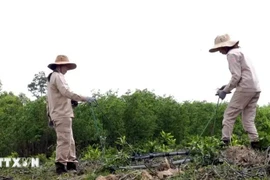
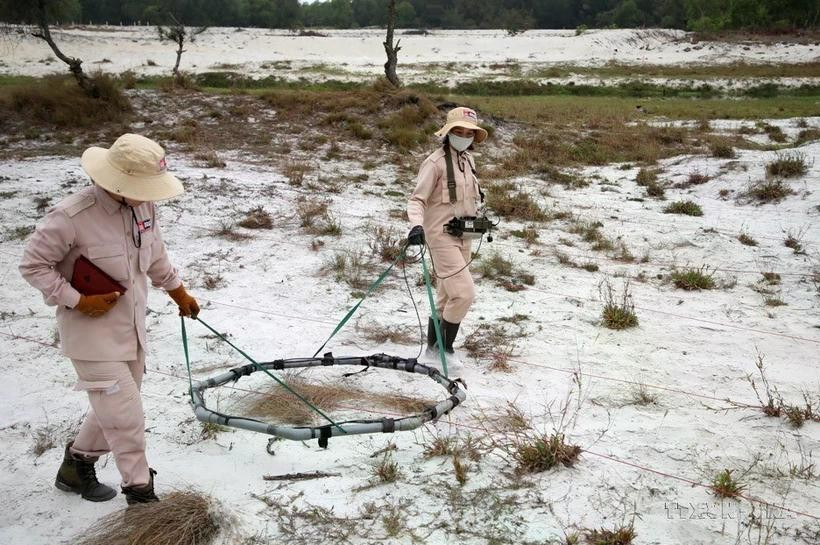
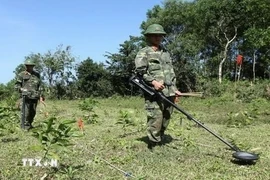
A bomb and mine clearance activity in Quang Tri province. (Photo: VNA)

Hanoi (VNA) - Efforts to address the consequences of unexploded ordnance (UXO) not only tackle the remnants of war but also pave the way for the revival of once-devastated land areas.

More than half a century after the war, millions of unexploded bombs and mines remain buried underground, threatening lives and hindering development in many localities.

According to the Vietnam National Mine Action Centre (VNMAC), Vietnam remains littered with about 800,000 tonnes of UXO left over from the war. As of 2023, Vietnam had more than 5.6 million hectares of UXO polluted areas, or nearly 17.7% of the country’s total area. Since 1975, UXO left over from the wars has killed more than 40,000 people and injured 60,000 others, the majority of whom are breadwinners of families or children.
uxo2.jpg
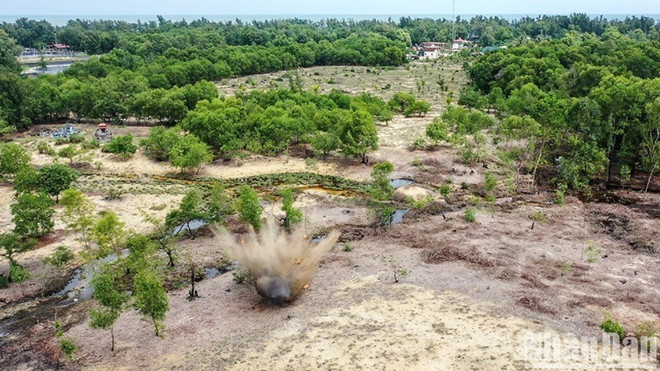
A bomb and mine clearance activity in Quang Tri province. (Photo: https://nhandan.vn/)

In fierce battlefields in the past such as Quang Tri, Quang Binh, and Ha Tinh, people still farm on fields riddled with hidden dangers. In Can Loc district of Ha Tinh province, which endured tens of thousands of bombings, all 17 communes and towns are contaminated with explosive remnants. Over the past 30 years, the area has recorded 36 bomb-related victims, including 15 fatalities. The consequences of UXO persist across generations as children are unable to attend school, land is abandoned, and projects are delayed.

In response to this situation, the Government approved a national mine action programme for the 2010–2025 period, aiming to mobilise domestic and international resources to reduce and ultimately eliminate the impact of post-war bombs and explosives, towards supporting socio-economic development and ensuring public safety.

According to the Ministry of National Defence, more than 500,000 ha of land have been cleared over the past 15 years. Millions of bombs, artillery shells, grenades, and anti-personnel mines have been safely detected and disposed of. In March 2014, the VNMAC was established to coordinate demining efforts nationwide. The centre has developed a modern database and contamination mapping system to support efficient clearance. Each area that is cleared not only becomes safe again but also opens up new opportunities for farming, construction, and infrastructure development.

International support plays a crucial role in this scheme. The US government has provided over 250 million USD for survey and clearance operations. A joint project between Vietnam, the Korean International Cooperation Agency (KOICA) and the United Nations Development Programme (KOICA-UNDP) for the 2022–2026 period, with a total funding of 25 million USD, is currently being implemented in Quang Binh and Quang Tri – the two most heavily contaminated provinces in the country.

Since 1999, the non-governmental organisation Mines Advisory Group (MAG) has cleared over 286 sq.km of land and destroyed more than 350,000 explosive items. Thanks to large-scale clearance campaigns, contaminated areas are gradually being revived.

Mine risk education programmes have also been introduced in schools in high-risk areas, helping children know how to recognise and stay away from explosive hazards.

In Ha Tinh province, awareness-raising campaigns and livelihood support programmes have been arranged, benefiting hundreds of victims.

Since 2014, the Vietnam Association for Supporting UXO/Mine Action (VNASMA) has provided livelihood assistance to over 6,000 victims, implemented social welfare programmes, and conducted mine risk education campaigns for millions of people, including students.

VNASMA Standing Vice President Lieutenant General Pham Ngoc Khoa said in the post-war context where severe consequences remain, supporting UXO victims is not only a humanitarian duty but also a powerful expression of solidarity, resilience, and the Vietnamese people's enduring will to overcome hardships./.
VNA

See more

Nguyen Mai Khanh Chi, a student in the Faculty of Arts and Humanities at the University of Hong Kong (Photo: VNA)

President Ho Chi Minh’s legacy drives Vietnamese students in Hong Kong to deepen ties

Nguyen Nhan Tri, President of the Vietnamese Students’ Association in Hong Kong and a student at Hong Kong Metropolitan University, committed to continuous learning and self-improvement to carry forward the spirit of previous generations, adding that each stage of President Ho Chi Minh’s journey shaped his political thought, moral values and lifestyle, which remain principles that guide many Vietnamese today.

PM Le Minh Hung speaks at the event (Photo: VNA)

Labour productivity key to double-digit growth: PM

The PM affirmed that safeguarding the legitimate rights and interests of workers is not only a social mandate but also an important foundation to raise productivity, enhance business efficiency, and sharpen economic competitiveness.

Deputy PM Pham Thi Thanh Tra and officials offer incense at the ceremony (Photo: VNA)

Excavation for war remains begins in Quang Ngai

Y Ngoc, Permanent Vice Chairwoman of the provincial People’s Committee and head of the provincial Steering Committee for the search, recovery and identification of martyrs’ remains, said the mission aims to conduct definitive excavation and verification to bring home the remains of martyrs from Regiment 24A, the B3 Front, Special Forces Battalion 406, and Infantry Battalion 304, who fell during the 1968 Tet Offensive.

At the working session (Photo: VNA)

Vietnam, Laos hasten 500-day campaign to identify martyrs' remains

The campaign to search for, recover, and identify the remains of Vietnamese volunteer soldiers and experts is a major policy of the two Parties and States, embodying a shared tradition of gratitude and remembrance and profound respect for those who laid down their lives for national liberation, defence, and noble international duties.

A building on the campus of Hanoi Medical University (Photo courtesy of the university)

Four Vietnamese universities rise in global rankings

According to the 2026 CWUR World University Rankings released on June 1, Duy Tan University remained the highest-ranked Vietnamese institution, climbing 33 places to 936th globally and placing in the top 4.4% of universities worldwide.

Specialised personnel collect samples from the remains of unidentified fallen soldiers at the Duc Linh commune Martyrs’ Cemetery in Lam Dong province for DNA identification and verification. (Photo: VNA)

Scientific advances applied to identify unnamed fallen soldiers

The activity, carried out at the Duc Linh commune Martyrs’ Cemetery, marks an important step in applying scientific and technological advances to help identify fallen soldiers while responding to the long-standing aspirations of their families and relatives.

Floodwaters inundate parts of Da Nang in October 2025. (Photo: VNA)

Da Nang explores ‘sponge city’ model to tackle urban flooding

The central city of Da Nang is exploring the “sponge city” model and other nature-based solutions to strengthen its resilience against urban flooding as climate change and rapid urbanisation place increasing pressure on existing drainage infrastructure.

Maj. Gen Nguyen Quoc Toan, spokesman of the Ministry of Public Security and Chief of its Office, speaks to reporters. (Photo: VNA)

Ministry details early gains in IP violation crackdown

Police across the country have initiated criminal proceedings in 56 cases, involving 98 suspects, for violations of copyright and related rights, industrial property offences, and the production and sale of counterfeit goods. Administrative fines were also stepped up, with 216 individuals fined more than 850 million VND (32,600 USD) in the first month.

Vietnamese guest workers are bound for Japan, RoK (Photo: VNA)

Vietnam sends over 53,100 workers abroad in five months

Japan remained the top destination, taking in 24,030 workers, including 10,750 women. Taiwan (China) followed with 21,104 workers, 6,752 of them women. The Republic of Korea (RoK) received 3,217, China 1,498, Singapore 704, Greece 441 and Russia 344.