Hanoi (VNA) – Vietnam’s economy expanded by 8.02% in 2025, a robust performance underscoring the country’s resilience and policy effectiveness amid lingering global uncertainty, according to Nguyen Thi Huong, Director General of the National Statistics Office (NSO).
Despite a year marked by volatility and external challenges, Vietnam achieved impressive growth thanks to coordinated efforts across the political system, business community, and wider society.
Quarterly data reflected a clear upward momentum, with growth accelerating from 7.05% in the first quarter to 8.46% in the fourth, signalling steadily strengthening economic activity throughout the year.
The final quarter served as a decisive acceleration phase, as macroeconomic policies generated their strongest spillover effects and economic sectors moved in synchrony to drive expansion.
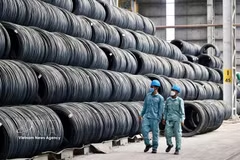
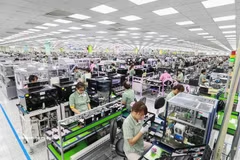
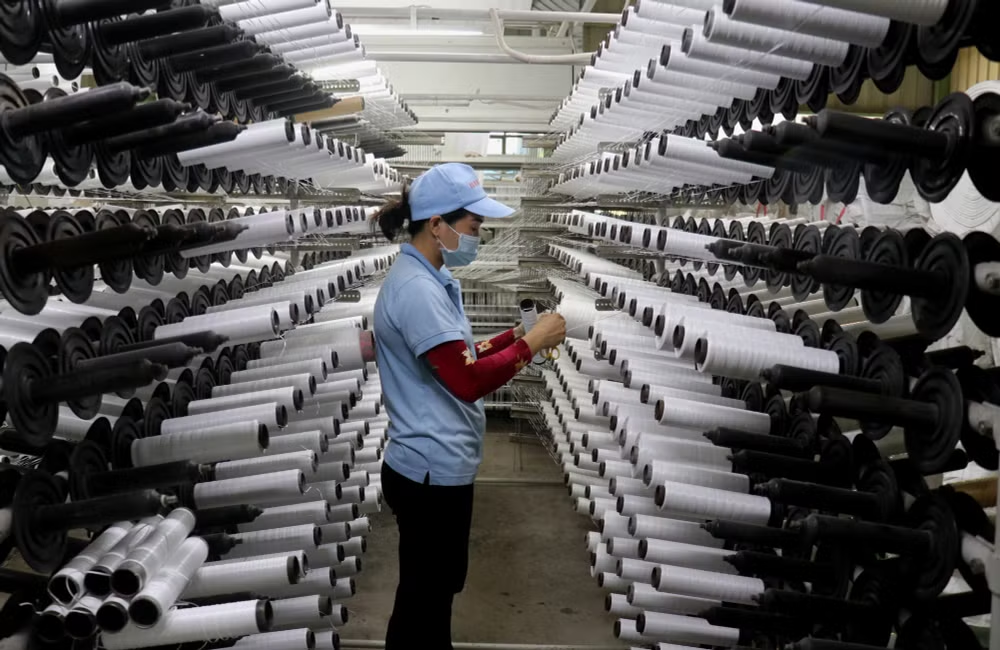
On the supply side, industry and construction led growth, rising 8.95% year-on-year. Manufacturing and processing, widely regarded as the economy’s core engine, maintained its pivotal role with growth of 9.97%.
Services staged a strong rebound, expanding 8.62%, supported by nationwide celebrations marking the 50th anniversary of the Liberation of the South and the 80th anniversary of National Day. Accommodation and food services grew 10.02%, transportation and warehousing 10.99%, and arts, entertainment, and recreation 11.3%.
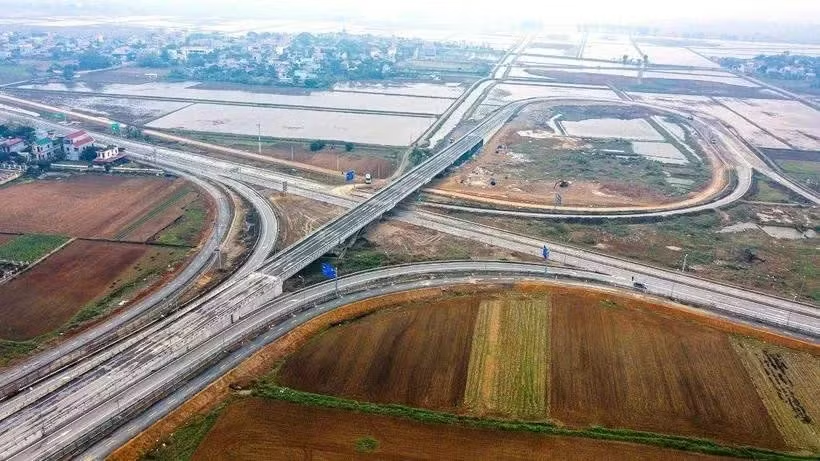
State budget-funded investment surges by 26.6% compared to 2024, acting as “seed capital” to stimulate overall social investment and sustain confidence among foreign direct investors. (Photo: VietnamPlus)
Meanwhile, agriculture, forestry, and fisheries were a stabilising pillar, posting growth of 3.78% despite natural disasters and outbreaks of African swine fever.
On the demand side, three main drivers underpinned economic momentum in 2025.
Domestic consumption recovered strongly, with final consumption rising 7.95%. E-commerce expanded by more than 20%, placing Vietnam among Southeast Asia’s two largest digital markets. The continued 2% VAT reduction further stimulated spending, helping total retail sales of goods and services increase 9.2%.
Public investment played a catalytic role, with State budget capital surging a record 26.6% compared to 2024. This “seed capital” boosted total social investment by 12.1% and sustained foreign direct investment inflows, which rose 11.7%.
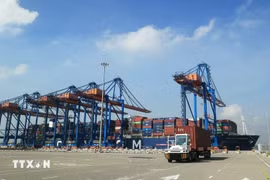
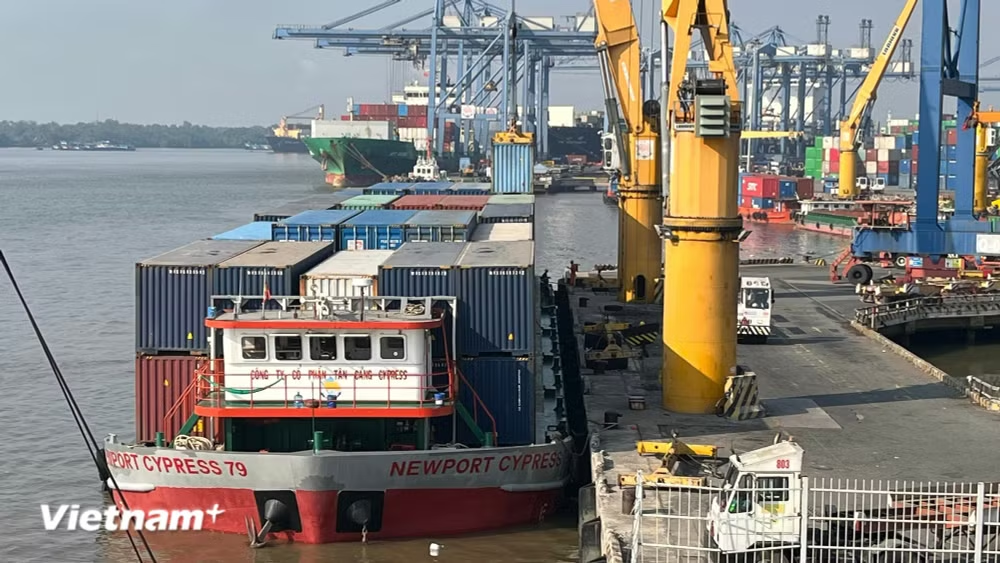
Trade activity also set new records, with total import–export turnover surpassing 930 billion USD, up 18.2%, alongside a trade surplus of 20 billion USD, highlighting the enduring competitiveness of Vietnamese exports.

According to Huong, export performance in 2025 stood out as a remarkable achievement against strong global headwinds. Export turnover reached approximately 475 billion USD, up 17% year-on-year, despite rising protectionism and reciprocal tariff measures, particularly in the US market.
Three factors defined export success. First, export quality improved significantly, with processed industrial goods accounting for 88.7% of total export value, signalling deeper integration into global value chains.
Second, agriculture recorded both strong output and favourable prices. Coffee export value surged 58.8%, pepper rose 26.3%, and cashew exports increased 20.4%, reflecting stronger compliance with traceability requirements and green production standards.
Third, Vietnamese exporters demonstrated notable market resilience. The US remained the largest export destination, reaching a record 153.2 billion USD, up 28.2%, despite mounting trade barriers.
The record export performance and trade surplus helped balance international payments while strengthening foreign exchange reserves, contributing to macroeconomic stability.
Looking ahead, Huong described double-digit growth, above 10%, as a strategic aspiration reflecting Vietnam’s determination to escape the middle-income trap and move to a higher development stage. While the 8.02% expansion in 2025 provides a solid launchpad, sustaining faster growth will require stronger coordination and deeper reforms.
Five key conditions were outlined.
First, maintaining macroeconomic stability through effective inflation control, safe public debt management and balanced major economic indicators to preserve policy flexibility.
Second, mobilising investment more effectively, with public investment continuing to act as catalytic capital while accelerating major infrastructure projects and attracting high-quality FDI tied to technology transfer and environmental standards.
With these foundations in place, Vietnam’s economy is poised to enter a new and promising growth cycle. (Photo: VietnamPlus)
Third, transitioning toward a productivity-driven growth model powered by science, technology and innovation, reducing reliance on low-cost labour and improving capital efficiency.
Fourth, harnessing the digital economy for new growth, expanding development space as digital transformation spreads across all sectors.
Finally, institutional breakthroughs are needed to create a more transparent business environment, lower compliance costs and strengthen investor confidence, thereby unlocking development resources./.