Hanoi (VNA) – On the 50th anniversary of the liberation of the South and national reunification (April 30, 1975-2025), former war reporters of the Việt Nam Thông tấn xã (VNTTX) (now Thông tấn xã Vietnam - Vietnam News Agency - VNA) and the Liberation Press Agency (LPA) who covered the Ho Chi Minh Campaign in April 1975 have recalled the arduous yet heroic time.
On October 12, 1960, in Chang Riec forest in the southwestern province of Tay Ninh, the LPA issued its first bulletin, entitled "Liberation News," officially announcing the establishment of the official news agency of the National Front for the Liberation of South Vietnam. From that point until the end of the resistance against US imperialism, the LPA consistently fulfilled its glorious mission of providing timely information to encourage the righteous struggle of the military and people in the South for peace and national reunification.
The LPA is a unique case in the history of the world journalism. It is the news agency and mouthpiece for a resistance force, born in the midst of enemy bombs and growing during the most brutal phase of the war.
From 1961 to 1962, the network of the LPA gradually formed across nearly all provinces and cities in the Southeast and Southwest regions, including Sai Gon -Gia Dinh and various command posts of the liberation army.
As the conflict in South Vietnam intensified, the demand for revolutionary propaganda information became urgent. Many young people and intellectuals were mobilised to participate in the information front to support the armed forces' operations. Some were trained as reporters to write and edit news, while others engaged in liaison and logistics work to ensure non-stop and updated information flow.
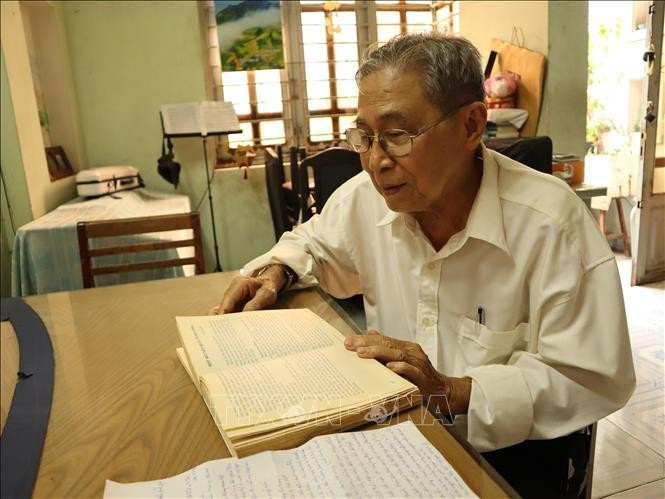
Recalling his chance to become a reporter, journalist Nguyen Thanh Ben, a former reporter for the LPA, shared that in 1963, while serving as a communication officer in Long An, he and many others were ordered by the Long An provincial Party Committee to attend a second training course in propaganda journalism at the Central Office for South Vietnam. After completing the course, he was assigned to the LPA to edit news from localities and then, transmit to Hanoi.
"At that time, the LPA operated in the resistance base area along the Tay Ninh - Cambodia border, where living and working conditions were extremely difficult. Without desks or chairs, reporters used tree branches to write news articles. When paper was scarce, we would wash used paper in the stream, dry them, and reuse them; often we wrote while watching for enemy reconnaissance aircraft. For safety, the telegraph team and reporters had to stay far apart. Whenever we needed to send news, the telegraph team had to carry a hand-cranked generator far from the base to avoid detection by the enemy's radio waves," Ben recalled.
During his time in the war zone, Ben and his colleagues experienced eight relocations, each requiring them to carry heavy machinery and equipment, traversing forests and streams regardless of day or night. LPA reporters not only performed their journalistic duties but also participated in various tasks such as digging shelters, creating trenches, building housing, digging wells, transporting rice, milling grains, carrying paper for the printing house, growing vegetables, and managing food supplies.

Pham Thi Loan, who was later nicknamed “The little liaison of the Liberation Press Agency,” recounted that her parents moved from Hanoi to Cambodia to open a tailoring shop in 1948. By the end of 1967, at the age of 15, she lived comfortably with her family in Phnom Penh, going school by car.
With her French competence, she initially planned to join a group of female students training to be nurses. However, her older sister, who worked as a typist for the LPA's reporting team, advised her to join the agency instead. They decided to "go into the jungle" without informing their family, and the night before her departure, her mother learned of it and stayed up late to sew her two shirts.
After joining the LPA and working in the Tay Ninh -Cambodian border area, Loan was assigned to receive and classify news reports, delivering them to reporters for editing and to telegraph operators for transmission to Hanoi.
“One evening in 1971, while I was transferring news in Dam Be area near the Cambodian border, I suddenly heard the roar of B-52 bombers overhead. I quickly ran towards the group of reporters to find shelter. Just as I jumped into the bunker, before I could get my bearings, I heard bombs exploding right next to me. That time, many people, including soldiers and reporters, lost their lives. Pushing aside the grief and loss, those of us who remained had to quickly gather our belongings, machinery, and equipment to relocate to a new site and continue our mission of maintaining seamless communication,” Loan recalled.
Leaving classes, heading to battlefield
From 1970 to 1975, the LPA consistently received regular support in personnel and equipment from the VNTTX. A team of reporters, technicians, and telegraphers, trained in all aspects, was continuously deployed to the southern battlefield to meet the information needs, update news for the entire nation, especially in preparation for the liberation day.
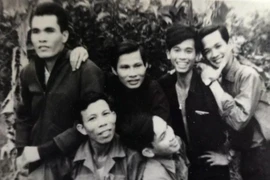
In July 1972, as the southern battlefield was reaching a peak towards liberation, nearly 150 students and graduates from universities in Hanoi were selected to attend a training course for war correspondents. These were the trainees of class GP10, tasked with supporting the LPA.
The students studied majors of foreign languages, physics, and biology, none of which were related to journalism. They received thorough training from experienced journalists like Thep Moi, Xich Dieu, and Thanh Dam, who provided knowledge about journalism, writing skills, and updates on the military situation in the South.
Recalling the early days of participating in the training course in Hoa Binh, journalist Hoang Dinh Chien, a former reporter from class GP10, remarked that while learning to become a reporter in peacetime mostly required writing and photography skills, war correspondents needed to develop physical endurance and survival skills to navigate rivers, trek through forests, and cross the Truong Son mountains to reach their work sites.
“As students who are only familiar with books, we had to practice carrying bricks and moving across mountainous terrain. Each person stuffed 10 to 12 bricks into their backpacks, carrying them on their backs. Even with torn clothes and mats to cushion our backs, each time we lifted our backpacks, the bricks would hit our spines painfully. In those early days, after practice, everyone’s back was bruised. We were so exhausted that we were unable to get up on our feet,” Chien said.
After a period of training, by March 1973, 108 reporters were assigned to various units to support the LPA. The teams traveled along the Truong Son mountains and into Laos.
Journalist Nguyen Sy Thuy, a former LPA reporter, was a fresh graduate of the Biology Faculty at the University of Hanoi when he was selected to attend the war correspondent training course. Just three days after getting married, Thuy and his colleagues set off to support the LPA.
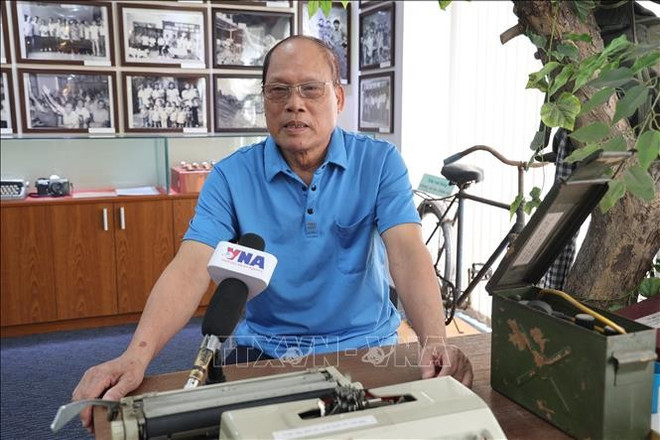
On March 16, 1973, he and the GP10 reporters began their journey to the southern battlefield. The trip lasted nearly three months, filled with unforgettable experiences and memories. Their North-South journey involved not only crossing high passes and deep streams but also facing life-and-death situations. After several legs of travel by train and on foot, upon reaching the Vietnam-Laos border, the reporters boarded open-top trucks for an overnight ride, arriving at the military station at 1 or 2 am to finally rest.
“When the truck carrying us reached Attapeu province (Southern Laos), it overturned, resulting in three fatalities and over 20 injuries, many of whom were severely hurt and unable to continue, forcing them to return north. Regaining our spirits, we continued our march on foot, and after nearly three months, we finally reached the southern battlefield to take on our mission,” Thuy recounted.
After a short period of operation in Tay Ninh, in early 1974, Thuy and two colleagues were assigned to reinforce the Southeastern bureau located in military zone D in Ma Da forest of Dong Nai, to carry out information duties in the area.
That was a complex region with diverse terrain and communities, where many villages were far away, requiring weeks of travel along forest trails; some areas were notorious for their "anti-communist" sentiment, creating a tense mix of friend and foe. Here, he frequently visited bases, infiltrated enemy areas, took photographs, and wrote reports on labour production movements and the activities of soldiers and guerrillas.
Choosing the path of a war correspondent, Thuy faced many hardships, but the greatest nightmare for him was not the moments spent under fire or close to the enemy, but rather the "mung beans."
“When the base ran out of rice and resupply was delayed, we only had our homegrown mung beans. Eating a heavy amount of mung beans caused us to feel extremely bloated and uncomfortable," Thuy recalled vividly, even after more than 50 years./.