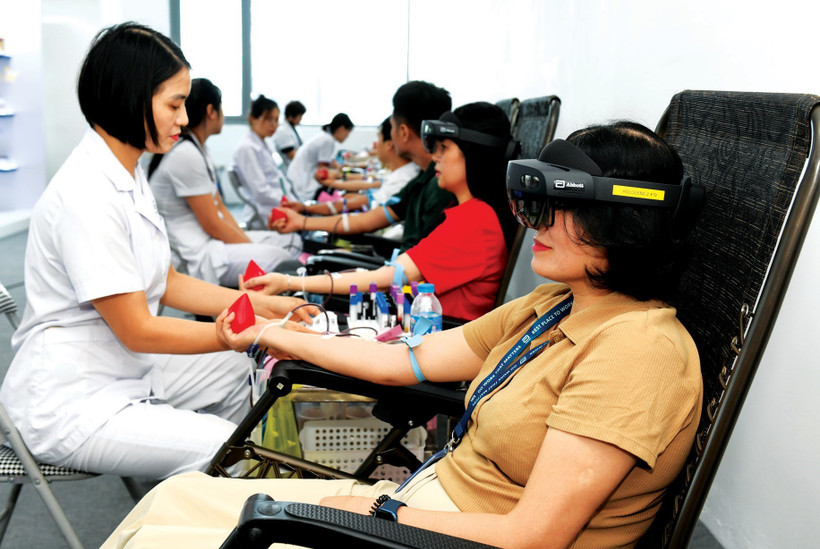
Hanoi (VNA) - As Thanh Thuy entered the blood donation room in downtown Hanoi, she was handed a modern-looking, lightweight headset.
Thuy, an Abbott Vietnam employee, was testing an upgraded version of the company’s mixed reality technology during one of its three blood donation events held in Ho Chi Minh City and Hanoi this month to mark World Blood Donor Day on June 14.
The experience was created by Abbott, the global leader in blood screening and plasma, and Blood Centres of America, the largest blood supplier network in the US, to help distract blood donors and reduce their anxiety levels. This can help encourage young people to return to give blood.
Wearing the headset, blood donors enter a digital world with soothing music, moving their eyes to control a cursor and complete different tasks. At the same time, they remain fully aware of their real-world surroundings, allowing blood donation professionals to safely conduct the procedure and interact with donors at every step of the process, as donors’ eyes are always visible.
The upgraded version this year includes two games. Thuy from Abbott Vietnam and other donors could either choose to plant seeds in a zen garden while listening to relaxing music or build a robot team to explore planets and solve puzzles.
“I think combining blood donation with mixed reality technology is a wonderful initiative,” said Dr Nguyen Thi Hong Trang from the Blood Transfusion Centre at Viet Duc Friendship Hospital.
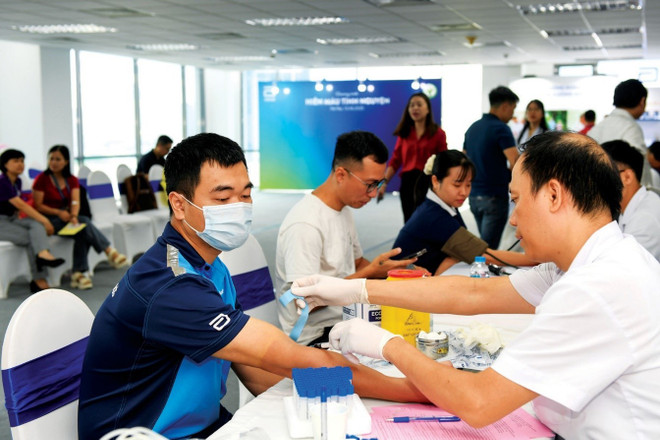
“I found the experience refreshing and engaging. It’s a great way to encourage more people to donate blood, especially those who may feel hesitant or are donating for the first time,” she said at the event held in Hanoi on June 13 by Abbott and Viet Duc Friendship Hospital.
Following the launch of the new technology in the United States two years ago, an Abbott study published in early 2024 showed that 68% of blood donors who experienced pre-donation anxiety said the use of mixed reality during donation decreased their reported anxiety, while 89% of donors said they wanted to give blood again.
Abbott’s mixed reality innovation fits well with Vietnam’s campaign for voluntary blood donation to help meet the basic blood demand for emergencies and treatments in the Southeast Asian country of around 100 million people.
In 2000, the Government issued a directive encouraging people to donate blood, naming April 7 National Voluntary Blood Donation Day. Since then, the movement has gained nationwide popularity and recorded positive outcomes.
In 2024, Vietnam received more than 1.7 million units of blood, or 7.4 times the quantity recorded in 2000, while the voluntary donation ratio accounted for 98% of total blood collection, up 30% in four years, according to data from the National Institute of Haematology and Blood Transfusion.
Following Abbott’s blood donation events, mixed reality technology will soon be introduced at different blood centres in Hanoi and HCM City, so more donors in Vietnam will be able to try it.
Life-changing tech
The change in blood donors’ experience thanks to Abbott’s innovation is part of the company’s effort to introduce life-changing technologies to transform healthcare, from management to providing support for more effective treatments and better outcomes.
The FreeStyle Libre® continuous glucose monitoring system, a first-of-its-kind wearable sensor-based technology that made its 2014 debut in Europe, has now empowered millions of people with diabetes in more than 60 countries to manage their glucose levels without having to go through the routine use of painful fingersticks up to four times per day.
Following the launch of the system in Vietnam in March 2021, people with diabetes and their doctors could get a detailed picture of glucose levels and actionable insights thanks to a quick scan of the FreeStyle Libre sensor worn on the back of the upper arm. Based on clinical trials and real-world data, FreeStyle Libre system users have better glucose control, decreased occurrences of hyperglycaemia and hypoglycaemia, as well as reduced hospitalisations and HbA1C levels, significantly improving their quality of life.
However, the FreeStyle Libre system is not the first technology Abbott brought to Vietnam in its effort to help control diabetes, one of the most challenging chronic health conditions. In 2020 and 2021, Abbott launched a new and enhanced reformulation of Glucerna®, which was designed to improve insulin sensitivity and achieve glycaemic control within four weeks.
Along with Glucerna, the company’s science-based nutrition products, such as Ensure® and PediaSure®, have been marketed to help strengthen immunity and prevent malnutrition across different life stages.
Many of Abbott’s technological innovations are directed at supporting healthcare professionals by providing accurate and timely information for treatment decisions and better results, making patients the final beneficiaries.
The company’s Alinity® diagnostic systems offer high levels of automation, exceptional accuracy and fast processing speeds, allowing healthcare professionals to make timely treatment decisions, especially in chronic and emergency care settings.
Among the technology breakthroughs developed to maximise the effects of minimally invasive treatments, Abbott’s XIENCE™ Drug-Eluting Stents have become the world’s leading drug-eluting stent, delivering unparalleled outcomes, exceptional safety and efficacy.
After receiving regulatory approval in the EU in 2006 and the United States in 2008, the stents have been made available in many countries, including several in Asia.
Other devices invented for cardiovascular patients and brought to Vietnam include the HeartMate 3™ Left Ventricular Assist Device, a heart pump that aims to improve haemocompatibility and reduce complications in patients with advanced heart failure, and the Amplatzer Piccolo™ Occluder, which treats premature infants and newborns with an opening in their heart (patent ductus arteriosus), without the need for open-heart surgery.
Abbott’s innovations, from im- mersive digital experiences in blood donation to life-changing health technologies, reflect the long-term commitment of the diversified US healthcare company established in 1888 to help people in more than 160 countries across the globe lead healthier, better lives.
The company’s technology port- folio spans the spectrum of health- care, with leading businesses and products in diagnostics, medical devices, nutritional supplements and medicines.
Since its 1995 arrival in Vietnam, Abbott has consistently contributed to building a healthier community.
“We are dedicated to bringing our technology and innovations to Việt Nam, advancing healthcare and fostering a healthier, stronger future for all,” said Douglas Kuo, Divisional Vice President and General Manager of Abbott in Vietnam. The company celebrates 30 years in the country this year.
Over the three decades of operation, Abbott and the Abbott Fund have invested over 280 billion dong (nearly 11 million USD) to help address critical health issues, with a focus on improving nutrition, preventing and treating chronic diseases such as diabetes and cardiovascular problems, training medical professionals and raising public awareness about healthcare./.