Ancient features of Dinh Bang communal house

As a massive ancient structure containing unique traditional wooden art decoration values, Dinh Bang communal house in Tu Son town, northern Bac Ninh province, has long been considered one of the three most beautiful communal houses in the region formerly called Kinh Bac (Northern Region) – a land with a long history and ancient culture.
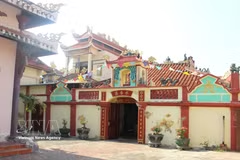
Ancient features of Dinh Bang communal house ảnh 1The roof of the communal house is one of the largest of its kind in Vietnam (Source: Vietnam Pictorial)

Hanoi (VNA) - As a massive ancient structure containing unique traditional wooden art decoration values, Dinh Bang communal house in Tu Son town, northern Bac Ninh province, has long been considered one of the three most beautiful communal houses in the region formerly called Kinh Bac (Northern Region) – a land with a long history and ancient culture.
The communal house is about 20km north of the capital city of Hanoi.

The construction of Dinh Bang communal house was initiated by a mandarin in the village namely Nguyen Thac Luong. He and his spouse Nguyen Thi Nguyen along with locals in the region donated workdays and money to build the communal house.

Dinh Bang house is used for worshipping Cao Son Dai Vuong (Mountain Spirit), Thuy Ba Dai Vuong (Water Spirit), and Bach Le Dai Vuong (God of Agriculture), together with the six individuals who rebuilt the village in the 15th century after it was devastated during the Ming occupation (1408-1428).

The communal house is located on a high ground and faces the south. It was surrounded by 17 lakes – which were the remains of Tien Luong (or Tieu Thong) river, a canal which was linked to the Duong River and served as a convenient water way for the Kings of the Ly dynasty (1009-1225) to come to visit the area from Thang Long, the then royal capital. Yet only a small lake in front of the communal house still exists.

Long ago, it had a three-entrance gate with a left wing and a right wing. It was destroyed during the wartime. There now remain only the Hall of Ceremonies and a corridor leading to the Inner Room.

The Hall of Ceremonies is 20 metres long, 14 metres large and comprises seven smaller compartments and two wings. Its elevated floor is covered with blue stones and stairs. The roof is supported by 60 ironwood columns and a framework of valuable wood, which are elaborately sculptured with common images such as dragon figures.

Two big ceremonies held annually in Dinh Bang communal house are the traditional festival on the 12th day of the second lunar month and the festival in commemoration of the establishment of the Ly dynasty on the 15th day of the third lunar month.

The communal house’s interior is decorated with many themes such as dragon, phoenix, pine, apricot, bamboo, wine gourd, and sword. In particular, the dragon image occupies a large proportion with about 500 images totally. The main hall (the nave) has a low floor which is paved with “nem” leaf tiles. This space is the lowest part called "boat bed". The plank floors of the two sides are gradually higher with two levels, distinguishing the status of the officials, who sit "upper" or "below" depending on their position in the village.

Previously, Kinh Bac consisted of Bac Giang province and Dong Anh and Long Bien districts of Hanoi. The region is associated with several legends and is considered the cradle of the Dai Viet (Great Viet) civilization.

Located in the center of the Red River Delta, Kinh Bac is blessed with fertile land, beautiful landscapes and favorable conditions for economic and cultural exchanges with other localities throughout the country.

Ancient features of Dinh Bang communal house ảnh 2Dinh Bang communal house is located in Tu Son town, Bac Ninh province (Source: Vietnam Pictorial)

Since the early years before Christ, the region was one of the cradles of the wet rice civilization and the founding place of the Great Viet civilization. It is home to several relics, pagodas, towers, temples and stupas which were built under several feudal regimes.

Kinh Bac is also famous nationwide for its folk festivals, especially Quan Ho folk singing, an art form that combines various elements, including music, lyrics and costumes, and features the distinctive culture of people in the region formerly called Kinh Bac.

The singing represents different kinds of relationships -- the relationship between male and female singers as romantic lovers, the relationship between two friendly villages and the relationship between performers and the audience. Each element helps define quan ho, give it life and meaning, and the resulting harmony is so much more than just a beautiful song.

From only 49 original Quan ho villages and 34 clubs, there are now 369 Quan ho villages and 381 clubs with over 10,000 members. Especially, more than 140 clubs are run in other provinces and by overseas Vietnamese communities.

The art of love duets was inscribed in UNESCO’s representative list of intangible cultural heritage in September 2009./.
VNA

See more

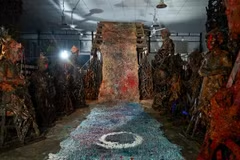
An installation by Le Huu Hieu at the 61st Venice Art Biennale in Italy (Photo courtesy of Venice Art Biennale)

Vietnam lacquer artists debut at Venice Biennale

Vietnam's appearance at the Venice Art Biennale 2026 is not only a symbolic milestone for the country's fine arts scene but also a new chapter in the integration of Vietnamese art into the global landscape.

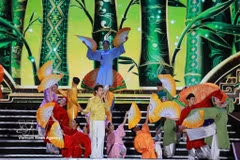
A performance at the art programme to welcome the New Year 2026. (Photo: VNA)

Spreading Vietnamese cultural identity in digital space

In the context of deep international integration, cultural identity serves as both a “shield” against assimilation and a defining marker of a nation’s image. Protecting and promoting uniquely Vietnamese cultural values has therefore become a pressing task, particularly in an increasingly complex digital environment.

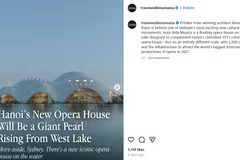
Hanoi’s New Opera House takes center stage for the global travel elite, drawing comparisons to the world’s most legendary architectural icons. (Photo: travelandleisureasia)

Asia’s leading luxury travel magazine hails Hanoi's new opera house: "Move aside, Sydney"

The magazine opened its feature with a bold declaration: "Move aside, Sydney. There’s a new iconic opera house on the water." The fact that Hanoi’s architectural masterpiece is being showcased by a platform that shapes the trends of the global travel elite is a clear testament to the project's worldwide appeal. International experts have already begun to place the Hanoi Opera House on the same scale as the most legendary icons on the planet.

The display space of the archival photo exhibition “Echoes of a New Era” at the Imperial Citadel of Thang Long. (Photo: VNA)

Exhibition traces Vietnam’s post-reunification journey

Showcasing more than 70 documentary images, the exhibition highlights Vietnam’s journey from the 1975 Spring Victory through the early years of recovery and reconstruction, with a spotlight on the nationwide general election on April 25, 1976.

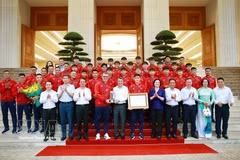
Prime Minister Le Minh Hung and members of Vietnam’s national U17 men’s football team pose for a group photo. (Photo: VNA)

PM hails U17 football team’s ASEAN triumph, sets sights higher

Presenting a certificate of merit to the team, the PM praised their championship run as a compelling and remarkable journey marked by resilience, determination, and a strong competitive spirit. The team remained unbeaten throughout the tournament, recording four wins and one draw while scoring 19 goals.

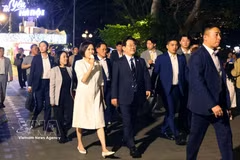
President of the Republic of Korea Lee Jae Myung and his spouse take a stroll around Hoan Kiem Lake in Hanoi during a visit to Vietnam in April 2026. (Photo: VNA)

Vietnamese cuisine gains global spotlight through leaders’ street food moments

In recent years, Vietnamese dishes have gained wider global recognition through travellers and international rankings. A social media group named “Vietnam Banh Mi Appreciation Society,” with nearly 200,000 foreign members, is dedicated to reviewing banh mi from street stalls to established shops, reflecting growing international enthusiasm for the dish.

Offering of cylindrical glutinous rice cakes to Hung Kings at Thuong Temple in Ho Chi Minh City (Photo: VNA)

Vietnam Culture Day: Rendezvous of identity, internal strength

Culture has long been described as the spiritual foundation of society, an internal strength, and a driver of development; yet for that idea to truly take root in everyday life, it must be translated into concrete, visible, and tangible policies.

Visitors explore blooming plum orchards in Hom hamlet, Chieng Coi ward, Son La province. (Photo: VNA)

Northwest cultural showcase to open in Son La in May

Conceived as an integrated cultural space, the Huong sac vung cao (Highland Hues) exhibition will bring together archival and artistic images alongside artefacts to depict the cultural and social life of ethnic communities, underscore the Party and State’s focus on upland areas, and reflect local development progress.

Van Thuy Tu temple in Phan Thiet ward, a well-known destination offering insight into the unique whale worship (Photo: VNA)

Historic coastal communal houses keep folk fishing traditions alive

Stretching along the coastal belt of Lam Dong province, centuries-old communal houses and temples worshipping the “Ong” (Whale God) stand as quiet custodians of history, embodying the distinctive cultural and spiritual life of Vietnamese coastal communities, while increasingly emerging as compelling cultural tourism attractions.

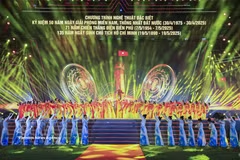
A special art programme is held in Dien Bien province in 2025 to celebrate the 50th anniversary of the Liberation of the South and the national reunification, the 71st anniversary of the Dien Bien Phu Victory, and the 135th anniversary of the birth of President Ho Chi Minh. (Photo: VNA)

Boosting traditional arts talents key to preserving cultural heritage

Politburo’s Resolution No. 80 on developing Vietnamese culture places a stronger emphasis on nurturing talent in traditional arts. It is expected to breathe fresh life into Vietnam’s cultural heritage, as these art forms face mounting challenges in the modern entertainment landscape.