Foreign students contribute 5 billion USD annually to Malaysia’s economy

The role of international students extends beyond universities, benefiting local communities and service sectors in areas where students live and study.

Kuala Lumpur (VNA) – The presence of around 167,000 international students currently contributes approximately 20 billion MYR (5 billion USD) annually to Malaysia’s economy through tuition fees, living expenses and other related spending.

The figure was cited recently by Novie Tajuddin, Chief Executive Officer of Education Malaysia Global Services (EMGS), during a Malaysian culture exploration programme held from August 21 to 23 at Pantai Teluk Ketapang.

EMGS is an organisation under Malaysia’s Ministry of Higher Education responsible for promoting international education and supporting the management of international students in the country.

According to Novie, an EMGS study found that each international student spends an average of around 10,000 MYR per month while studying and living in Malaysia.

He noted that the role of international students extends beyond universities, benefiting local communities and service sectors in areas where students live and study.

Local communities around universities benefit from demand for housing, food, transportation and other services. The presence of international students is also helping boost business activity among local enterprises, particularly those in the food and service sectors, while generating positive economic and social impacts in areas hosting higher education institutions.

Novie said Malaysia is currently regarded as one of the world’s top 14 higher education destinations, reflecting the country’s growing position in the international education market.

Countries such as the UK, the US, Australia and Canada were traditionally the top choices for international students. However, Malaysia is now also among the destinations being considered by an increasing number of foreign students.

He said Malaysia is emerging as a competitor in the global education sector, with the number of international students studying in the country rising by about 23% over the past three years.

Malaysia aims to attract 500,000 international students by 2035, in line with the goals set out in its 10-year higher education blueprint, he said.

To achieve this target, it is implementing various overseas education promotion programmes. EMGS plans to reach out to around seven to eight regions worldwide to promote Malaysian higher education institutions and enhance the country’s ability to attract international students.

Novie said China, Indonesia, Bangladesh, India and Pakistan are currently the five countries with the largest numbers of students in Malaysia. International students attend both public and private higher education institutions, with the majority pursuing postgraduate programmes./.

VNA

See more

The Strait of Malacca as seen from Malaysia (Photo: Xinhua/VNA)

Malaysia, Indonesia, Singapore reaffirm commitment to safeguarding key straits

At the 17th Cooperation Forum held in Singapore on August 25, the three nations affirmed the status of the SOMS as straits used for international navigation – where the right of transit applies, as enshrined in the 1982 United Nations Convention on the Law of the Sea (UNCLOS) and reflected in customary international law.

Singapore unveils measures to strengthen family support

Singapore unveils measures to strengthen family support

Prime Minister Lawrence Wong said that under the new childcare leave policy, each working parent will be entitled to eight days of leave per year if they have one child aged 12 or below, 10 days if they have two children, and 12 days if they have three or more children

Cambodia warns of new social media scam

Cambodia warns of new social media scam

The regulator advised users not to pay for account-protection services, share passwords or OTPs, or grant administrator access to strangers. Users should also avoid clicking suspicious links, enable two-factor authentication and grant administrator privileges only to trusted individuals.

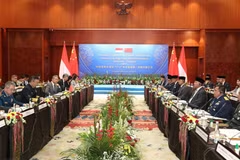
An overview of the Second Ministerial Meeting of China-Indonesia Joint Foreign and Defense Ministerial Dialogue (the second 2+2 meeting) held in Jakarta on August 21 (Photo: Xinhua/VNA)

Indonesia, China enhance strategic cooperation

President Prabowo Subianto welcomed the growing number of Chinese companies investing and doing business in Indonesia, and pledged to continue creating a favourable business environment for them.

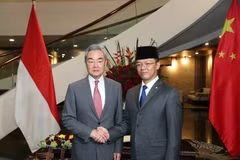
Indonesian Foreign Minister Sugiono (right) and his Chinese counterpart Wang Yi at the inaugural Comprehensive Strategic Dialogue (CSD) in Jakarta on August 21, 2026 (Photo: Xinhua/VNA)

Indonesia, China strengthen economic, defence-security cooperation

Indonesian Foreign Minister Sugiono and his Chinese counterpart Wang Yi co-chaired the CSD, a new ministerial-level bilateral dialogue mechanism established during Sugiono’s visit to China in April 2025. The mechanism aims to review cooperation outcomes and identify strategic priorities for bilateral relations.

Aquatic products is processed at Ba Ria-Vung Tau Seafood Processing and Import-Export Joint Stock Company (Baseafood) in Ba Ria ward, Ho Chi Minh City. (Photo: VNA)

Vietnam remains Cambodia’s top seafood supplier in H1

Vietnam remained Cambodia’s largest seafood supplier, with shipments to the neighbouring market valued at more than 33 million USD. China ranked second, with exports worth over 16 million USD. Imports from other markets, including Hong Kong (China), Australia, France, Japan, the Republic of Korea and Malaysia, totaled around 10 million USD.