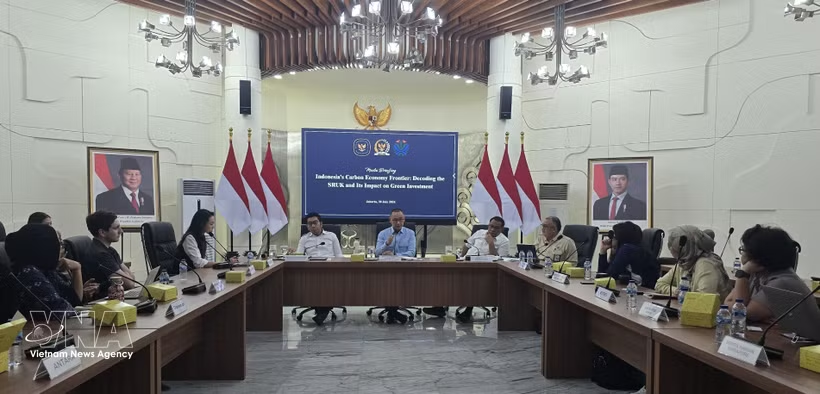
Jakarta (VNA) – Indonesia has launched its national Carbon Unit Registry System (SRUK), marking a major step in strengthening carbon market governance, improving transparency and creating new opportunities to attract green investment for the country's energy transition and emissions reduction efforts.
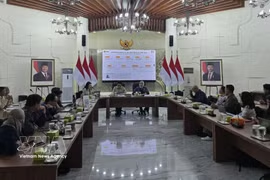
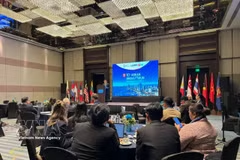
Speaking at a press conference in Jakarta on July 30, Indonesian Environment Minister Mohammad Jumhur Hidayat said the system is a key component of the country's new carbon market framework, providing a unified national database for all carbon units.
Officially operational since July 9, the SRUK records and tracks the entire lifecycle of every carbon unit, from issuance and transfer to trading, retirement, suspension or cancellation. Each unit is assigned a unique identification code containing information on its origin, emissions reductions, ownership and current status. Integrated with Indonesia's national carbon exchange and supported by blockchain technology, the system updates ownership records and transaction data after every trade.
Before carbon units can enter the market, projects must undergo measurement, reporting, validation and verification by accredited independent organisations to ensure emissions reductions are genuine. For cross-border transactions, transfers require approval from Indonesian authorities, while exported carbon units cannot be counted towards the country's own climate targets, preventing both buyers and sellers from claiming the same emissions reductions.
Eddy Soeparno, deputy speaker of Indonesia's People's Consultative Assembly, said the new legal framework and the SRUK would help transform the country's rich forest, peatland, mangrove and renewable energy resources into financing for green development.
He noted that Indonesia needs around 470 billion USD to meet its climate commitments, in addition to about 100 billion USD for a programme to develop 100 GW of solar power. As public funding alone will not be sufficient, the carbon market is expected to become an important source of finance for clean energy, forest conservation and emissions reduction projects.
Estimates presented at the press conference suggest that effectively unlocking the economic value of carbon could contribute up to 21 billion USD to Indonesia's economy by 2030, with forestry and renewable energy expected to generate the largest share.
However, Soeparno stressed that building the registry is only the first step, saying Indonesia must now develop high-quality carbon credit projects that meet international standards while ensuring communities protecting forests and ecosystems receive a fair share of the benefits./.
Indonesia advances 93 hydrogen projects worth 2 bln USD
Indonesia is implementing 93 hydrogen ecosystem development initiatives, with a total investment value of 32 trillion IDR (2.05 billion USD), according to Indonesian news agency Antara.