ASEAN stresses rules-based maritime cooperation to enhance regional resilience

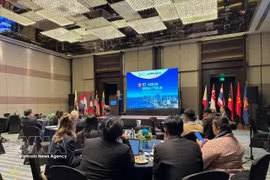
Participants at the panel discussion on ASEAN’s role in promoting rules-based maritime cooperation highlighted the bloc’s strategic role in maritime governance amid intensifying geopolitical competition, supply chain disruptions and growing non-traditional security threats.

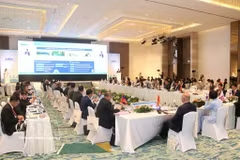
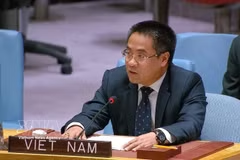
Panelists at the discussion session of the 10th ASEAN Media Forum. (Photo: VNA)

Manila (VNA) - The Association of Southeast Asian Nations (ASEAN) should strengthen rules-based maritime cooperation to safeguard regional stability, secure supply chains and address emerging security challenges, speakers said at a panel discussion, as part of the 10th ASEAN Media Forum in Manila, the Philippines, on July 30.

Participants at the panel discussion on ASEAN’s role in promoting rules-based maritime cooperation highlighted the bloc’s strategic role in maritime governance amid intensifying geopolitical competition, supply chain disruptions and growing non-traditional security threats.

The discussion focused on balancing negotiations on a Code of Conduct in the East Sea (COC) with broader cooperation in marine biodiversity conservation, the sustainable sea-based economy and coordinated law enforcement to combat transnational maritime crime.

Haji Mohamed Safwan Bin Othman, Chairman of the Federation of ASEAN Shipowners’ Associations (FASA), stressed that maritime transport remains the backbone of ASEAN’s trade and economic growth.

With no shipping, there is no trade, he said, noting that more than 80% of global trade by volume is transported by sea, while ASEAN’s total trade is valued at around 4.4 trillion USD.

He added that the Malacca and Singapore Straits handle about 28% of global trade, with more than 90,000 vessel transits annually and around 35% of the world’s seaborne oil shipments. Ensuring freedom of navigation and safe, secure shipping lanes in accordance with international law is therefore essential for regional supply chains and investor confidence, he said.

Safwan also pointed out key challenges facing the region’s maritime sector, including the transition to net-zero emissions, regulatory differences among countries and geopolitical tensions that have increased shipping costs and disrupted supply chains. He called for greater harmonisation of maritime regulations, investment in port infrastructure and clean fuels, and a unified ASEAN maritime strategy.

Neil S. Silva of the Institute for Maritime Affairs and Law of the Sea at the University of the Philippines underscored the importance of ensuring that the future COC remains fully consistent with the 1982 United Nations Convention on the Law of the Sea (UNCLOS), without undermining its authority or limiting the use of international dispute settlement mechanisms.

Meanwhile, Emirza Adi Syailendra, a researcher from the S. Rajaratnam School of International Studies (RSIS), Nanyang Technological University (NTU), Singapore, said recent global crises have exposed ASEAN’s dependence on external supply chains. He urged member states to deepen intra-regional trade, diversify partnerships and strengthen supply chain connectivity to enhance the region’s resilience against future geopolitical and economic shocks./.

VNA

See more

Panelists at the discussion session of the 10th ASEAN Media Forum (AMF 2026). (Photo: VNA)

ASEAN media urged to uphold trust, embrace AI responsibly

AI does not create misinformation but enables false content to be produced and disseminated more quickly and easily. ASEAN should therefore strengthen trusted information sources, improve the public's ability to identify false information and encourage greater accountability among digital platforms.

The Cambodian side is pictured from the Ban Pakkad border checkpoint in Khlong Yai district of Chanthaburi province, Thailand. (Photo: XINHUA/VNA)

Thailand, Cambodia pledge to maintain ceasefire agreement

Representatives from both sides concurred on strengthening coordination to ensure that humanitarian assistance for citizens of both countries is delivered fully and effectively at a meeting held at the Ban Khlong Luek international border crossing in Thailand's Sa Kaeo province on July 29.

Bali Island is a popular tourist destination in Indonesia. (Illustrative photo: Xinhua/VNA)

Indonesia aims to become ASEAN’s leading MICE hub

An Indonesian official reaffirmed the country's ambition to strengthen its position as ASEAN's business events hub while promoting high-quality and sustainable tourism that generates greater added value.

Young generation drives Indonesia's digital creative economy

Young generation drives Indonesia's digital creative economy

In a statement released on July 29, Indonesia’s Creative Economy Minister Teuku Riefky Harsya said the creative economy is closely aligned with young people, making partnerships with digital platforms and creative media essential to strengthening the sector's ecosystem.

The 3rd Roundtable on Climate and Water Issues and the 9th Meeting of the Asian Parliamentary Assembly Water Consultative Council (AAWC) in Vientiane on July 28. (Photo: VNA)

Laos advances sustainable water management to address climate challenges

In his opening remarks, Lao NA Vice President Vilayvong Boutdakham highlighted the growing challenges posed by climate change, natural disasters and energy shortages, noting that these issues are having significant impacts on livelihoods and sustainable development across the region.

A corner of Kuala Lumpur, Malaysia. (Photo: Xinhua/VNA)

Malaysia on track to achieve high-income status by 2028-2030: OECD

Malaysia's gross domestic product (GDP) is forecast to expand by 4.9% in 2026 and 5% in 2027. Inflation is projected to rise to 2.1% in 2026 and 2.3% in 2027, driven by higher wages and energy prices, while unemployment is expected to decline further to a healthy 2.9% in 2026.

Thai police bust credit card data theft ring

Thai police bust credit card data theft ring

Police said the Chinese man and three Thai suspects were arrested last week after the Chinese embassy sought legal action against criminals who had misused stolen credit card data from 1,200 Chinese tourists in Thailand. They were part of a criminal network operating in China, Thailand and the US.

A shopper browses a supermarket in Bangkok, Thailand. (Photo: Xinhua/VNA)

Thailand's exports to US surge

Thai exports to the US grew over the first nine months of the fiscal year (starting October 1, 2025), up by nearly 34% year-on-year for a value of 2.13 trillion THB (63.32 billion USD).

Thailand bets on wellness tourism as new growth engine

Thailand bets on wellness tourism as new growth engine

Thailand expects the 2026 Global Wellness Summit, scheduled for November 10-13 in Phuket, to generate at least 300 million THB (8.91 million USD) in economic value, reinforcing Thailand's role in the global wellness industry.

Thailand tightens investment standards for AI data centres

Thailand tightens investment standards for AI data centres

BOI Secretary-General Nrit Therdsteerasukdi said Thailand's investment policy will shift from prioritising the quantity of data centre projects to emphasising quality, supporting the country's ambition to become a competitive and sustainable digital economy hub in the region.