Manila (VNA) – While artificial intelligence (AI), changing audience behaviour, and digital platforms are reshaping the media landscape, journalism's core value lies in its credibility, rigorous fact-checking and ability to earn public trust.
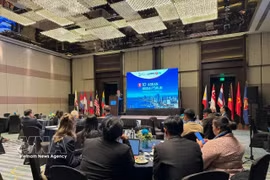
This was the main topic discussed by many speakers at the panel discussion on the role of media in shaping ASEAN's future within the framework of the 10th ASEAN Media Forum (AMF 2026), held on July 30 in Manila, the Philippines.
Speakers said AI is transforming journalism by supporting data collection, information processing, translation and content production. When used responsibly, it can improve newsroom efficiency, enable new storytelling formats and help media organisations reach wider audiences.
Talking to the Vietnam News Agency (VNA), Akhyari Hananto, founder of Good News from Indonesia, said his organisation has integrated AI into various stages of content production and recorded a significant increase in readership. However, he stressed that AI is only a supporting tool, with editorial decisions remaining firmly in human hands.
According to Hananto, all content must undergo editorial review and verification by journalists and editors before publication.
Experts also cautioned that AI systems can produce "hallucinations" by generating inaccurate information or citing non-existent sources. They stressed that cross-checking multiple sources and maintaining strict editorial standards remain indispensable requirements for professional journalism.
Participants noted that as misinformation and AI-generated content become increasingly widespread, the greatest asset of news organisations is no longer speed but credibility.
Noel Hidalgo Tan from the Culture and Information Division of the ASEAN Secretariat said the ASEAN Work Plan for Information and Media 2026–2035 identifies key priorities, including safeguarding information integrity, promoting the responsible use of AI, strengthening media capacity and improving media literacy among the public. He noted that AI does not create misinformation but enables false content to be produced and disseminated more quickly and easily. ASEAN should therefore strengthen trusted information sources, improve the public's ability to identify false information and encourage greater accountability among digital platforms.
Several speakers also emphasised that despite the growing influence of social media platforms and content creators, professional journalism remains indispensable for investigative reporting, fact verification and the provision of reliable information that supports policymaking and serves the public interest.
Beyond AI-related challenges, delegates called for stronger cross-border media cooperation to provide more comprehensive coverage of regional issues. They observed that audiences in many ASEAN countries continue to focus primarily on domestic news, while information about neighbouring countries remains limited. This underscores the need to build a more integrated regional information space through news sharing, closer collaboration among media organisations and joint journalistic projects.
Speakers also stressed that digital transformation should complement rather than replace traditional media. While younger audiences increasingly obtain information through social media and digital platforms, radio and television continue to play an essential role in delivering official information to communities, particularly in rural and remote areas.
Combining technological innovation with professional standards and regional cooperation will enable ASEAN media to remain an effective bridge between the public and ASEAN policies, while contributing to building a more cohesive and resilient regional community, they said./.