Jakarta (VNA) – Indonesia is strengthening regional connectivity and expanding its business events ecosystem in a bid to establish itself as ASEAN's leading hub for international meetings, incentives, conferences and exhibitions (MICE).
Opening the Southeast Asia Business Events Forum (SEABEF) 2026 in Jakarta on July 29, Indonesian Minister of Tourism Widiyanti Putri Wardhana reaffirmed the country's ambition to strengthen its position as ASEAN's business events hub while promoting high-quality and sustainable tourism that generates greater added value, the Indonesian news ageny Antara reported.
He said the business events industry plays a strategic role in enhancing destination competitiveness, attracting investment, fostering innovation, facilitating knowledge transfer and creating added value across multiple sectors of the economy. It has evolved beyond the traditional role of hosting conferences and exhibitions to become a new driver of tourism growth.
The MICE sector is now one of the largest segments of the global business events industry. In 2024, it accounted for about 30.75% of total industry revenue, with the global market estimated at nearly 1.2 trillion USD.
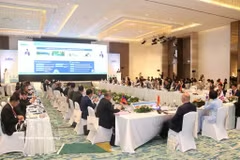
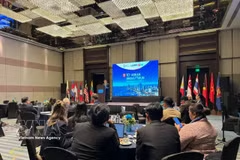
Held on July 28–29, SEABEF 2026 brought together government officials, representatives of international associations, businesses, academics and media organisations.
Discussions focused on harmonising business events policies across ASEAN, developing competitive and sustainable destinations, leveraging digital technologies and artificial intelligence, expanding sports and entertainment events, strengthening human resources, and enhancing the region's capacity to bid for and host international events.
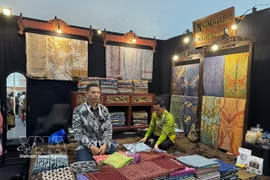
It was held in conjunction with the Indonesia Business Event Mart (IBEM) 2026, which runs from July 28 to 31 as a business-matching platform for domestic and international MICE professionals. IBEM 2026 has attracted around 200 buyers from 37 countries and 100 sellers./.

Indonesia steps up efforts to reclaim cultural heritage
Indonesia has recovered a collection of cultural artefacts from Papua that was illegally taken to the US, marking what Jakarta described as a significant step in restoring national ownership of its cultural heritage.