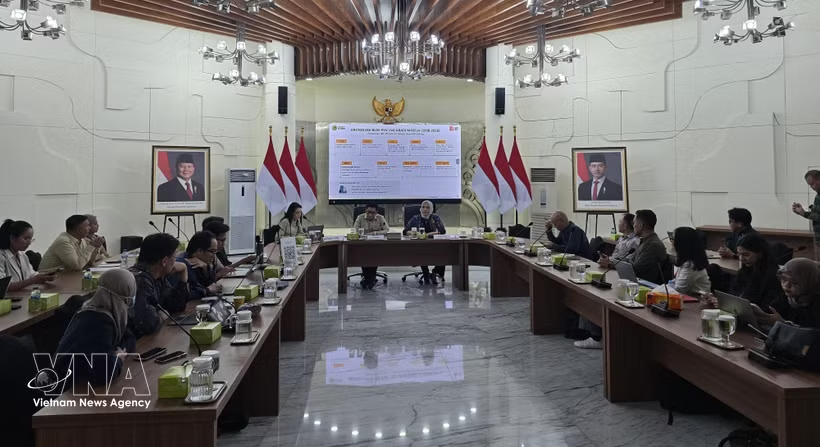
Jakarta (VNA) – The Indonesian Government on July 21 unveiled its national energy policy that outlines measures to strengthen energy self-reliance, enhance energy security and accelerate the transition to clean energy, identifying these priorities as key pillars for achieving sustainable economic growth.
Speaking at an international press briefing jointly organised in Jakarta by the Indonesian Government Communications Agency and the Ministry of Energy and Mineral Resources (ESDM), Dwi Anggia, spokesperson for ESDM, said the country's energy policy has been formulated in line with its national development agenda, with energy independence identified as a strategic priority alongside the goal of achieving food self-sufficiency.
Indonesia has built its energy security strategy on the principles of availability, accessibility, affordability, acceptability and sustainability.
The country is also implementing a range of measures simultaneously to reduce its dependence on imported fossil fuels, increase the share of renewable energy and make more effective use of its domestic energy resources.
According to the ministry, Indonesia has become the first country in the world to mandate the nationwide implementation of the B50 programme, which uses diesel blended with 50% palm oil-based biodiesel, while most countries currently adopt blending ratios of only 10–20%. The move not only helps reduce fuel imports and save foreign exchange, but also provides a stable market for the country's palm oil industry, and contributes to lower greenhouse gas emissions.
The Government also continues to view natural gas as a transitional energy source. In this regard, the Abadi Masela Project, one of Indonesia's largest liquefied natural gas (LNG) projects, is expected to strengthen the country's energy security and help meet growing domestic energy demand.
Anggia stressed that Indonesia will continue to capitalise on its abundant domestic energy resources, and step up investment in renewable energy, including geothermal, solar, hydropower and biofuels, with the aim of building a diversified, sustainable and resilient energy system capable of withstanding fluctuations in the global energy market./.

Indonesia expects B50 biodiesel programme to save 10.8 billion USD in 2026
Under the B50 programme, diesel fuel is blended with 50% biodiesel produced from domestically sourced palm oil, reducing the country's dependence on imported fossil fuels while strengthening national energy security.