Jakarta (VNA) – The ratification of the ASEAN Food Safety Regulatory Framework Agreement (AFSRFA) could boost Indonesia’s food trade balance by up to 634.83 million USD, said Trade Minister Budi Santoso on July 21.
The agreement is expected to achieve this by harmonising food safety standards, thereby streamlining trade and investment flows across the ASEAN region, reported Indonesia's national news agency Antara.
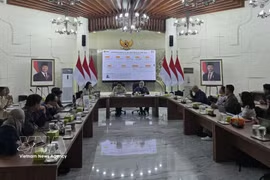
During a meeting with Commission VI of the House of Representatives (DPR) monitored online in Jakarta on the day, Budi noted that the agreement is also projected to generate 252.17 million USD in national welfare gains.
"According to a study conducted by the Ministry of Trade, this agreement will boost investment flows into the food sector by lowering compliance costs, stabilising domestic food prices, and increasing Indonesian purchasing power," the minister remarked as quoted by Antara.
With the agreement in place, he added, Indonesia is projected to see export growth in several key commodity groups, including agricultural products, vegetable oils and fats, and processed food products.
He explained that the AFSRFA establishes technical aspects and cooperation for implementing the ASEAN Food Safety Policy (AFSP). According to him, the agreement's primary objective is to enhance consumer health protection while facilitating trade in safe food across the ASEAN region by harmonising regulations and removing technical barriers.
To ensure effective implementation of the agreement, the Indonesian government has prepared several mitigation measures, including drafting and aligning laws and regulations to serve as the legal foundation. Additionally, it will develop an automated system for certificates of origin to enable exporters to automatically utilise preferential tariff facilities under various trade agreements.
It will also strengthen trade remedy policies and governance to protect domestic industries, step up outreach to stakeholders to ensure the agreement's benefits are maximised, and accelerate the digitalisation of traceability-based food safety systems to support Indonesia's integration into the ASEAN food trade network./.
Indonesia prioritises energy independence, green transition under new policy
The country's energy policy has been formulated in line with its national development agenda, with energy independence identified as a strategic priority alongside the goal of achieving food self-sufficiency.