Hanoi village preserves centuries-old pig procession festival

The true stars are “ong lon”, literally “Mr. Pig” - massive, meticulously prepared hogs offered in gratitude for the legendary general Tinh Quoc Tam Lang, a heroic figure from the era of the sixth Hung King.

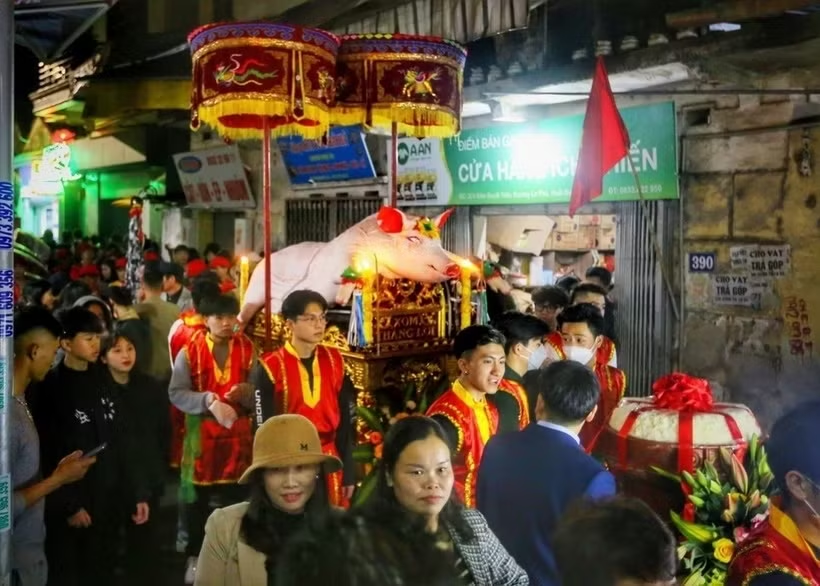
At the pig procession ceremony (Photo: VNA)

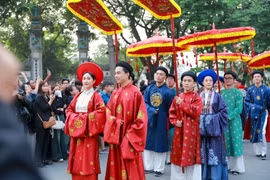
Hanoi (VNA) – Every year on the 13th day of the first lunar month, residents of La Phu village in An Khanh commune on the outskirts of Hanoi stage a vibrant procession of ceremonial pigs to the village communal house. The procession honours the tutelary deity in a ritual that blends spiritual devotion with community tradition.

While most Vietnamese festivals revolve around carrying a deity’s palanquin, La Phu’s spectacle stands apart. Here, the true stars are “ong lon”, literally “Mr. Pig” - massive, meticulously prepared hogs offered in gratitude for the legendary general Tinh Quoc Tam Lang, a heroic figure from the era of the sixth Hung King.

Local lore holds that Tam Lang was known for repelling foreign invaders and safeguarding the realm. Before leading his troops into battle, he ordered pigs slaughtered and sticky rice prepared as a hearty feast to bolster morale and reward loyalty. After his passing, grateful villagers elevated him to the status of tutelary spirit, a guardian watching over their lands and fortunes. Over the centuries, successive Vietnamese monarchs, from Le Dai Hanh and Tran Thai Tong to Le Thai To and the illustrious Emperor Quang Trung, bestowed royal decrees upon him, formally recognising his merits.

Strict selection and care

Preparation for the festival begins nearly a year in advance. As early as February, each hamlet within the village carefully selects one or two exceptional male pigs destined for the following year’s ceremony. The cost is shared among residents, with a designated household entrusted with the pigs’ upbringing.

Only pigs meeting strict physical standards, such as balanced proportions, straight backs, and unblemished pink-white skin, are chosen. Caretakers themselves must hail from reputable, stable families of good standing in the community.

The pigs are pampered like prized thoroughbreds, fed sticky rice porridge, eggs, and fresh vegetables, bathed daily, and protected from mosquitoes, with fans installed in summer and warm water or charcoal heaters in winter. By the time the festival arrives, each pig typically weighs 250–270 kg. In the final days before the process, the animals are fed vegetarian porridge to ensure ritual purity.

Elaborate evening procession

The procession takes place on the evening of the 13th lunar day. After being carefully cleaned and decorated, the pigs are placed on ornate palanquins and arranged in lifelike poses. Fat is skillfully preserved and used as a ceremonial covering, while organs are cooked and placed back inside the body as part of the offering.

Each hamlet decorates its pig differently, competing for recognition as the most impressive display. Villagers believe that a well-presented pig brings prosperity and good fortune for the year ahead.

Starting around 18:00, hundreds of villagers form separate processions representing each hamlet, carrying offerings, including sticky rice trays and ceremonial items, along village roads toward the communal house. The two-hour parade culminates at about 21:00 when 17 pigs are assembled for judging and ritual offerings. Six of the most elaborately prepared pigs are selected for placement in the main sanctuary, while the rest are displayed in the outer hall for worship.

The festival was added to Vietnam’s National Intangible Cultural Heritage list in June 2025 by the Ministry of Culture, Sports and Tourism, a testament to the enduring power of community rituals in preserving local identity and historical memory./.
VNA

See more

A performance staged in service of the Ky Yen (Peace praying) Festival at communal houses and historical relic sites. (Photo: VNA)

New move opens pathways for creative market

The successful piloting of the culture and arts fund, together with the establishment of a professional cultural market, could open a new stage of development for Vietnamese culture and contribute more substantially to national development.

Organisers present individual awards to athletes competing in the 2026 National Triathlon Club Championships. (Photo: VNA)

Vietnam triathlon aims higher on regional, global stage

The 2026 Asia Triathlon Cup – Tam Chuc and National Triathlon Club Championships attracted nearly 400 athletes from 31 countries and 13 localities nationwide, with competitors taking part in triathlon, duathlon and aquathlon events across multiple men's and women's categories.

Young people visit the exhibition. (Photo: VNA)

Exhibition highlights spirit of democracy, civic responsibility in Hue

The exhibition in Hue retraces the revolutionary history of Vietnam’s National Assembly as the highest representative body of the people and highlights President Ho Chi Minh’s role in founding and building the Democratic Republic of Vietnam - a state “of the people, by the people and for the people”.

2026 Sen Village Festival opens in Nghe An (Photo: VNA)

Sen Village Festival opens in Nghe An

In his opening speech, Vice Chairman of the provincial People’s Committee Thai Van Thanh noted that over 45 years, the event evolved from “Songs from Sen Village” and the “Sen Village Singing Festival” into the Sen Village Festival in 2002. Since then, it has been staged annually at the provincial level and every five years on a national scale.

An Ao Dai performance at the event. (Photo: VNA)

Vietnamese cultural spirit shines through Ao Dai festival in Europe

Themed “the essence of Vietnamese Ao Dai", the event featured 19 performances and cultural activities, including ao dai showcases, musical performances, art exhibitions and interactive cultural spaces, offering audiences a vivid glimpse into Vietnamese culture in the heart of Europe.

A performance at the show (Photo: VNA)

Vietnamese water puppetry draws crowds in Laos

Following two sold-out shows in Vientiane, Vietnam’s traditional water puppetry continued to pull in strong audiences. The 700-seat auditorium of the Savannakhet provincial cultural house was filled to capacity on both floors well before the show began.

Meritorious Artisan Nguyen Thi Oanh (Photo: VNA)

Couple saves 500-year-old Dong Ho painting art from extinction

Born in Bac Ninh province’s Dong Khe residential area half a millennium ago, Dong Ho painting hit its roaring peak in the 1940s, when 17 family clans churned out vividly coloured, all-natural works for spiritual, festive and daily rituals, especially the Lunar New Year

Soldier Tran Thanh, a member of the Hoang Dieu Citadel National Salvation Youth Union, carries a lunge mine to destroy enemy tank on the streets of Hanoi on December 23, 1946, during the early days of the nationwide resistance war. (File photo: VNA)

Nghe An to host exhibition featuring President Ho Chi Minh’s call for national resistance

This is an important political and cultural event that celebrates the lasting historical significance of President Ho Chi Minh's call for national resistance, while highlighting the vision, determination, and intellectual strength of the Party and the Vietnamese people during a pivotal moment in history. The exhibition also aims to celebrate the late President’s 136th birth anniversary (May 19, 1890 - 2026).

Tthe DIFF 2026 stage has been designed around the concept of convergence, inspired by the image of converging horizons where cultures, time, and emotions meet (Source: DIFF)

DIFF 2026 set to mark breakthrough in stage scale, performance technology

The DIFF 2026 stage has been designed around the concept of convergence, inspired by the image of converging horizons where cultures, time, and emotions meet. With a width of up to 100 metres and a total area of nearly 1,200sq.m, the stage is considered the largest in the history of DIFF.