Health sector to improve care through national system of smart hospitals

The development of smart hospitals and pioneering leadership meets current development requirements while reflecting future trends, Minister of Health Dao Hong Lan has stressed, noting that Vietnam’s healthcare sector is gradually building digital infrastructure of the national healthcare system.

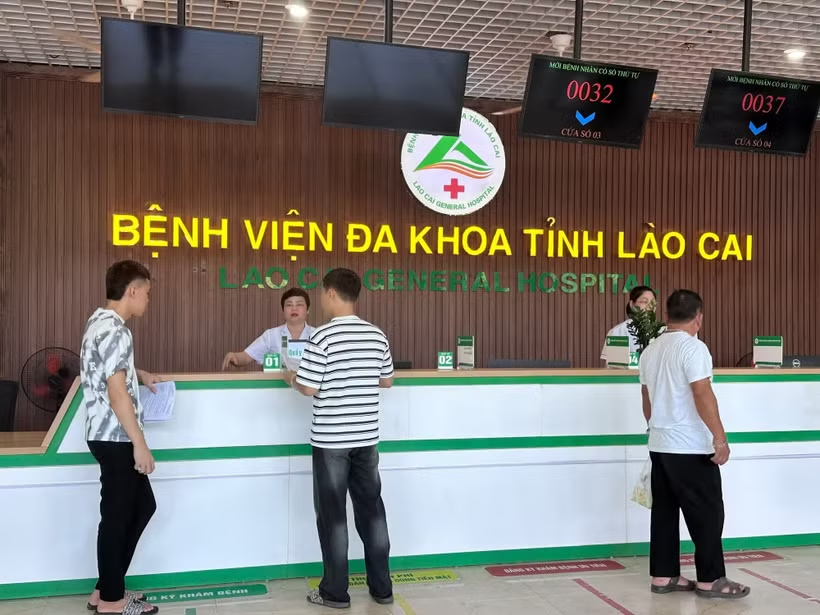
Digital transformation is being strongly promoted at Lao Cai General Hospital No. 2. (Photo: VietnamPlus)

Hanoi (VNA) – The development of smart hospitals and pioneering leadership meets current development requirements while reflecting future trends, Minister of Health Dao Hong Lan has stressed, noting that Vietnam’s healthcare sector is gradually building digital infrastructure of the national healthcare system.

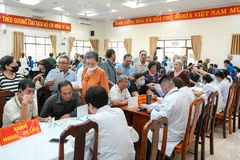
Addressing the 2026 annual conference of the northern provinces’ hospital directors club held in Lao Cai province on May 22–23, Lan said the infrastructure is being built through the deployment of electronic medical records, electronic prescriptions, electronic health records and interconnected examination and treatment data.

This will provide an important foundation for smart preventive health care, lifelong health management and personalised treatment in the future, she noted.

According to the minister, competition among healthcare systems is no longer limited to hospital size or the number of advanced medical techniques, but is increasingly focused on governance capacity, data utilisation, innovation and the quality of patient experiences.

Against the backdrop of the Fourth Industrial Revolution, artificial intelligence, big data, cloud computing and other digital technologies are fundamentally transforming healthcare governance and service delivery worldwide, she said, adding that Vietnam, therefore, must pursue stronger, deeper and more substantive reforms to meet growing public expectations.

The minister noted that the Party and State have issued major strategic policies critical to the sector’s development, including Resolution No. 57-NQ/TW on breakthroughs in science – technology development, innovation and national digital transformation, and Resolution No. 72-NQ/TW on enhancing the protection, care and improvement of public health.

lan.jpg
Minister of Health Dao Hong Lan speaks at the conference. (Photo: VietnamPlus)

The Ministry of Health is building 14 specialised databases that are accurate, complete, clean, up-to-date, unified and shared while promoting substantive, effective, and people-centred electronic medical records and electronic health records. Administrative reforms have also been accelerated, reducing the number of procedures on medical examination and treatment from 106 to 39.

The minister stressed that a smart hospital is not simply one equipped with numerous software systems or modern devices. At its core, it represents a new governance model in which data becomes a strategic asset and management and professional decisions are supported by technology and scientific evidence.

According to the minister, a smart hospital must help reduce waiting times, administrative procedures and professional errors, optimise resources and improve treatment quality. More importantly, it should give health workers more time to focus on patients instead of being overwhelmed by administrative processes.

However, technology alone cannot determine the success of this transformation, she said, stressing that the decisive factor is human, particularly the role of leaders at healthcare facilities.

Lan called on leaders of healthcare establishments to possess not only strong professional expertise but also a modern governance mindset, data management capabilities, the ability to lead transformation and the capacity to adapt quickly to technological changes.

Assoc. Prof. Dao Xuan Co, Director of Bach Mai Hospital, who is also head of the northern provinces’ hospital directors club, said technologies such as AI, big data, electronic medical records, robotic surgery, precision medicine, gene therapy, stem cells, multi-organ transplantation, 3D printing and digital hospital governance are no longer distant prospects but have already entered hospitals and shaped medical and governance decisions.

Vietnamese hospitals need a new mindset; they cannot serve patients in the digital era through slow, fragmented and poorly connected procedures, he emphasised.

The conference sought to promote a systemic development vision centred on patients, with healthcare facilities as the foundation and governance capacity and professional quality as key drivers of sustainable development, Co said.

The event featured a scientific conference with plenary sessions and 12 symposiums focusing on strategic areas and emerging trends in modern medicine. These include developing and operating smart hospitals, AI in hospital governance, diagnosis and treatment, digital transformation in treatment, quality management, inter-hospital emergency care, 3D technology, robotic surgery, organ transplants, gene therapy, stem cells, and precision medicine.

The conference also included free medical examinations, medicines and gifts presented to more than 800 disadvantaged people, and a healthcare technology exhibition./.

See more

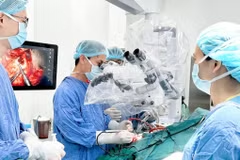
Dr. Nguyen Thanh Xuan is performing brain surgery on a patient (Photo published by VNA)

National strategy aims to build advanced medical ecosystem

Vietnam's adjusted healthcare network master plan for 2021–2030, with a vision to 2050, also outlines a regional structure covering the country's six socio-economic regions. It envisages 17 provincial general hospitals serving regional functions, at least one highly specialised hospital in each region, and at least one advanced medical facility in every province and city.

Vietnamese Ambassador to Bulgaria Nguyen Thi Minh Nguyet and Prof. Dr. Nguyen Huu Tu, President of Hanoi Medical University, meet with Prof. Boycho Landjov, President of Sofia Medical University. (Photo: VNA)

Vietnam, Bulgaria forge closer medical ties

The visit's highlight was the signing of a memorandum of understanding (MoU) between Hanoi Medical University and Sofia Medical University, creating a long-term framework for academic exchanges, scientific research and institutional cooperation between the two countries' leading medical schools.

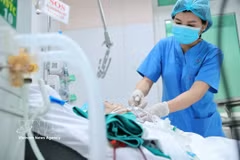
The Intensive Care Unit at Duc Giang General Hospital has continuously introduced and applied advanced specialised techniques to improve the treatment and survival of critically ill patients. (Photo: VNA)

40 years of renewal: Healthcare quality advanced for new era

Over the past four decades of Doi moi (Renewal), Vietnam’s healthcare sector has made remarkable progress, and is now well positioned to achieve further breakthroughs by harnessing science, technology and innovation to improve public health care in the new era, according to experts from the Vietnam Union of Science and Technology Associations (VUSTA).

Doctors from Cho Ray Hospital conduct preventive health screenings for residents at the Cho Lon ward health station. (Photo: VNA)

Ho Chi Minh City targets completion of universal health check-ups by December 15

According to the municipal Department of Health, as of July 20, a total of 732,873 residents had undergone periodic check-ups and had electronic health records established. The figure reflects encouraging initial results from the citywide campaign launched by the department and underscores local authorities' commitment to implementing one of the largest community healthcare programmes ever undertaken in the southern metropolis.

Medical staff at Cho Ray Hospital in Ho Chi Minh City cares for and treat the victim. (Photo published by VNA)

Last survivor of Phu Quoc boat capsize shows signs of recovery

The health condition of the last patient receiving treatment following the deadly boat capsize off the Phu Quoc special one in An Giang province has shown positive signs of improvement after three more days of intensive care, Cho Ray Hospital in Ho Chi Minh City said on July 16.

The number of foreign tourists coming to Ho Chi Minh City for travel combined with medical check-ups is increasing. (Photo: VNA)

Vietnam looks to unlock medical tourism potential with national strategy

The draft strategy aims to position Vietnam as a trusted healthcare destination in Southeast Asia by 2030 and eventually among Asia's leading medical tourism hubs. The plan marks a shift from viewing medical tourism as an untapped opportunity to making it a national development priority.

Delegates at the conference. (Photo: VNA)

Vietnam to produce first homegrown next-generation vaccines from 2028

Under the agreement, Sanofi will transfer technology to VNVC to manufacture selected high-demand vaccines for children and adults at VNVC Vaccine and Bioproduct Plant. The first next-generation vaccines produced in Vietnam are expected to roll off production lines in 2028.

Eric and Alysha joyfully welcome their baby through Mini IVF after more than 10 years of waiting. (Photo: Hong Ngoc Phuc Truong Minh General Hospital)

Vietnam - a destination for journeys to parenthood

An increasing number of international families are choosing Vietnam for infertility treatment, embarking on journeys to parenthood that transcend geographical distance and differences in nationality.

Prime Minister Le Minh Hung delivers remarks at the inauguration ceremony for Viet Duc University Hospital's second campus in Ninh Binh province. (Photo: VNA)

PM urges modern restructuring of healthcare network

The PM stressed that throughout the country’s development process, people have consistently been regarded as the centre, the driving force, the objective and the most important resource for national development. Sustainable and rapid development requires not only a healthy, knowledgeable and skilled population but also a modern, equitable, efficient, sustainable and accessible healthcare system.

Thu Duc General Hospital, with a capacity of 1,000 beds, was inaugurated and put into operation in April 2025 (Photo: VNA)

Ho Chi Minh City moves to expand robotic surgery to gateway hospitals

According to the municipal Department of Health, developing gateway hospitals is a key pillar of the city's strategy to establish a regional specialised healthcare system. The network is designed to permanently relieve overcrowding at major downtown hospitals while strengthening strong inter-regional emergency care and treatment network.