Maritime giant targets stronger revenue and profit growth

The Vietnam Maritime Corporation (VIMC) has set ambitious targets for 2026, aiming to accelerate revenue and profit growth while expanding its seaport, shipping, and logistics operations despite continued global uncertainty.

vnanet-cang-bien-vimcjpg.jpg
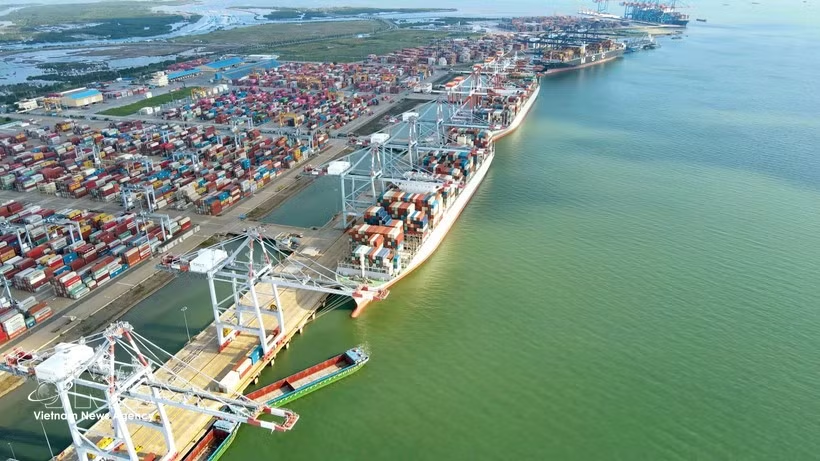
Container handling at a Vietnam Maritime Corporation port. (Photo: Vietnam+)

Hanoi (VNA) - Amid forecasts of continued global uncertainty and volatility, the Vietnam Maritime Corporation (VIMC) aims to eclipse its business targets this year, creating momentum for breakthrough growth in its new development phase.

At a conference on January 26 to launch VIMC’s 2026 tasks, Deputy Minister of Finance Cao Anh Tuan said 2025 was marked by geopolitical tensions, tariff changes, exchange rate and interest rate volatility, as well as prolonged natural disasters that disrupted port operations.

Despite these challenges, VIMC delivered solid results. Seaborne cargo volume reached 21.5 million tonnes, up 11% year on year and exceeding its annual target. Consolidated revenue totalled 20.475 trillion VND (780 million USD), up 6% year on year, while consolidated profit reached 3.079 trillion VND (120 million USD), fulfilling the 2025 plan.

This year marks the first year of the 2026–2030 five-year plan, a period in which State-owned enterprises are expected to strengthen their role as key drivers of the economy. VIMC is positioned as a strategic player in maritime transport and logistics.
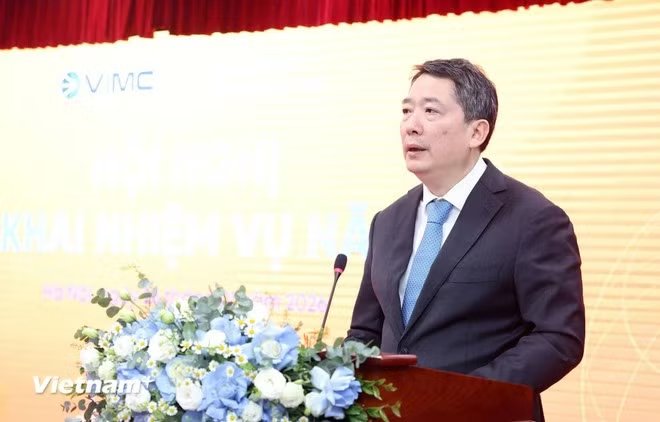
thu-truong-tai-chinh.jpg
Deputy Minister of Finance Cao Anh Tuan addresses the 2026 task deployment conference of VIMC. (Photo: Khanh Hung/Vietnam+)

The Deputy Minister called on VIMC to streamline its organisational structure, enhance governance, improve capital efficiency, and prioritise major projects, notably the Can Gio International Transshipment Port, a project of national strategic importance. He also stressed the need to promote innovation, digital transformation, and green transition to strengthen competitiveness and deepen integration into global supply chains.

VIMC Chairman Nguyen Canh Tinh said the corporation is determined to create a solid platform for breakthrough growth in the new development phase.

For 2026, VIMC targets 23.7 million tonnes of seaborne cargo and a total port throughput of 180.1 million tonnes. Revenue is projected at 22.186 trillion VND (845 million USD), with pre-tax profit expected to reach 3.236 trillion VND (123 million USD).

To achieve these goals, the corporation will develop its integrated three-pillar model of seaports, shipping, and logistics, aiming to provide comprehensive services and enhance its competitive edge. It plans to modernise logistics infrastructure and upgrade its fleet to improve operational efficiency, while investing in high-quality human resources.

VIMC Deputy General Director Le Quang Trung said the corporation will closely monitor market developments and remain ready to respond to volatility. It will expand integrated logistics services and introduce new value-added services to boost cargo volume and revenue. Efforts will also be made to address regulatory bottlenecks to ensure the timely implementation of infrastructure and equipment projects.
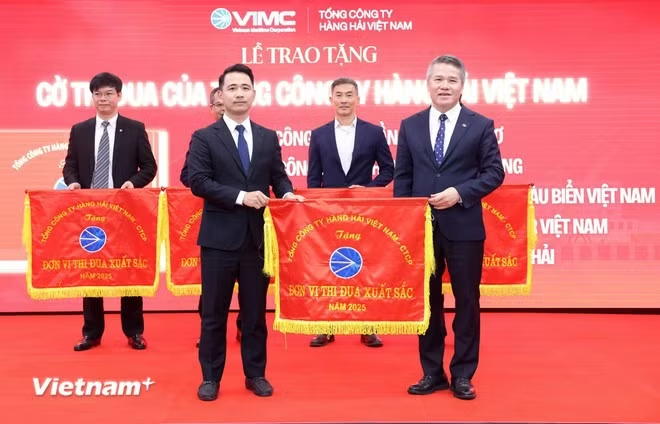
tinh-vimc.jpg
VIMC Chairman Nguyen Canh Tinh presents emulation flags to outstanding member units in 2025. (Photo: Khanh Hung/Vietnam+)

According to VIMC, port operations in 2025 were affected by global political tensions, freight rate fluctuation, and restructuring among shipping alliances. Meanwhile, newly upgraded and commissioned port projects nationwide intensified competition and increased supply pressure in some segments.

Amid fierce competition and an unpredictable market environment, VIMC’s leadership reaffirmed its commitment to safeguarding market share and expanding integrated logistics services to sustain growth in the coming years./.

See more

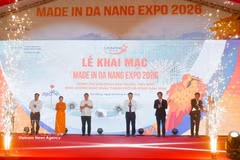
Delegates at the opening ceremony of the Made in Da Nang Expo 2026 (Photo: VNA)

Nearly 300 firms join Made in Da Nang Expo 2026

Speaking at the opening ceremony, Vice Chairman of the Da Nang People’s Committee Tran Chi Cuong said the exhibition is a large-scale trade promotion event aimed at showcasing products, connecting markets, and helping businesses enhance competitiveness while expanding domestic and export markets.

 Green production, standardised value chains key to fruit, vegetable sector growth

Green production, standardised value chains key to fruit, vegetable sector growth

Facing mounting pressure from increasingly stringent domestic and international standards, Vietnam’s fruit and vegetable sector is accelerating its shift toward green, safe, and sustainable production models. Beyond changing farming practices, localities and businesses are stepping up efforts to standardise value chains and build brands to achieve growth targets for 2026.

The launch of the Vietnam National Brand Week 2026 on April 16 (Photo: VNA)

Vietnam National Brand Week 2026 opens

Running from April 16 to 23 nationwide, the Vietnam National Brand Week 2026 marks the 18th anniversary of Vietnam Brand Day (April 20, 2008 – 2026).

Ca Mau is currently home to more than 5,200 fishing vessels, including nearly 1,900 boats measuring over 15 metres in length, and all have been equipped with vessel monitoring systems. (Illustrative photo: VNA)

Ca Mau drives changes among fishermen to tackle IUU fishing

Ca Mau is stepping up communication campaigns to disseminate legal regulations on IUU fishing, highlight recent enforcement results, and convey recommendations from the European Commission (EC)’s fifth inspection mission to fishing communities and relevant stakeholders.

The new infrastructure system will not only meet immediate needs but also create new growth poles, helping reshape the economic landscape. (Photo: VNA)

Construction sector striving for high-growth target

The construction sector faces mounting pressure to keep major projects on schedule while managing costs and stabilising markets. Yet, with gains from institutional reform, infrastructure investment, and growth model transformation, it remains well positioned to serve as a key growth engine.

Fuel taxes are slashed to 0% from April 16 under a National Assembly resolution. (Illustrative photo: VNA)

Fuel taxes cut to 0% from April 16

Accordingly, the environmental protection tax on petrol (excluding ethanol), diesel, kerosene, mazut, and aviation fuel has been cut to 0 VND per litre. These products are also exempt from VAT declaration and payment, while still eligible for input VAT credit.