Hanoi (VNS/VNA) - More than 30% of Vietnamese consumers are interested in purchasing electric vehicles (EVs), according to a recent Deloitte’s global automotive consumer study.
The main drivers for the interest are reduced operating costs, climate change concerns, and personal health benefits. Driving experience is also an important factor.
According to the study, about 49% of Vietnamese people still favour petrol and diesel, an increase of around one% compared to last year.
Meanwhile, the number of users interested in battery electric vehicles (BEV) and plug-in hybrid electric vehicles (PHEV) accounts for 16% and 17%, respectively.
Regarding hybrid vehicles (HEV), only about 9% of Vietnamese are interested in this vehicle line, two or three times lower than other countries in the region such as Thailand, Singapore, the Philippines, Malaysia or Indonesia.
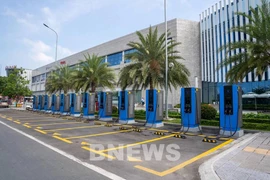
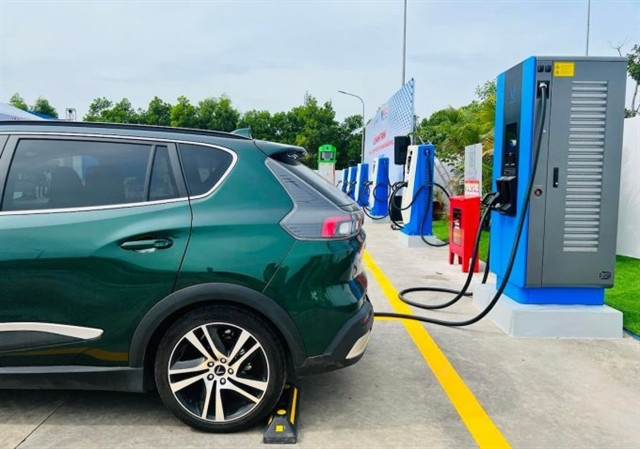
The majority (48%) of EV owners in Việt Nam still rely primarily on charging at home. However, a significant proportion (20%) now regularly charge at their workplace, which is the highest rate among the surveyed countries. Around a third (32%) of current Vietnamese EV owners use public charging stations or on-street charging.
Southeast Asian countries are now prioritising a roll out of public charging stations, driven by concerns about 'range anxiety' - the fear of running out of battery power.
If EV owners cannot charge at home, they need reassurance that a public charge point is conveniently close by.
The study stressed that this issue requires strategic vision to maximise profits from investing in building a national public charging system.
The data on electric vehicle (EV) charging times shows how long drivers would be willing to wait at public charging stations to charge their vehicle from empty to 80%.
Approximately 37% of EV users are willing to wait between 21 and 40 minutes, 31% of users expect the charging process to take between 10-20 minutes and only 10% of users are willing to accept waiting up to 10 minutes.
According to Deloitte, the suggestion that charging an electric vehicle takes the same amount of time as filling a fossil fuel tank is exaggerated. In reality, consumers in most Southeast Asian markets are willing to wait more than 10 minutes to charge their vehicles.
The report concludes that, when it comes to pure electric vehicles (EVs), consumers in Southeast Asia are mainly concerned about insufficient charging station infrastructure, charging times and vehicles suddenly running out of charge, along with costs.
In the Vietnamese market, the three biggest issues that users are concerned about regarding EVs are travel distance, battery charging time and knowledge about electric vehicles.
Only about four% of Vietnamese consumers are concerned about the limitations of brands and models available in the domestic electric vehicle market. This indicates that while there may be fewer choices compared to more established markets, it is not a primary concern for most consumers./.
See more
Phu Tho pivots to high-quality FDI attraction
In 2026, Phu Tho aims to attract over 1.1 billion USD in FDI and around 70 trillion VND (2.66 billion USD) in domestic investment, positioning itself as a leading investment destination in the 2026–2030 period.
West of West Lake emerges as new destination for international retailers
According to Savills Vietnam, Hanoi’s retail market continues to improve in both demand and rental performance. The city’s total modern retail supply now stands at around 1.7 million square metres, with shopping centres accounting for the largest share.
Ho Chi Minh City takes proactive steps to sustain double-digit growth
With clear priorities and coordinated implementation, Ho Chi Minh City aims not only to achieve its short-term growth target but also to reinforce its role as Vietnam’s leading economic engine in the next phase of development,
Petrol supplies still ensure production and consumption in coming months: PM
Petrol prices have been kept under control and aligned with global trends, while overall energy supplies have continued to meet production and consumption needs without major fluctuations.
Measures sought to address business challenges amid Middle East conflict
Vietnam is facing a three-stage ripple effect - first on transport and fuel-dependent industries, then on sectors relying on their outputs, and ultimately on consumers. Volatility in key commodities like fuel is disrupting the entire supply chain and increasing the risk of market instability.
Vietnam International Trade Fair 2026 set to take place in April
Positioned as a business-to-business (B2B) event, the expo will focus on direct matchmaking activities, enabling companies to meet potential partners, seek importers and distributors, and explore investment opportunities.
Vietnam Airlines to change terminals at some international airports from late March
Vietnam Airlines has recently continued expanding its international flight network to meet rising travel demand. In 2025 alone, it launched 14 new international routes and expanded its European network with new destinations including Copenhagen in Denmark and Milan in Italy.
PM directs tasks to accelerate 2026 export growth
During January – February, Vietnam’s total export-import value hit 155.7 billion USD, up 22.3% year-on-year. Of the total, exports were estimated at 76.4 billion USD, up 18.3%, while imports totaled 79.3 billion USD, up 26.3%.
Update on active notices to air missions in Middle East
These notices may impact flight operations, air traffic management, and flight planning for airlines, flight crews, and relevant agencies.
Hanoi builds momentum for new development phase
With comprehensive measures, Hanoi is expected to sustain its leading economic role while emerging as a dynamic regional innovation hub in the near future.
Higher marketplace fees weigh on online sellers
Analysts identify rising operational costs as the key factor behind the exodus. In 2025, platforms simultaneously rolled out fee hikes ranging from 10–15%, significantly increasing the financial burden on merchants.
Fragrant rice deepens EU market presence
Although the volume of individual shipments remains relatively modest, industry experts say the steady flow of exports reflects stable demand in the EU for high-quality rice.
Phu Tho, Thailand boost investment cooperation, business connectivity
Thai Ambassador Urawadee Sriphiromya praised Phu Tho’s development orientations, stating that stronger partnerships in investment, trade, tourism, and people-to-people exchanges are highly feasible.
Domestic market offers vast potential for textiles, footwear amid export challenges
With a population exceeding 100 million and a rapidly expanding middle class, Vietnam is regarded as a highly promising market for fashion, footwear and apparel.
Vietnam emerges as hub for high-quality FDI
Vietnam is gradually becoming a strategic destination for high-quality global FDI. Investment flows are increasingly directed toward sectors such as high-tech manufacturing, electronics, digital infrastructure, modern logistics, and industries that are closely linked to global supply chains.
Vietnam explores nuclear power cooperation with France's Assystem
Vietnam places top priority on the highest standards of nuclear safety and security, environmental protection, human resources development, and the establishment of a legal framework aligned with international practices.
Ericsson, VNPT partner to modernise airport connectivity in Vietnam
This collaboration marks the first engagement between Ericsson and VNPT in the airport industry, leveraging advanced cellular connectivity to enable greater agility and advance airport operations across the country.
Reference exchange rate kept unchanged on March 17
With the current trading band of +/- 5%, the ceiling rate applicable for commercial banks during the day is 26,321 VND/USD, and the floor rate 23,815 VND/USD.
VinFast sets records for revenue, EV deliveries in 2025
For the entire year, VinFast delivered 196,919 electric cars, a surge of 102% compared with 2024.
Fisheries sector proactively adjusts to emerging challenges
In addition to food safety regulations, the US continues to closely monitor the origin of imported seafood through the Seafood Import Monitoring Programme (SIMP) administered by the National Oceanic and Atmospheric Administration (NOAA). Requirements linked to the Marine Mammal Protection Act (MMPA) are also a major concern for businesses.