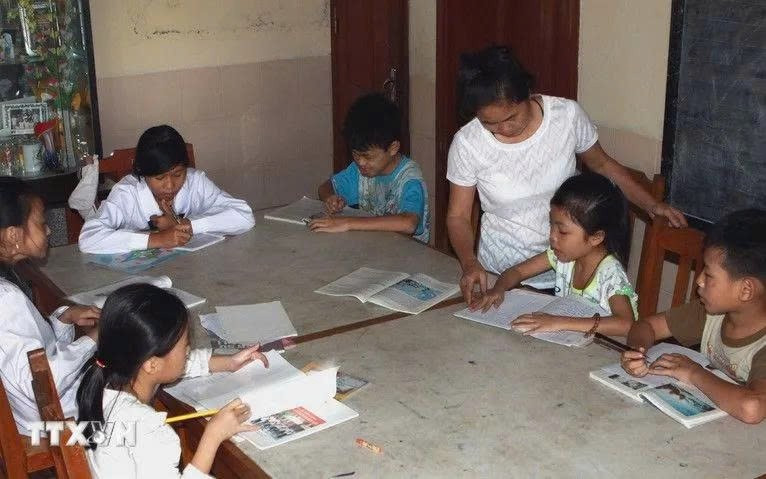
Party chief’s conclusions on disadvantaged children care, protection

Children in special circumstances suffer multiple disadvantages in living conditions, nutrition, education and health care. Caring for them is not only about alleviating present hardship but also about safeguarding the nation’s future and affirming the humanity of the socialist system.

Orphans are raised at SOS Children's Village Hai Phong. (Photo: VNA)

Hanoi (VNA) – The Office of the Party Central Committee has released a notice on conclusions of Party General Secretary To Lam following a working session with the Party Committee of the Ministry of Health and relevant central agencies on care and protection for children in special circumstances.

According to the notice, dated November 26, at the meeting on November 24, the General Secretary emphasised that children in special circumstances suffer multiple disadvantages in living conditions, nutrition, education and health care. Caring for them, he noted, is not only about alleviating present hardship but also about safeguarding the nation’s future and affirming the humanity of the socialist system.

To better care for the group of children, the leader assigned specific tasks to Party committees and organisations, and agencies at all levels.

First, the Party chief asked for measures to minimise new cases of abandoned children, stressing that this is the most fundamental and humane priority. Agencies must strengthen psychological and legal counselling, reproductive healthcare support and socio-economic assistance for high-risk groups, including women with unplanned pregnancies, single mothers, broken families and migrant workers in distress. Local Party committees and authorities must closely monitor disadvantaged households and provide timely support.

Second, it is necessary to ensure every abandoned child is promptly received and safely cared for. Hospitals, local authorities and public security forces must take responsibility where a child is found, strictly following procedures on initial healthcare, screening, handover and legal documentation. Any delay or negligence resulting in harm must be strictly handled.

Third, the General Secretary requested the renovation of care models and strengthen social protection facilities. The system should progressively shift from large-scale institutional care to family- and community-based models, with small home units and stable caregivers. Existing social protection centres must be upgraded in facilities, staffing and child-protection standards, while new centres should be developed in localities with high demand. Transparent social mobilisation mechanisms are needed to attract non-budget resources.

Relevant agencies need to focus on finalising an integrated process for detecting, receiving and providing initial care for abandoned children, linked to the national population database; developing appropriate education and integration programmes, ensuring full legal procedures for children to access social policies; preventing exploitation and abuse; and mobilising the public to support abandoned children and expand effective models such as “mentor mothers” and “safe houses”.

Particularly, he asked major cities, especially Hanoi and Ho Chi Minh City, to take the lead in transitioning to new care models and preventing overload or the lack of responsibility in social protection facilities./.

VNA
See more

Glenn Mathews and his wife hand over the diary of Vietnamese martyr Vo Van Cong to Minister Counsellor Nghiem Xuan Hoa, representing the Embassy of Vietnam in Australia. (Photo: VNA)

Australian veteran’s son returns diary of Vietnamese martyr

Entries in the diary show that Vo Van Cong was born in 1944 in the former Phuoc Tho commune, Nhon Trach district, Bien Hoa province, now Dong Nai province. He joined the revolutionary movement in April 1961 and was admitted to the Communist Party of Vietnam in May 1962.

A number of youth union members at the Vietnam Academy of Social Sciences visit the exhibition space showcasing books and materials on culture. (Photo: VNA)

Book week underscores role of knowledge in policymaking

The highlight is a series of activities on April 21, including a book and document exhibition on culture, the launch of a special publication titled “Special scientific information for leadership” and initiatives promoting reading culture, including a book donation programme and a book review contest.

Hanoi has over 1,100 libraries and numerous cultural and educational spaces in the community. (Photo: VNA)

Spreading value of books, building foundations of learning society

Each weekend in Hanoi, the “Reading with Children” Club brings together students to practise reading, explore language, and express ideas creatively. According to founder of the club Nguyen Thuy Anh, the club encourages children to reflect, retell stories, and connect books with personal experiences, making reading more vivid and meaningful.

Automated ticketing system is used on the urban railway Cat Linh-Ha Dong line in Hanoi. (Photo: VNA)

Digital transformation powers Hanoi metro expansion

Beyond convenience, stable fares and the elimination of fuel, parking and maintenance costs have made urban rail increasingly attractive. The growing preference for metro travel is also contributing to a greener, more modern urban lifestyle.

Delegates cut the ribbon to inaugurate the operation of electric bus route No. 43. (Photo: VNA)

Hanoi accelerates shift to green buses, targets 100% by 2030

In the 2027–2030 period, the city will accelerate the transition towards the complete phase-out of fossil fuel-powered buses. The share of electric and green energy-fueled buses is projected to reach 79–89% by 2029 and 100% by 2030.

At the second session of the Ho Chi Minh City People’s Council (Photo: VNA)

Ho Chi Minh City greenlights central square, administrative centre in Thu Thiem

The new central city square and administrative centre will create a modern, centralised political-administrative complex for Ho Chi Minh City, designed to house around 8,000 officials, civil servants, and employees. It will also handle daily traffic of 1,500- 2,000 citizens and business representatives through a unified one-stop-shop administrative service system.

A working session at the job fair (Photo: VNA)

Vietnamese students flock to Seoul Job Fair 2026

The second annual Job Fair 2026 was held for Vietnamese students in the Republic of Korea. Organisers pitched it as a straight-up bridge between eager students and bosses hungry for young talent who can actually handle multicultural workplaces.

Defendants at the court (Photo: VNA)

Ho Chi Minh City court opens trial over Agribank lending scandal

The investigation revealed that multiple credit files were incomplete or riddled with inaccurate information, while some pledged assets lacked proper legal standing yet were accepted and grossly overvalued. As a result, the loans became high-risk and largely unrecoverable, leading to losses surpassing 1 trillion VND.